
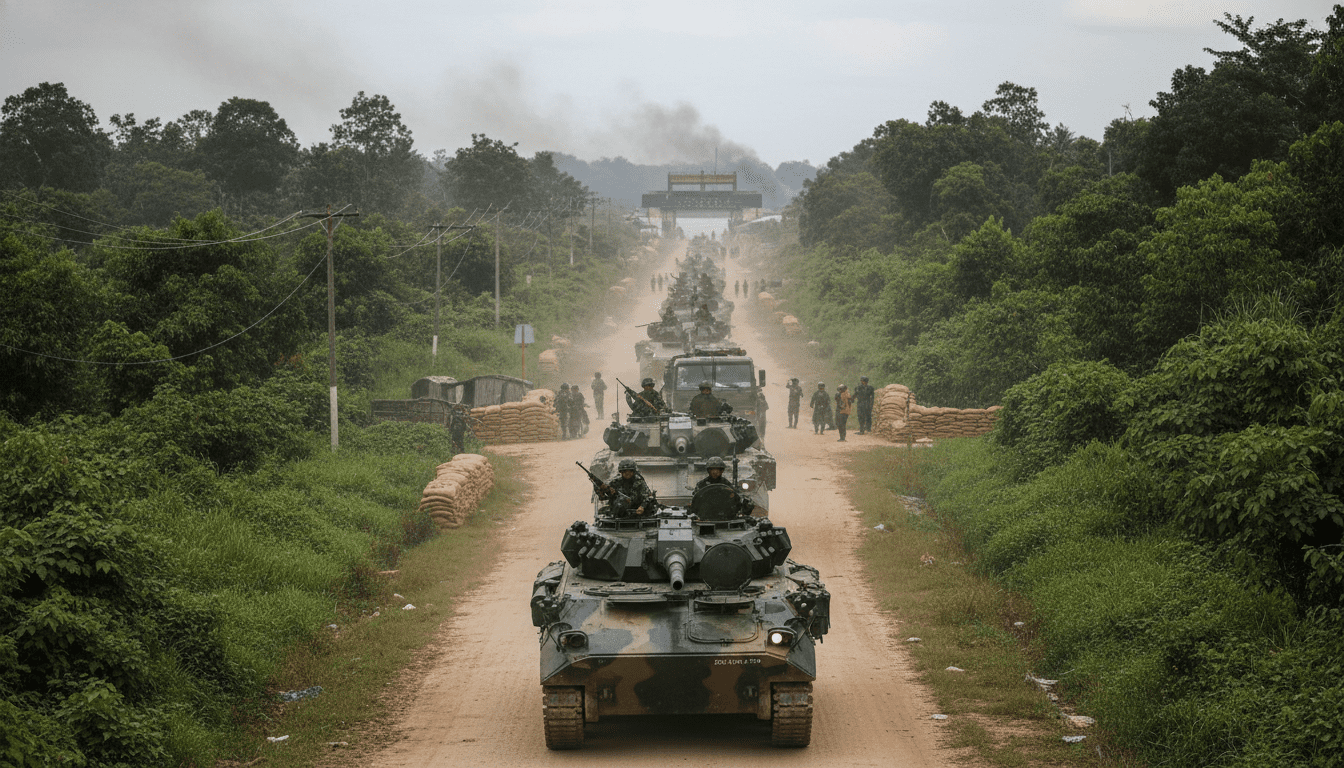
Myanmar military offensive targets border regions and trade routes
Myanmar military offensive led by Ye Win Oo targets Kachin, Chin and Karen to retake key trade corridors from ethnic rebels amid restricted media access.
The Myanmar military offensive launched this month has pushed into multiple border states as junta commanders seek to reassert control over strategic trade routes and communications lines. Reuters and rebel groups cited Ye Win Oo, the military chief appointed in March, as driving the operations that focus on Kachin, Chin and Karen states. The campaign aims to wrest important cross-border corridors from ethnic armed organizations, but independent verification of battlefield claims remains limited.
Military Launch and Aims
The junta says the campaign is intended to restore government control over the country’s principal land and trade arteries, which it argues are vital to national stability. Officials presented the operation as a coordinated effort to secure logistics and communications nodes that have fallen under rebel influence since 2021. Analysts, rebel spokespeople and regional observers, however, warn that the offensive risks intensifying clashes and further disrupting civilian life along contested corridors.
Geographic Focus: Kachin, Chin and Karen
Reported operations are concentrated in Kachin State along the Chinese border, Chin State on the Indian frontier, and a key Karen corridor near Thailand that serves as a major conduit for goods and people. Kachin’s routes link northern resource areas to central markets, while the Mandalay–Myitkyina axis cited in local reports is a crucial north–south corridor. In Chin, the town of Falam has been named by pro-junta outlets as a tactical objective because of its position on routes toward India.
Claims of Recent Gains
State media, including the Global New Light of Myanmar, reported that military leaders claimed to have secured Falam and a strategic road between Mandalay and Myitkyina. Those accounts follow statements by Ye Win Oo to troops and were issued without independent confirmation. The presidential office declined to comment when asked, and foreign correspondents and humanitarian agencies say access to active combat zones is severely restricted.
Rebel and Analyst Accounts
Rebel groups and outside analysts have been the principal sources for much of the reporting on the offensive, telling Reuters that the operation is broad in scope and heavily focused on border approaches. Several ethnic armed organizations have publicly rejected recent overtures for talks, saying ceasefire proposals and limited negotiations cannot proceed without substantive political change. Analysts caution that information from both sides is likely to be contested, with propaganda and battlefield confusion complicating objective assessments.
Roots in the 2021 Coup and Continued Fighting
The current escalation cannot be divorced from the wider conflict that erupted after the military coup of 2021, when the junta ousted the democratically elected government led by Aung San Suu Kyi. Nationwide protests, an armed resistance movement and the mobilization of ethnic armies have left large swaths of the country outside effective junta control. Over time, several ethnic armed organizations expanded territorial control, creating new front lines that the military now says it must reclaim.
Diplomatic Context and the 100-Day Offer
The offensive follows a recent public offer from Min Aung Hlaing for peace talks within 100 days, an initiative that several armed groups rejected as insufficient. Min Aung Hlaing, who became head of the military government after the coup, framed the offer as a pathway to dialogue even as military operations resumed. International diplomats and regional capitals have expressed concern about both the offensive and the collapse of tentative negotiation prospects.
Regional Trade and Humanitarian Consequences
The contested border corridors are vital to commerce with China, India and Thailand, and renewed fighting threatens to choke cross-border trade and supply chains. Local economies that rely on road and river links risk severe disruption if checkpoints and transit routes are militarized or damaged. Humanitarian agencies warn that intensified operations could worsen displacement and hamper relief access in already vulnerable communities.
The unfolding offensive marks a significant escalation in a conflict that has persisted for years and highlights the fragility of any short-term political settlement. With media access constrained and battlefield reports competing, independent observers say establishing an accurate picture of gains and losses will take time. International actors will be watching closely for the humanitarian and regional economic fallout as fighting continues.
