
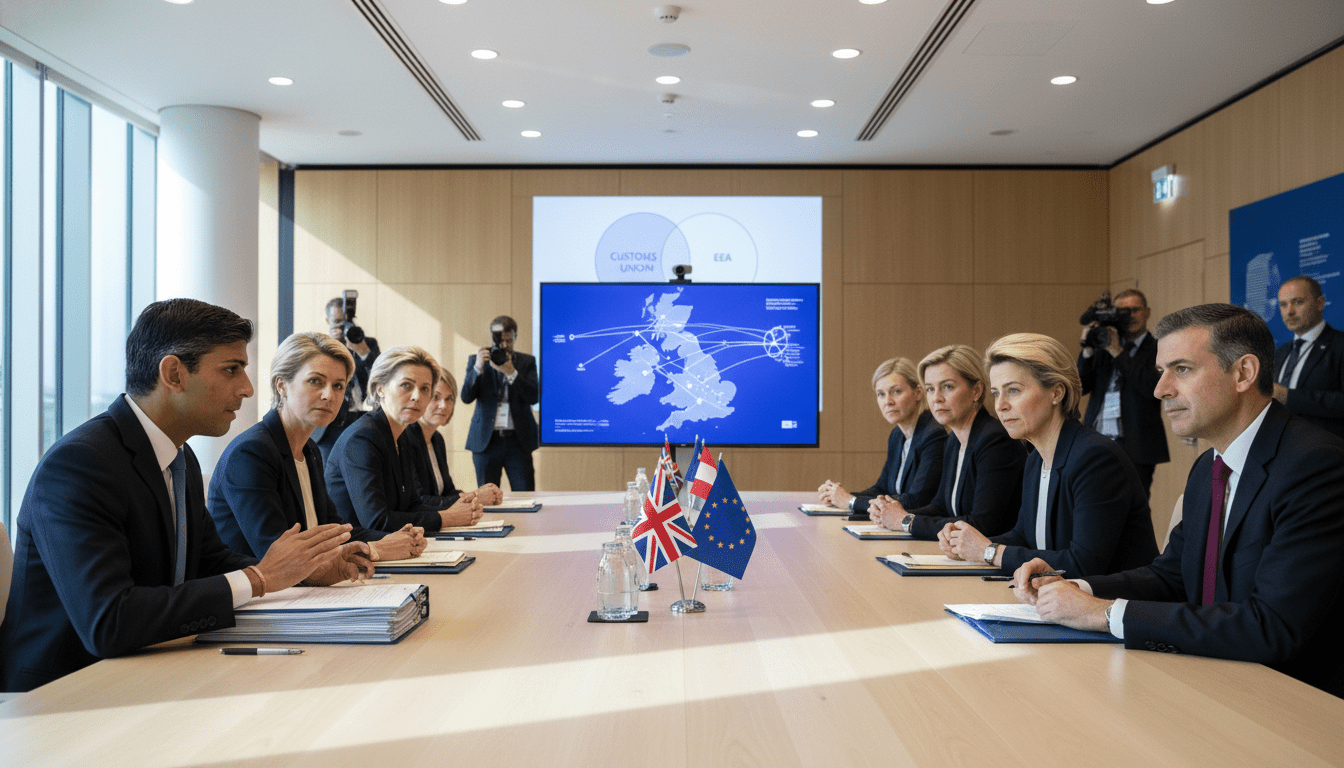
UK Proposes Goods Single Market to EU as Brussels Recommends Customs Union or EEA
Britain has reportedly offered the European Union a goods single market for trade, an initiative the EU has countered by suggesting a customs union or membership of the European Economic Area, both of which would require the UK to accept free movement of workers.
The proposal for a goods single market is said to be part of preparations for an EU–UK summit scheduled for July, with Brussels signalling that deeper alignment likely means concessions on migration rules and regulatory oversight.
Proposal Delivered to Brussels
British officials delivered an outline to EU counterparts describing a goods single market that would ease tariffs and technical barriers on traded products. The plan focuses on simplifying cross-border trade in manufactured goods while stopping short of full regulatory integration across services or labour policy.
UK ministers framed the approach as a pragmatic measure to reduce the economic frictions that emerged after Brexit, aiming to protect manufacturing supply chains and food and drink exports. Government sources said the package would include sector-specific agreements alongside the wider market proposal.
EU Response and Preferred Alternatives
EU negotiators told British counterparts they viewed a goods-only market as insufficient to address regulatory divergence and suggested two established frameworks instead: a customs union or participation in the European Economic Area. Both pathways involve closer regulatory alignment and mechanisms for oversight by EU institutions.
Officials in Brussels highlighted that either option would entail obligations beyond goods trade, notably commitments that touch on the movement of people and state-aid rules. EU representatives framed those conditions as necessary to preserve the integrity of the single market.
Free Movement as a Deal-Breaker
A central hurdle in the talks is the question of free movement of workers, which the EU sees as integral to any deep market access arrangement. Brussels has made clear that customs union or EEA membership would be conditional on the UK accepting the associated freedom of movement provisions.
That demand places the issue at the heart of the political debate in London, where control over immigration was a prominent theme in the 2016 referendum campaign. Prime Minister Keir Starmer has so far resisted reintroducing unrestricted free movement, making the negotiations politically sensitive.
Domestic Political Fallout for Labour
The timing of the diplomatic push coincides with a period of political strain for the government in Westminster. Recent local and regional election setbacks have weakened the prime minister’s standing and intensified scrutiny of his economic strategy and European policy.
Internal party dynamics have added pressure. A high-profile resignation from the health secretary has fueled speculation about leadership challenges, with some figures openly calling for a reassessment of the UK’s long-term relationship with the EU. Other senior Labour figures have explicitly ruled out an immediate campaign for re-entry.
Practical Issues and Policy Items on the Table
Beyond the high-level institutional choices, negotiators are reported to be discussing concrete measures designed to ease trade. These include agreements on food and drink standards, mutual recognition of certain product rules, and cooperation on emissions trading systems to align carbon-market mechanisms.
Treasury and trade officials have indicated London may be prepared to follow a number of EU rules in specific sectors if that reduces border checks and paperwork. Finance ministers in the UK have publicly acknowledged the economic costs tied to post-Brexit barriers and signalled a willingness to compromise to restore market fluidity.
Roadmap to the July Summit
Both sides are treating the forthcoming EU–UK summit as an opportunity to narrow differences and set a framework for further technical talks. British negotiators emphasise that the goods single market remains on the table, while EU counterparts maintain their preference for established models of integration.
Diplomatic sources indicate that workstreams will continue in the coming weeks to test the technical feasibility of each option and to map the political compromises required. Officials on both sides have stressed that no final decisions will be taken ahead of the leaders’ meeting.
The outcome of these talks will hinge on whether UK policymakers are willing to reconcile domestic political priorities with the institutional commitments Brussels considers essential for deeper market access.
