
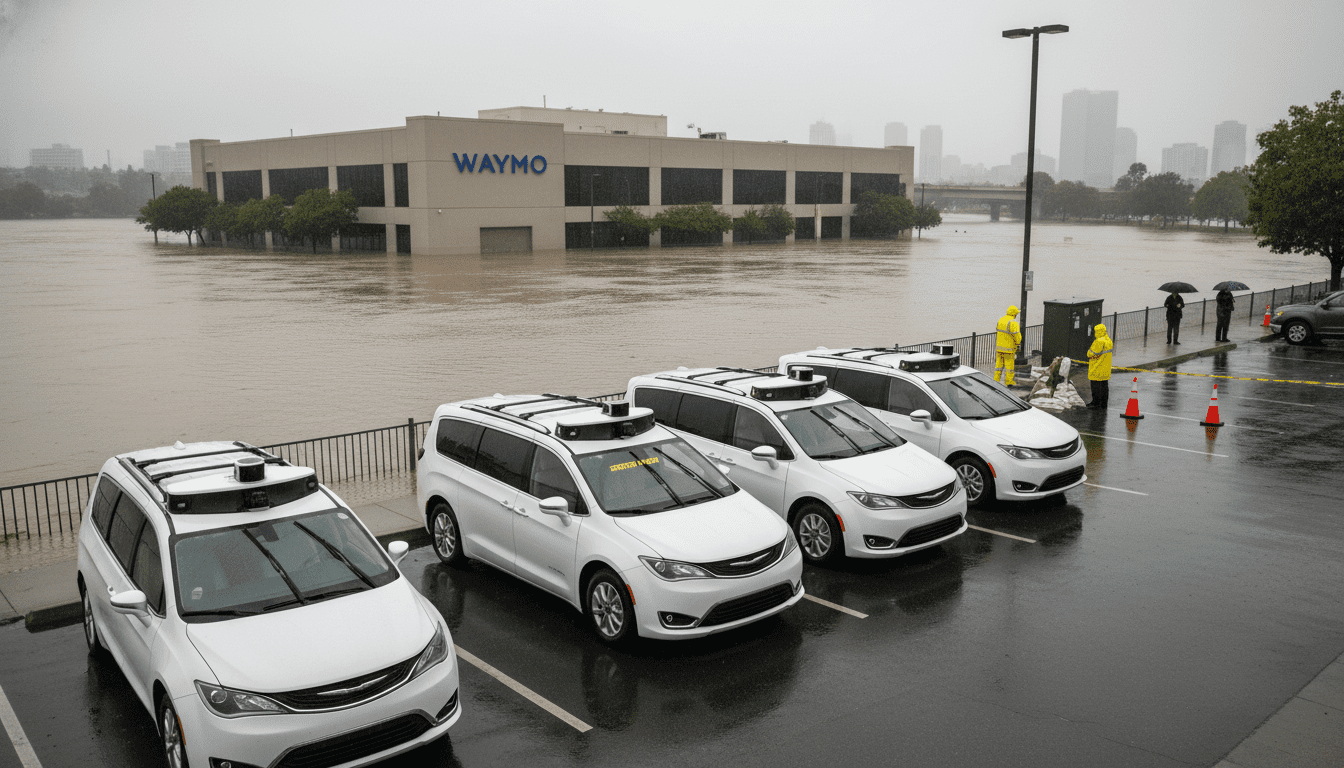
Waymo robotaxis paused in four U.S. cities after flood-related incident sparks federal scrutiny
Waymo pauses robotaxi service in four U.S. cities after a vehicle became stuck in floodwater, prompting probes into software and safety fixes across its fleet.
Waymo robotaxis have been temporarily taken offline in four U.S. cities after a vehicle became immobilized in floodwater, raising fresh questions about how autonomous fleets handle sudden severe weather. The company said it suspended operations in Atlanta, San Antonio, Dallas and Houston as it works to refine software restrictions intended to avoid flooded, higher-speed roadways. Federal safety officials have opened or expanded inquiries into Waymo’s software and incident responses, increasing scrutiny of the autonomous taxi provider’s operational safeguards.
Service paused in Atlanta, San Antonio, Dallas and Houston
Waymo confirmed the pauses and said the moves were precautionary while engineers investigate how its systems respond to heavy rainfall and flooded streets. The company previously halted service in San Antonio after identifying similar flood-related risks, and it extended the suspension to Dallas and Houston amid severe weather forecasts in Texas. In Atlanta, local reporting and company statements converged on an unoccupied vehicle that stopped after encountering a flooded intersection.
The decision to suspend operations in multiple markets signals a broader operational recalibration rather than an isolated local adjustment. Waymo said the step reflects an abundance of caution for rider and public safety while updates are tested and validated. City-level transport authorities and emergency services have been briefed in several cases as the company coordinates recovery and inspection of affected vehicles.
Robotaxi stalled on flooded Atlanta street
Video and eyewitness reports showed a Waymo vehicle entering a flooded roadway in Atlanta and remaining stuck for roughly an hour before recovery crews removed it. Waymo told reporters the vehicle was unoccupied at the time and that crews retrieved and removed it from the scene after the incident. The company added that the storm produced rapid inundation, and that flooding began before the National Weather Service had issued flash-flood warnings in the area.
Waymo’s account underscores a key operational challenge: rapid-onset floods can outpace the public-alerting infrastructure the company uses as part of its route-planning safety logic. The Atlanta event prompted the National Highway Traffic Safety Administration to open lines of communication with Waymo and to indicate it will take further steps if warranted. Local officials reported no injuries tied to the incident.
Recall and interim software restrictions released last week
Last week Waymo issued a recall tied to how its vehicles detect and avoid flooded, higher-speed roadways, acknowledging it had not yet developed a final technical remedy. According to regulatory filings, the company deployed a software update that imposes restrictions at certain times and in locations with elevated flood risk as an interim measure. Those constraints were intended to reduce the chance of vehicles entering hazardous water, but the Atlanta incident shows they do not eliminate exposure under extreme conditions.
Waymo described the update as an interim mitigation while engineers continue testing more comprehensive avoidance measures. The company emphasized ongoing fleet monitoring and iterative updates, noting that software changes are rolled out carefully to maintain safety and reliability. Regulators have examined the redacted documents Waymo provided and sought additional material to understand the effectiveness of these measures.
Regulators demand more data from Waymo
Both the National Highway Traffic Safety Administration and the National Transportation Safety Board are investigating elements of Waymo’s fleet behavior and incident reporting. NHTSA has already reviewed a batch of documents from Waymo and issued a second request for data, indicating the initial submissions did not fully satisfy the agency’s information needs. The dual investigations also encompass other operational concerns, including earlier reports of robotaxis illegally passing stopped school buses and a January collision in Santa Monica that injured a child.
Federal scrutiny now spans multiple incident types and software responses, increasing the compliance burden on Waymo and potentially influencing how quickly the company can resume full service in affected cities. Investigators will evaluate whether Waymo’s sensor fusion, route-planning logic, and reliance on external alert systems are sufficient to protect road users in extreme weather. The outcome could shape future guidance for all commercial autonomous vehicle deployments in the United States.
Operational limits of weather alerts and onboard sensing
Waymo relies on a combination of onboard sensors, real-time mapping data, and external alerts such as National Weather Service advisories to anticipate and avoid hazardous conditions. Rapidly rising floodwaters pose a particular challenge because they can appear and spread faster than external warning systems can broadcast alerts. Sensors and perception software must therefore detect and classify water hazards in real time, a complex problem that involves visibility, depth estimation and road-surface assessment.
Engineering teams for AV firms face trade-offs between conservative avoidance behavior and operational availability, especially in urban environments where temporary closures affect mobility. Stricter avoidance policies reduce risk but also limit where and when robotaxis can serve passengers, potentially hindering business models. The recent incidents highlight the technological gap that remains between controlled test conditions and chaotic, real-world weather dynamics.
Potential consequences for autonomous deployment and public trust
The spate of weather-related interruptions and ongoing federal reviews could slow planned rollouts and dampen public confidence in fully driverless services. Regulators may impose tighter reporting requirements, mandatory software audits, or operational constraints in certain weather conditions to ensure public safety. For companies like Waymo, demonstrating robust, verifiable fixes that prevent vehicles from entering flood zones will be essential to restoring trust and resuming broader service.
Investors, city partners and riders will watch how quickly and transparently Waymo implements effective remedies and how regulators respond to the new evidence. The balance between innovation and precaution is likely to remain a central theme as autonomous vehicle firms scale their services in diverse and weather-prone urban areas.
Waymo says safety remains its top priority and that it is cooperating with federal investigators while refining software and operational procedures. The company is recovering and inspecting affected vehicles, testing additional restrictions, and coordinating with local authorities in each city where service is paused. Regulators and the public will be closely monitoring subsequent updates and any further incidents as Waymo works to demonstrate that its robotaxis can safely navigate sudden flooding and severe weather.
