
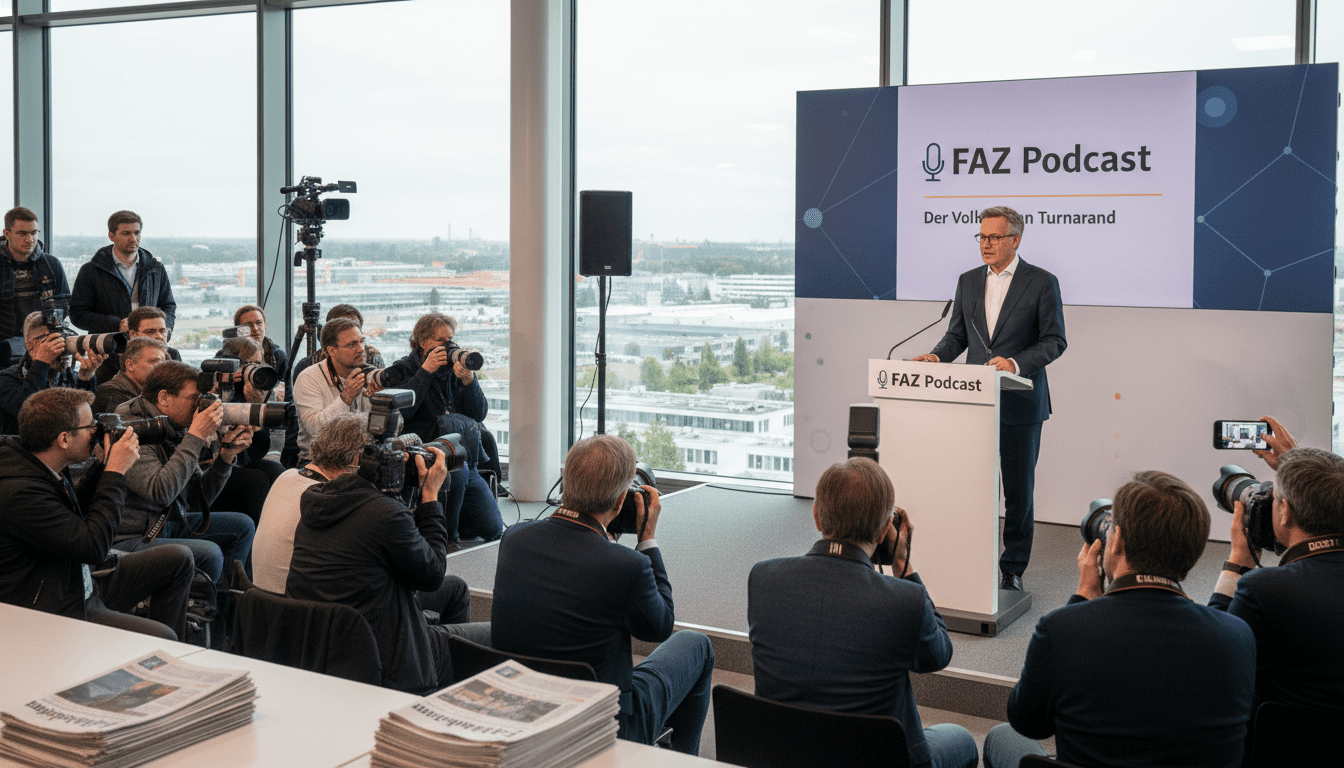
Volkswagen crisis deepens as F.A.Z. launches “Die VW-Story” podcast in a make-or-break year
Volkswagen crisis reaches a pivotal moment in 2026 as F.A.Z. debuts “Die VW-Story” podcast, examining the automaker’s challenges, leadership and path forward soon.
Volkswagen faces what analysts call a defining year, and the Volkswagen crisis is now the focus of a new podcast series by the Frankfurter Allgemeine Zeitung (F.A.Z.). The series, titled “Die VW-Story,” promises a detailed account of the company’s operational setbacks, strategic choices and the wider political and economic repercussions in Germany. Executives, workers and market observers alike are watching whether the Volkswagen group can stabilize performance and restore investor confidence before year-end.
F.A.Z. launches “Die VW-Story” as 2026 becomes decisive year
The F.A.Z. podcast arrives at a time when the Volkswagen crisis has moved from boardroom debate into public scrutiny. Producers say the series will compile interviews and archival material to trace how recent decisions brought the company to this point. The timing underscores concern inside and outside the firm that 2026 will determine whether Volkswagen can execute a turnaround.
Financial and operational setbacks define the current crisis
Recent quarters have shown widening gaps between Volkswagen’s revenue targets and actual results, pressuring margins across its passenger and commercial vehicle divisions. Production bottlenecks, software integration failures and rising costs tied to electric vehicle components have compounded the problem. Those operational weaknesses have translated into muted market reactions and a decline in the share price relative to domestic and global peers.
Leadership and strategic choices under scrutiny
Board-level decisions on product mix, platform investments and executive appointments are now a focal point in coverage of the Volkswagen crisis. Stakeholders are questioning whether management moved quickly enough to resolve legacy combustion-engine inefficiencies while ramping up electrification. The debate extends to governance, where investors are increasingly vocal about the need for strategic clarity and tighter execution discipline.
Workers, suppliers and Germany’s economy feel the pressure
Volkswagen’s role in Germany’s industrial base means the company’s troubles reverberate through supply chains and labor markets. Suppliers report order volatility and margin pressure, while unions are pressing for safeguards around employment and plant investments. Policymakers in Berlin have indicated concern, balancing the political importance of a stable Volkswagen with broader economic priorities for automotive transition and export performance.
Questions over electrification, margins and investor confidence
A central element of the Volkswagen crisis is whether the company can convert its heavy investment in electric vehicles into sustainable profitability. Analysts highlight persistent cost overruns on new platforms and slower-than-expected adoption in key European and global markets. Restoring investor confidence will require clear signals on margin recovery, credible timelines for new model launches and transparent progress on software and battery supply.
The F.A.Z. podcast series aims to map these threads in detail, offering listeners a narrative that connects boardroom strategy to assembly-line reality and market consequences. As Volkswagen and its stakeholders navigate 2026, the episodes could influence public and investor perceptions by clarifying past missteps and the feasibility of proposed remedies. The coming months will test whether management can reconcile short-term financial stabilization with long-term transformation goals amid intense scrutiny.
