
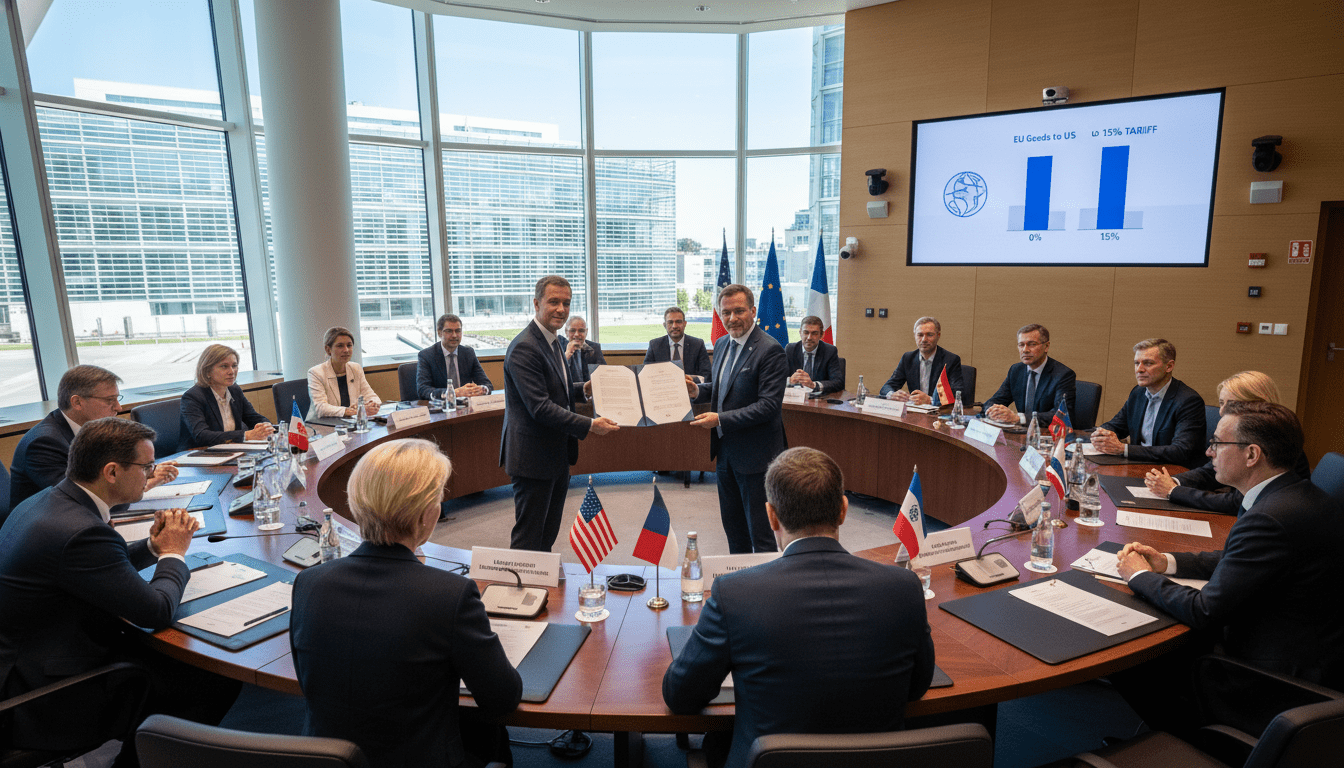
EU–US trade deal approved by EU institutions despite sharp tariff imbalance
EU–US trade deal approved by EU institutions; agreement offers planning certainty but leaves European exporters facing higher tariffs and pushes EU to diversify trade partners.
The European Union has formally approved the EU–US trade deal, ending a protracted standoff that stalled investment and planning for industry on both sides of the Atlantic. The agreement provides legal clarity for businesses, but it locks in a significant tariff asymmetry — with many European goods subject to a 15 percent levy while U.S. exports face little or no reciprocal tariffs. The deal’s passage reflects political and security constraints that limited Brussels’ bargaining room and leaves open major economic and diplomatic questions.
Tariff asymmetry at the heart of the agreement
The approved deal enshrines a wide disparity in tariffs that critics call one-sided. European producers will face broadly applied duties, while most American products enter the EU at much lower rates, creating an uneven competitive environment for EU exporters. Industry groups in several member states warned that the terms will disadvantage European manufacturers unless offset by other measures.
The imbalance has been a central point of contention throughout negotiations, and it shaped the bargaining positions of national governments. Governments that prioritized transatlantic security ties over trade gains were reluctant to press for tougher concessions, narrowing the Union’s negotiating leverage. As a result, the final text reflects compromises that prioritize predictability over tariff parity.
Why the EU moved to ratify now
EU institutions argued the time had come to end the prolonged uncertainty and give businesses a framework for investment and production planning. The European Parliament and the Council reached a compromise to put the deal into force after months of delay, citing the need to stop the stalemate that had disadvantaged exporters and supply chains. Officials said the approval was intended to stabilize transatlantic commerce and avoid further unilateral escalation.
Supporters of ratification highlight the planning certainty the deal creates for sectors exposed to U.S. competition. Opponents counter that legal clarity does not compensate for the structural disadvantages now binding European industry. The decision therefore reflects a political calculation that the immediate benefits of ending uncertainty outweigh the costs of an imperfect agreement.
U.S. response and continuing threats
Washington has made clear it expects the Turnberry agreement — struck last July — to be implemented without significant alteration, and American officials have signalled impatience over the EU’s protracted ratification process. The U.S. side completed its part of the bargain months earlier, and senior U.S. envoys reiterated that they will not accept changes to the core terms. At the same time, Washington has not abandoned leverage: threats to raise automobile tariffs to 25 percent remain on the table.
That lingering threat keeps the trade relationship volatile, and European capitals view U.S. intentions as a key risk factor for the deal’s durability. Analysts say the credibility of any guarantee depends on political developments in Washington as much as on legal safeguards written into the agreement.
Safeguards and a sunset provision added by the EU
To limit exposure, the European Parliament and member states insisted on a safety mechanism that allows rapid reaction if the United States fails to uphold the deal or if severe economic shocks occur. The compromise introduces a contingency that permits partial or full suspension of the agreement under specified circumstances. Lawmakers also achieved a sunset clause, though its timing pushes the formal expiry beyond the next U.S. presidential election.
Those additions were designed to preserve policy space for the EU while keeping the main framework intact. Critics argue the measures are only partial protections, since the suspension power is reactive and the sunset falls after the election cycle that most influenced the original negotiations.
Security dependence shaped the outcome
A central reason the EU accepted less favorable tariff terms was strategic dependence on the United States for defence and security cooperation. Several member states, notably Germany, were unwilling to risk transatlantic strains that could jeopardize military and diplomatic coordination. That security calculus constrained negotiators and reduced the appetite for a harder line in trade talks.
Officials in capitals that favored ratification argued the broader strategic partnership with the United States outweighs the immediate economic concessions. Detractors say that approach entrenches a structural weakness: reliance on a single security partner can translate into economic concessions that undercut domestic industries.
Calls grow for a diversified trade strategy
With the deal now in force, European business and political leaders are increasingly vocal about the need to diversify trade links to reduce exposure to bilateral political swings. Strengthening ties with alternative partners, expanding regional agreements and accelerating market access in Asia and elsewhere are cited as priorities to give European industry more resilient options. The consensus in Brussels is shifting toward using trade diversification as a tool to rebuild bargaining power.
Longer-term policies that boost competitiveness, support affected sectors and deepen trade cooperation with other regions are likely to feature in upcoming debates. For many observers, diversification is the clearest path to regain leverage and protect jobs and investment from future external shocks.
The EU–US trade deal ends a damaging period of uncertainty but leaves Europe with a difficult political choice: accept a flawed but stabilizing pact, or reopen confrontation with its most important security partner in pursuit of more balanced economic terms. The approval signals that, for now, Brussels has chosen predictability and strategic alignment while pressing for safeguards and broader trade diversification.
