
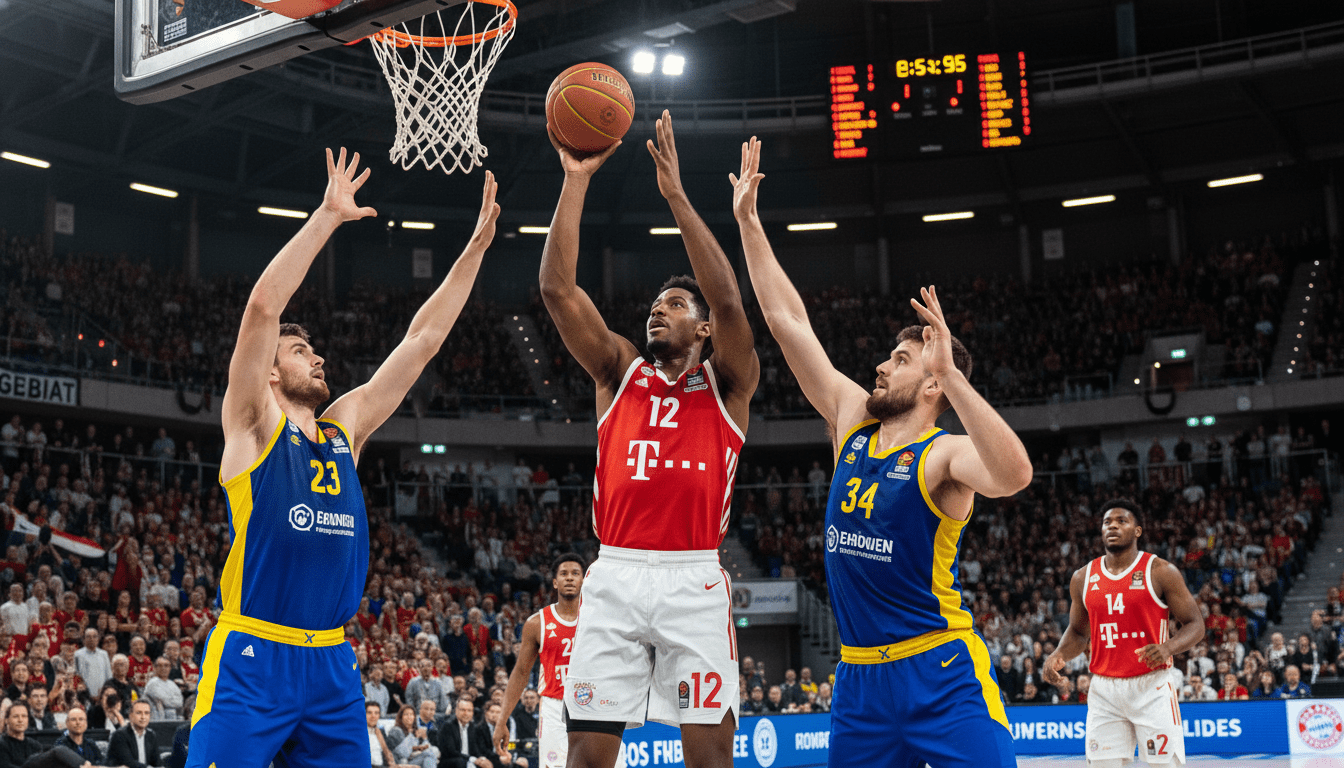
Bayern Munich basketball overcomes 0–10 hole to rout Gladiators Trier 92–65 in Game 2
Bayern Munich basketball recovered from a 0–10 start to defeat Gladiators Trier 92–65 at SAP Garden, taking a 2–0 lead in the BBL quarterfinals before 9,847 fans.
Bayern Munich basketball entered Game 2 of the BBL quarterfinals with familiar early-game problems but produced a comprehensive response to claim a 92–65 victory over Gladiators Trier. The defending champions trailed 0–10 in the opening minutes at SAP Garden before rallying to lead 48–33 at halftime and pull away in the second half. The win gives the titleholder a 2–0 advantage in the best-of series and underlined Munich’s depth and defensive adjustments.
Slow start repeats but recovery is swift
Bayern again began slowly, surrendering an early 0–10 margin that mirrored their opening-quarter hiccup in Game 1. That lacklustre beginning briefly threatened to hand momentum to the Gladiators in front of a near-capacity crowd. Munich, however, tightened its defense and found more consistent scoring across the roster to erase the deficit and seize control before the break.
The pattern of slow openings followed by strong middle quarters suggests the champions are managing tempo rather than collapsing under the early pressure. Coaches and players will note the recurring issue, but the capacity to recover quickly reduced the immediate cost of those lapses. Against Trier, the correction was decisive and left little room for a comeback.
Balanced scoring carries the offense
The victory was built on a remarkably even scoring distribution, with six Bayern players reaching double figures. Nenad Dimitrijevic led the team with 16 points, while Oscar da Silva added 14 and Wenyen Gabriel and Isiaha Mike contributed 12 apiece. Justinian Jessup and Johannes Voigtmann also scored 11 points each, providing complementary threats across the lineup.
That balance prevented Trier from focusing defensive attention on a single star and helped Munich sustain offensive pressure through the second and third quarters. By contrast, the Bayern attack in Game 1 had needed a late surge from Andreas Obst to turn the match; in Game 2, multiple contributors removed the necessity for one hero to carry the load.
Improved shooting and tougher defense shift the game
Munich’s shooting efficiency rose markedly after the slow start, and the team’s perimeter and interior defense limited Trier’s effectiveness. The champions posted a clearly superior field-goal percentage and cleaned up on the glass at key moments, turning defensive stops into transition opportunities. The half-time margin of 48–33 reflected both the offensive uptick and defensive discipline.
Trier’s offense faltered at critical stretches, and their usual go-to scorer, Jordan Roland, was unable to find consistent rhythm. Roland’s subdued performance, compared with expectations going into the series, left Trier short of a primary scoring anchor at a time when they needed one most.
Alex Mumbru in attendance as Bayern assert dominance
National team coach Alex Mumbru was among the spectators at SAP Garden, a reminder of the broader attention on the BBL playoffs and the national talent pipeline. The presence of senior figures in German basketball underscored the significance of high-stakes playoff form for player evaluation and tactical development. For Bayern, the game functioned as a showcase of depth and composure under pressure.
The crowd of 9,847 added to the intensity of the contest, amplifying momentum swings and providing a strong home-court lift once Munich found its footing. The atmosphere reflected both local interest in the defending champions and broader enthusiasm for the playoff stage.
Series outlook and adjustments for Trier
With the series now 2–0 in favor of Bayern, the pressure shifts heavily to Gladiators Trier to manufacture adjustments and find more reliable scoring sources. Trier will need to address early-game execution and find ways to free up Jordan Roland or other scorers to keep pace with Munich’s balanced offensive threats. Tactical changes on both ends of the floor will be necessary if Trier hopes to extend the series.
For Bayern, the challenge will be to correct the recurring slow starts while preserving the defensive intensity and shared scoring that proved decisive in Game 2. Maintaining rotation balance and managing minutes will be key as the playoffs progress and the possibility of deeper contests looms.
Bayern’s ability to absorb an early setback and convert it into a dominant win speaks to the team’s championship experience and roster flexibility, setting the stage for a tense but compelling continuation of the quarterfinal series.
