
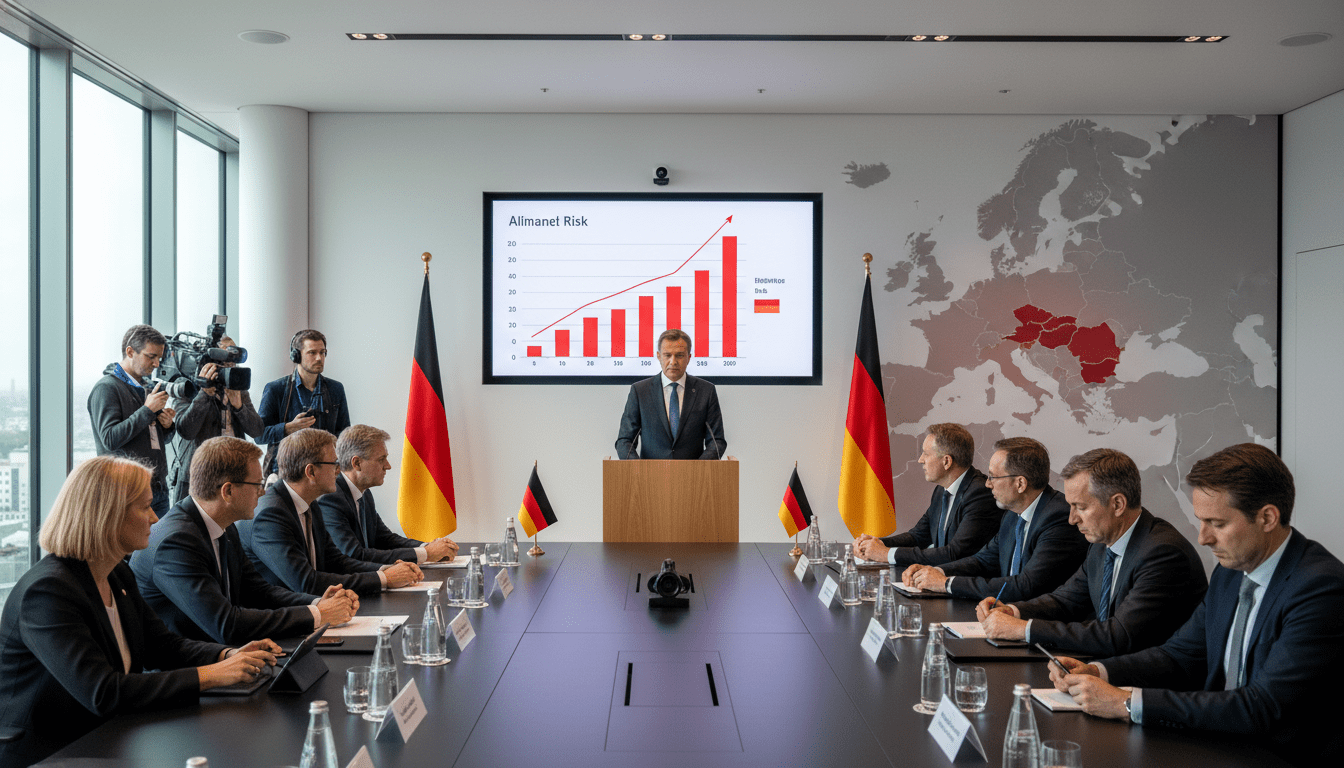
German firms name war the top political violence risk, Allianz survey finds
Nearly two-thirds of German companies now view war as the primary political violence risk, Allianz Commercial’s survey shows; business interruption and supply‑chain disruption are top concerns.
Almost two-thirds of German firms see war as the greatest political violence risk, according to a targeted Allianz Commercial survey of corporate risk managers. The study found terrorism and sabotage close behind, with disinformation campaigns also registering as a major concern among respondents. The Allianz findings build on the insurer’s broader Risk Barometer published in January 2026, which flagged political risks rising in prominence for companies worldwide.
Allianz survey: German risk priorities
A focused poll of German corporate risk managers by Allianz Commercial showed war topping the list of political violence worries, followed by terrorism or sabotage at roughly the mid‑50 percent level and disinformation at about 46 percent. The results reflect a shift in corporate threat perceptions as executives weigh the immediate and ripple effects of armed conflicts. Respondents identified risks not only in direct damage but in how political violence can cascade through operations and markets.
Global picture from the January 2026 Risk Barometer
Allianz’s January 2026 Risk Barometer placed political risks higher than in previous years, with political violence climbing several ranks in the global threat landscape. In a deeper survey of 500 companies across 50 countries, more than half singled out war as the most feared political‑violence scenario. The report links conflicts in Europe and the Middle East to disrupted trade, strained alliances and elevated operational uncertainty for multinational firms.
Business interruption emerges as the most feared impact
Insurers and company risk teams highlighted business interruption as the most dangerous consequence of political violence, with over 70 percent of firms naming interruptions or supply‑chain breakdowns as the single greatest threat to their business models. In Europe and the Asia‑Pacific, roughly six in ten respondents cited war as the primary concern. Civil unrest and terrorism also featured prominently, underscoring how different forms of political violence compound operational vulnerabilities.
Supply chains and inventory strategies under review
Companies are responding by reassessing inventory and sourcing strategies to reduce exposure to geopolitical shocks. About a third of surveyed firms reported plans to improve inventory management through measures such as storage in preferential trade zones, while nearly half were actively renegotiating and diversifying supplier networks. These moves reflect an effort to shorten and decentralize critical links that historically amplified disruptions during regional crises.
Nearshoring and regional relocation considerations
The Allianz analysis found a noticeable uptick in interest in nearshoring and onshore options: roughly one in three companies had already been evaluating moving processes, IT development or production to geographically closer countries or domestic locations. Executives cited the desire to reduce transit times, lower cross‑border exposure and gain greater control over critical inputs. Such strategic shifts, while costly to implement, are seen as an important hedge against escalating geopolitical volatility.
Insurance market adapts to higher losses and new demand
Allianz Commercial reports stronger buyer interest in political‑violence and terrorism coverage than prior to recent major conflicts, signaling a market adjustment to heightened risk perceptions. The insurer warns that losses tied to conflicts in the Middle East could, in certain sectors and regions, surpass those recorded after the Ukraine war and drive reassessments of pricing and coverage terms. Experts noted that the estimated conflict risk to corporate assets had risen by more than a fifth in the five years preceding the latest Middle East escalation.
Companies and insurers alike are emphasizing resilience as a commercial priority. Thomas Lillelund, head of Allianz Commercial, warned that wars and related political violence are likely to undermine geopolitical and economic stability through 2026 and beyond, and urged firms to improve identification of vulnerabilities within both physical and digital supply chains. Srdjan Todorovic, Allianz’s specialist on political violence, described understanding and limiting systemic impacts within interconnected business ecosystems as essential, and highlighted insurance as a core component of corporate risk strategies.
The Allianz findings underline a broader strategic shift: businesses are moving from passive exposure to active mitigation, blending operational changes with insurance solutions to manage an increasingly complex political‑risk environment. As firms weigh the costs and benefits of supply‑chain reconfiguration, inventory buffers and regional relocation, executives say the capacity to adapt quickly will determine which companies withstand the next round of geopolitical shocks.
