
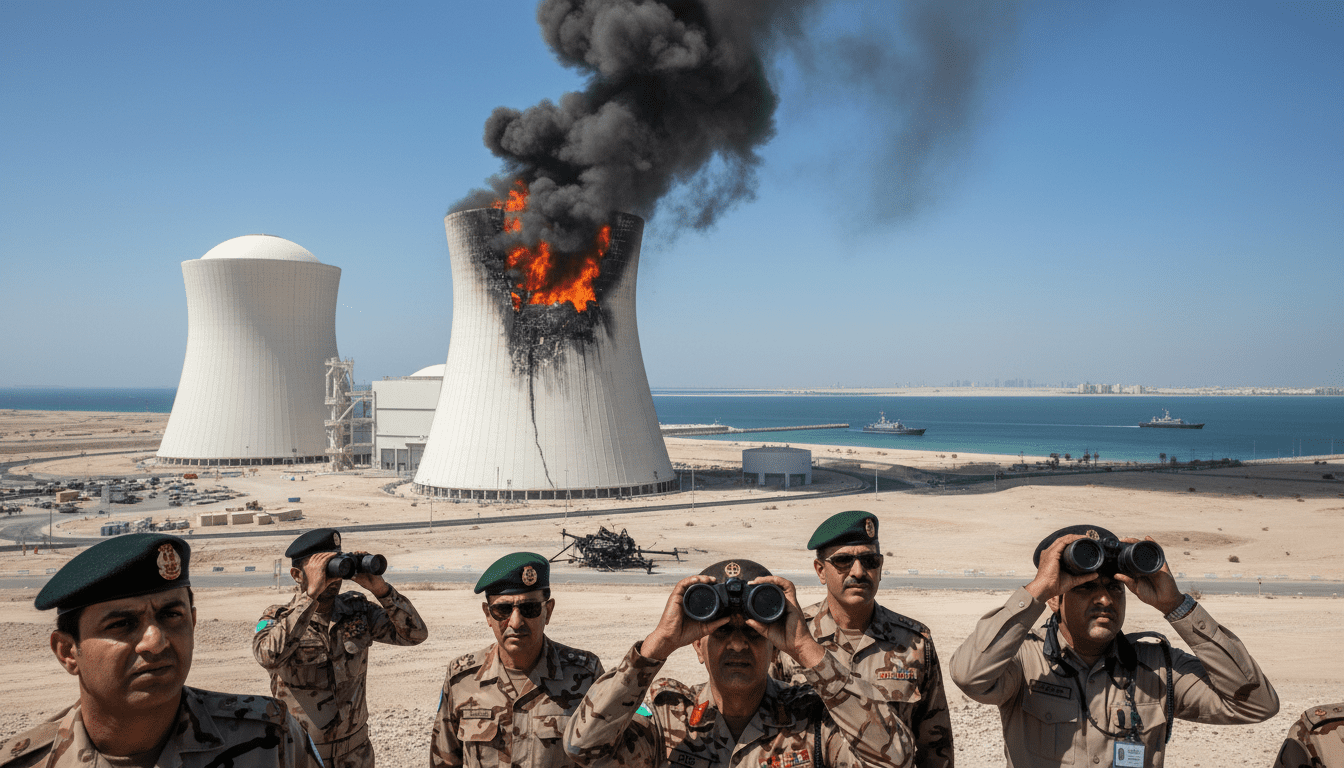
Drone Strike Sparks Fire Near Barakah Nuclear Plant, Raising Gulf Security Concerns
Drone strike ignited a fire near the Barakah nuclear plant in the UAE, prompting IAEA concern, regional condemnations and renewed fears of Gulf escalation.
Fire at Barakah’s Perimeter, Operations Unaffected
A single drone strike caused a blaze at an electrical generator outside the inner perimeter of the Barakah nuclear facility, UAE authorities said. No injuries were reported and official monitors indicated radiation readings remained within normal limits.
The UAE’s nuclear regulator reported that all reactor units continued to operate as normal and that plant safety systems were intact. Emergency services extinguished the fire and the operator said there was no impact on the plant’s core operations.
Barakah’s Capacity and Strategic Role
Barakah, located in Al Dhafra in Abu Dhabi, is the United Arab Emirates’ sole nuclear power station and the first on the Arabian Peninsula. The site comprises four pressurised water reactors, each based on an advanced 1,400 MW South Korean design capable of powering roughly one million homes apiece.
When fully operational the plant supplies about a quarter of the UAE’s electricity needs and has been promoted by authorities as a major source of low-carbon baseload power. Emirates Nuclear Energy Corporation figures cited substantial annual clean-energy output and estimated carbon-emission savings equivalent to removing millions of cars from the road.
UAE Response and Security Measures
The UAE government described the attack as an “unprovoked terrorist attack” and vowed to protect its sovereignty and security by all lawful means. The Ministry of Defence said two additional drones were intercepted, and state officials warned they would reserve the right to respond to threats in accordance with international law.
An adviser to the UAE president publicly condemned the strike as a dangerous escalation and indicated responsibility lay with a principal actor or its proxies, language that pointed toward groups aligned with Iran without naming a specific perpetrator. Emirati statements sought to reassure residents and international partners that critical systems at Barakah were secure.
Regional Interceptions and Possible Launch Points
Saudi authorities reported interceptions of multiple drones launched from Iraqi territory, where some Iran-aligned armed groups operate, raising questions about the origin of the devices. Experts have noted that commonly used attack drones in the region have ranges sufficient to reach both the UAE and Saudi targets from launch points in Iraq or farther afield.
No group immediately claimed responsibility for the Barakah strike and verification of launch locations remained uncertain, complicating attribution. The presence of transnational proxy networks and the demonstrated reach of certain drone types have multiplied risks for civilian infrastructure across the Gulf.
IAEA Assessment and International Concern
The International Atomic Energy Agency said the incident forced at least one reactor to rely temporarily on emergency diesel generators, prompting the agency’s director-general to voice “grave concern.” The IAEA emphasized that any military activity threatening nuclear facilities is unacceptable and increases risks to public safety.
International reactions included condemnations from several regional and extra‑regional capitals, underscoring anxiety over attacks that could imperil nuclear safety. Global watchdogs and governments urged restraint and called for independent assessments to confirm facts and prevent further escalation.
Potential Environmental and Public‑Health Consequences
Nuclear plants are designed with multiple redundant safety layers, but damage to ancillary systems or backup power can amplify risks, experts warn. A significant release of radioactive material could contaminate land, water and food supplies, with isotopes such as caesium-137 posing long-term environmental hazards and elevated cancer risks for exposed populations.
The Gulf’s reliance on desalination heightens regional vulnerability because many plants are not configured to remove radioactive contamination, raising concerns about potable water safety if coastal facilities were affected. Past incidents and repeated strikes on energy infrastructure in the wider conflict have sharpened fears that warfare could cross into sectors with far-reaching civilian consequences.
Diplomacy and clear, independent investigation into the Barakah incident will be essential to establish responsibility and reduce the risk of further attacks on critical infrastructure. Concerted international pressure to protect nuclear sites, coupled with transparent technical assessments, will be central to preventing contagion of the conflict into wider regional systems.
