
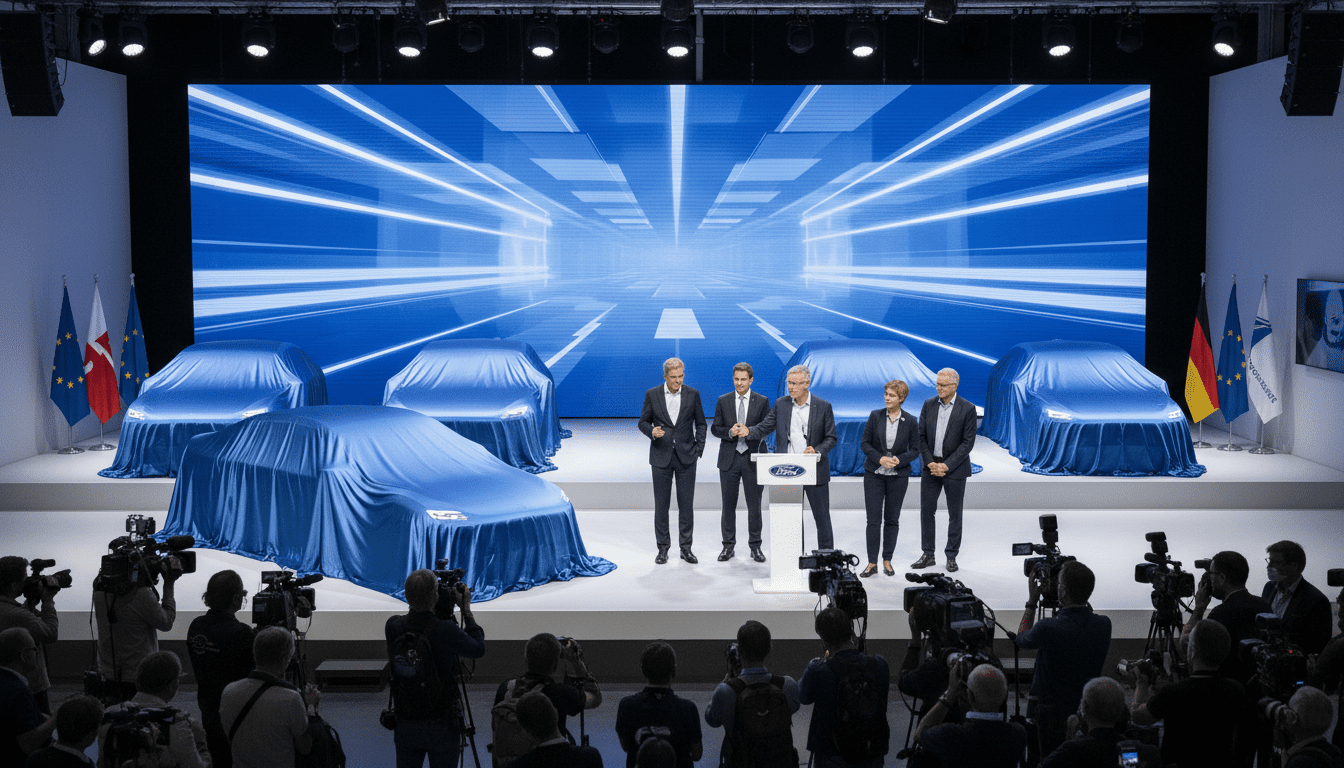
Ford Europe pledges five Europe-built models by 2029 under new chief Jim Baumbick
Ford Europe chief Jim Baumbick vows five Europe-built models by 2029, Renault partnerships and production in France and Spain to rebuild dealer trust.
Jim Baumbick, the newly appointed head of Ford Europe, unveiled a rapid product push aimed at quelling doubts about the company’s commitment to the continent. He told dealers and media that Ford Europe will deliver five new models developed for European customers by 2029, a move designed to shore up sales and reassure a nervous retail network.
Baumbick presents plan at Salzburgring
Baumbick used a high-profile dealer and media event at the Salzburgring to set out the company’s renewed European strategy. Emphasizing his engineering background, he positioned himself as a product-focused executive intent on rebuilding Ford’s reputation among European drivers.
The presentation sought to counter recent perceptions that Ford had pivoted away from passenger cars in Europe, instead doubling down on both design and performance to reconnect with traditional buyers. Attendees were given details on model mix, manufacturing locations and the role of strategic partnerships in accelerating development.
Five new Europe-developed models by 2029
Central to the plan is the promise of five new models produced and engineered for the European market before the end of 2029. Ford intends these vehicles to span electric city cars, compact SUVs and crossover models with motorsport-inspired credentials aimed at the compact and mid-size SUV segments.
The accelerated timeline relies on greater use of shared technical platforms with partner manufacturers, allowing Ford to shorten development cycles and spread costs across higher production volumes. Company officials stressed that platform sharing will not dilute visible Ford attributes such as exterior design and driving dynamics.
Renault tie-up for small EV and SUV, French production confirmed
Two of the announced vehicles will stem from a cooperation with Renault, with Ford building a small electric hatch and a compact SUV based on Renault’s current R5 and R4 architectures. Production of these two models will take place in France, according to Ford’s plan, marking an immediate, concrete element of the wider product push.
The Renault partnership is intended to provide a cost-efficient route into segments where Ford has lacked competitive electric offerings, while allowing Ford to retain brand-specific tuning and styling. Executives described the agreement as focused on behind-the-scenes components rather than visible design elements.
Smaller Bronco variant to be built in Spain
Ford also confirmed plans to introduce a smaller, Europe-focused variant of the American Bronco SUV, with assembly slated for Spain. The move aims to translate the Bronco’s rugged image into a package suited to European roads and buyer preferences.
The Spanish production decision is part of a broader effort to localize supply chains and manufacturing for the European market, reducing lead times and tailoring products more closely to regional demand. Ford indicated the European Bronco will be adapted in size and specification while retaining key off-road credentials.
Addressing dealer concerns amid steep market share decline
The product announcement comes against a backdrop of eroding market share in Europe, where Ford’s passenger car share reportedly fell from 6.2 percent in 2019 to 2.8 percent in 2025. That decline had prompted some dealers to warn that a Ford business focused only on commercial vehicles would not be sustainable.
Baumbick made clear the new model slate is intended to stop further dealer attrition by offering a credible passenger car lineup alongside a strong commercial vehicle business. Senior Ford managers acknowledged that restoring dealer confidence will require both fresh products and a visible commitment to Europe over several model cycles.
Platform sharing strategy and potential geopolitical questions
Ford says platform sharing with other automakers will be selective and aimed at components unlikely to be noticed by customers, while keeping Ford-specific elements for styling and handling. The company also declined to confirm reports that some crossover models might use architectures from a Chinese partner, saying platform discussions are ongoing.
Analysts warn that reliance on external platforms can accelerate time-to-market and reduce cost, but also raise questions about long-term differentiation and supply-chain complexity. Ford’s ability to balance cost-sharing with distinct brand DNA will be watched closely by dealers, customers and regulators alike.
The next 18 months will be critical as Ford moves from promise to delivery: production contracts, prototype reveals and the first showroom arrivals will determine whether Jim Baumbick’s strategy can reverse the decline in Ford Europe’s passenger car fortunes.
