
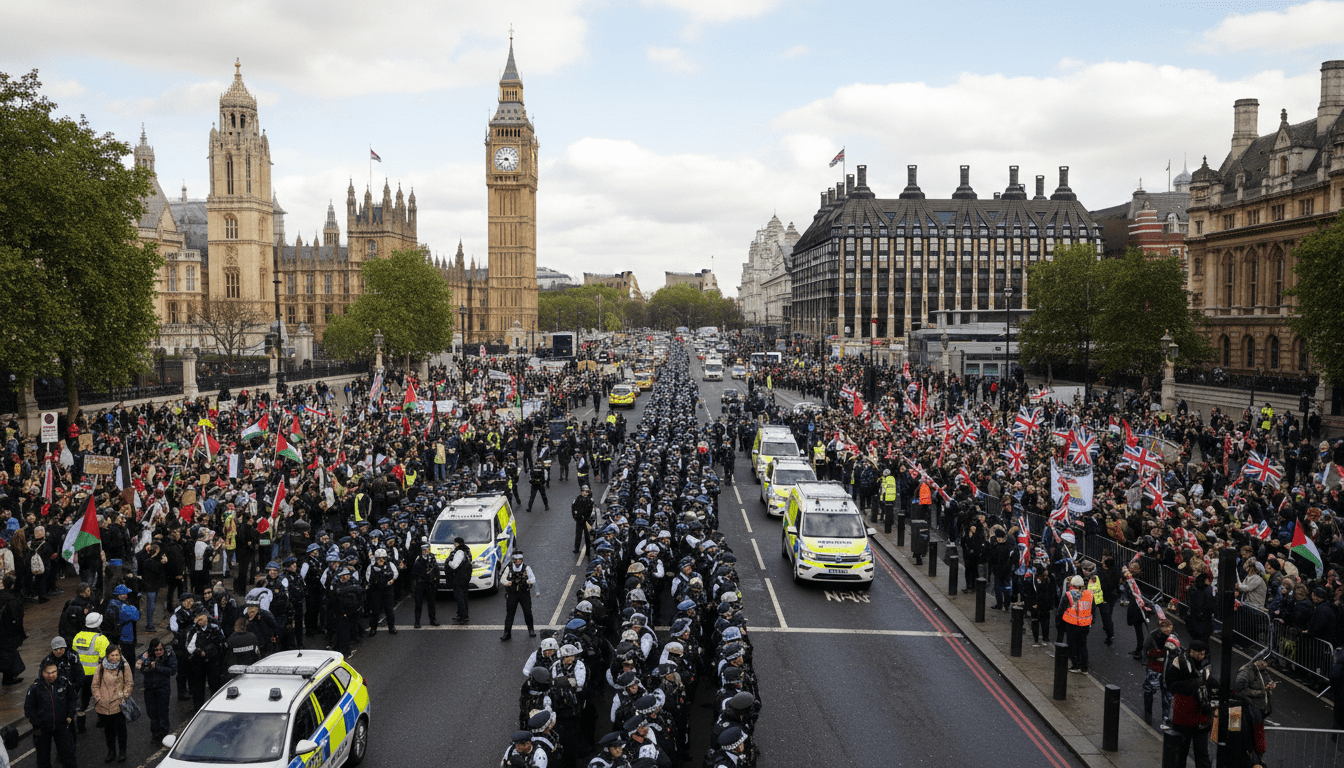
London protests draw tens of thousands as Met mounts largest public-order operation
Tens of thousands marched in central London on May 16, 2026 as rival Nakba Day and Tommy Robinson rallies prompted the Metropolitan Police’s biggest public-order operation, with 4,000 officers deployed.
Crowds and rival routes in central London
Tens of thousands of demonstrators took to central London in two separate events that ran concurrently on Saturday, creating one of the capital’s most volatile protest days in years. Organisers and police had forecast a combined turnout of around 80,000, with an estimated 50,000 at the far-right “Unite the Kingdom” march and roughly 30,000 attending the Nakba Day and pro-Palestine rally.
Authorities imposed restrictions on routes and timing to keep the rival groups apart and to reduce the risk of clashes. By midday, the Metropolitan Police reported 11 arrests for a range of alleged offences as officers sought to enforce the conditions attached to both events.
Police mount largest public order operation in years
The Met deployed approximately 4,000 officers for what it described as its biggest public-order operation in years, supplemented by reinforcements from forces outside London. Commanders said they would take “the most assertive possible use of our powers” and adopt a zero-tolerance approach to disorder.
The force estimated the policing operation would cost about £4.5 million, and warned that organisers would face new legal responsibilities for the conduct of invited speakers. Live facial recognition technology was used for the first time by the Met at the protests, according to police statements.
Tactics, equipment and surveillance on show
Armoured vehicles, mounted units, dogs, drones and police helicopters were deployed across central London to monitor movements and respond rapidly to pockets of unrest. Officers formed cordons and used surveillance tools to identify individuals they said posed a risk to public safety.
The use of live facial recognition marks an expansion of police powers in contentious public-order settings and drew scrutiny from civil liberties groups. Police described the technology as one component of a wider operational toolkit intended to prevent violence and protect both protesters and the public.
Legal measures and prosecutorial guidance
Prosecutors were briefed to consider whether particular placards, banners or chants could constitute criminal offences or incite aggression during the marches. The Crown Prosecution Service emphasised that actions taken were framed as measures to prevent hate crime, not to curtail lawful expression.
Stephen Parkinson, director at the CPS, stated the intention was to shield the public from threats and harassment while preserving lawful protest. For the first time, organisers were made legally accountable for ensuring invited speakers do not cross the threshold into hate speech.
Government bans and high-profile exclusions
In advance of the far-right rally, the UK government moved to block entry to 11 foreign nationals believed to be involved with the “Unite the Kingdom” event. Figures reported to have been turned away included politicians and activists from several European countries and the Americas.
The government’s travel bans were presented as part of a broader effort to limit external inflation of tensions in the capital. Downing Street and Home Office officials framed the exclusions as necessary to prevent foreign interference in what were described as potentially inflammatory gatherings.
Political reactions and fallout
Prime Minister Keir Starmer warned that anyone intent on “wreaking havoc” or intimidating people on the streets would face the full force of the law, as he pledged support for the police operation. His comments came amid political pressure following strong performances by the far-right Reform UK in recent local elections.
Starmer condemned the far-right organisers’ messaging as promoting “hatred and division,” while other political figures called for a careful balance between safeguarding free speech and preventing violence. The high-profile nature of the events has intensified debates over policing, public-order powers and the line between permitted protest and criminal conduct.
Saturday’s far-right rally was led by Stephen Yaxley-Lennon, better known as Tommy Robinson, who previously drew exceptionally large crowds to central London at a demonstration last September. That earlier event, which attracted international attention and controversy, included remarks from public figures on social media platforms and saw clashes that injured police officers.
Stand Up to Racism and allied groups combined an antifascism march with a pro-Palestine demonstration timed to follow Nakba Day, observed annually on May 15, which commemorates the displacement of Palestinians in 1948. Organisers said the event was intended to mark the historical date and to protest current policies and conflicts.
Security sources said the operation will be reviewed by senior commanders and independent oversight bodies in the days ahead. Police and prosecutors have signalled they will examine footage and evidence collected during the marches to determine whether further arrests or prosecutions are warranted.
Lawyers, civil liberties groups and campaigners are expected to challenge any perceived overreach in the use of surveillance and the new obligations placed on event organisers. Meanwhile, the Met has defended its tactics as necessary to prevent disorder and to protect the public during a day of heightened tensions.
The scale and coordination of Saturday’s events have left a clear imprint on London’s political and civic landscape, raising difficult questions about policing, protest rights and the management of large-scale demonstrations in an increasingly fractious public sphere.
