
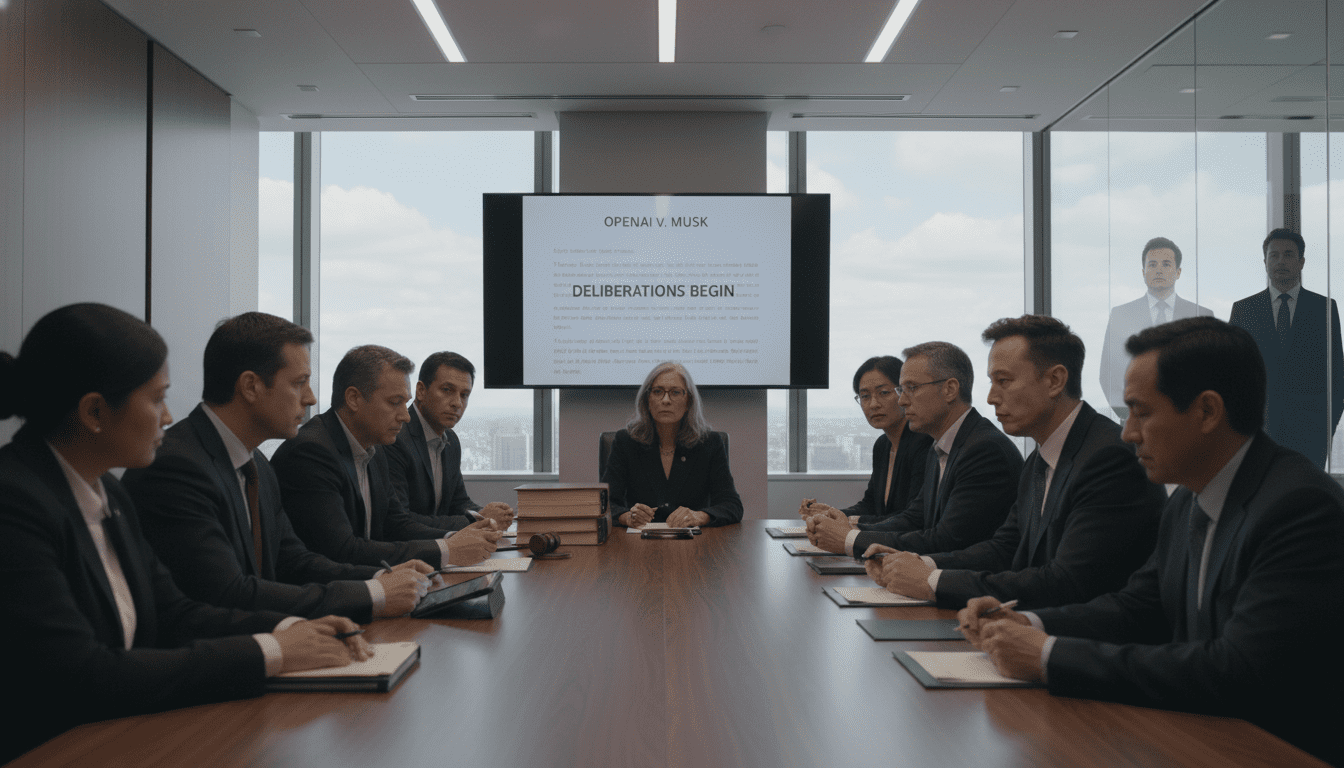
Jury Deliberates in High-Stakes OpenAI Trial Over Elon Musk’s Donations
Nine jurors are weighing claims in the OpenAI trial as Elon Musk accuses co‑founders and Microsoft of misusing his donations, with consequences and remedies pending.
Jury begins deliberations in landmark OpenAI trial
Nine California jurors have begun deliberations in the OpenAI trial, a case that could reshape the future of one of the world’s most prominent artificial intelligence labs.
The proceedings center on claims by Elon Musk that donations he made to OpenAI were diverted from their intended charitable purpose, and that founders and Microsoft profited improperly.
The jury will address narrow legal questions, including breach of charitable trust, unjust enrichment, and whether Microsoft aided and abetted any alleged breach.
Plaintiffs’ breach of charitable trust claims explained
Musk’s legal team argues that his contributions were intended to support a non‑profit mission to distribute the benefits of AI broadly, and that later decisions diverted those funds to private gain.
Plaintiffs have pointed to a major Microsoft investment in 2023 as a turning point that, they say, shifted OpenAI toward commercial priorities and enriched investors and executives.
Their case emphasizes the founding promise of the organization and asserts that subsequent deals and governance choices undermined that original charitable trust.
OpenAI’s defenses focus on timing and prior use of funds
OpenAI’s lawyers have presented three core defenses: statute of limitations, unreasonable delay, and unclean hands.
A forensic accountant testified that Musk’s donations were used by the foundation well before critical cutoff dates, a claim that could render the charitable‑trust count time‑barred.
Attorneys also argued that Musk and his advisers had ample public and private information for years and that his formal role and last donations date back to 2018 and 2020, respectively.
Unjust enrichment dispute and equity distributions
The unjust enrichment claim concentrates on whether founders and investors, including Microsoft, profited at Musk’s expense through equity held in OpenAI’s for‑profit affiliate.
Plaintiffs note multibillion‑dollar valuations and equity stakes for founders as evidence that donations ultimately benefitted private interests rather than the charity’s mission.
Defendants counter that equity distributions were necessary to attract and retain talent critical to advancing the non‑profit’s mission, and they maintain that the for‑profit’s work furthered safety and public access goals.
Microsoft’s role and the 2023 ‘blip’ are focal points
Testimony at trial has probed Microsoft’s involvement, particularly during the 2023 “blip” when Sam Altman was briefly removed from OpenAI’s board and then reinstated.
Plaintiffs contend that Microsoft executives, including the company’s CEO, played an outsized role in restoring Altman and structuring governance, pointing to contractual clauses that granted Microsoft veto rights over major decisions.
Microsoft’s witnesses, however, have denied knowledge of specific conditions tied to Musk’s donations and have said their investments and compute resources were essential to OpenAI’s technical progress.
Potential remedies and the judge’s upcoming hearings
If the jury rules in Musk’s favor on any claim, the trial will move to a remedies phase in which attorneys will argue what relief, if any, should follow.
Courtroom briefing and hearings scheduled for next week will let judges consider a range of outcomes, from financial awards to structural remedies affecting the for‑profit affiliate.
Legal experts say a ruling in favor of the plaintiffs could have profound effects, though exactly how those effects would play out remains subject to further judicial proceedings and appeals.
OpenAI has repeatedly emphasized that its current structure supports the organization’s mission and that public access to technologies such as ChatGPT aligns with the charity’s goals.
Musk’s attorneys have countered that, regardless of public access, the mechanics of governance and capital distribution altered the character of the organization from its original charitable design.
Jurors now face the task of parsing complex documentary evidence, witness testimony from board members and advisers, and financial analyses about when and how donations were spent.
The verdict in this closely watched OpenAI trial will have significant implications for donors, non‑profit governance, and the commercial development of advanced artificial intelligence.
