
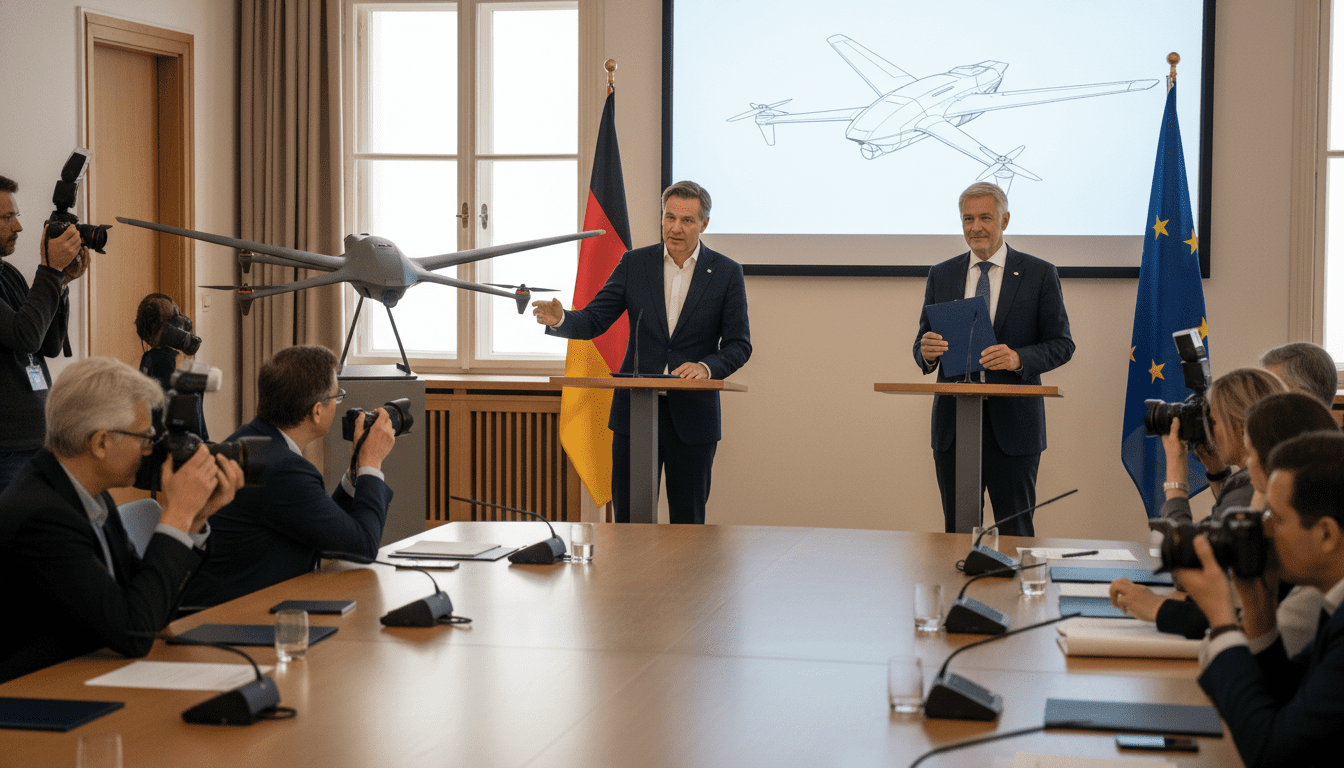
Munich Startup to Produce Perennial’s Merops Interceptor Drones for German and NATO Forces
Munich-based Twentyfour Industries will partner with Perennial Autonomy to manufacture Merops interceptor drones in Germany, aiming to supply NATO partners and the Bundeswehr and allies.
The German startup Twentyfour Industries has struck a partnership to build Perennial Autonomy’s Merops interceptor drones on German soil, marking a rapid commercialization of a new weapons category born of recent conflicts. Interceptor drones — unmanned systems designed to collide with or otherwise neutralize incoming attack drones — are being pitched as a low-cost alternative to expensive missile interceptors, and Twentyfour’s move signals growing European production capacity for this technology.
Merops interceptor system and its battlefield record
Perennial Autonomy’s Merops is billed as a simple, low-cost interceptor that can physically intercept attacking loitering munitions or carry a small warhead for greater effect. Company statements and media reports attribute thousands of shoot-downs of Iranian-style Shahed and Russian derivative drones to Merops in recent conflicts, a record that helped drive demand across multiple theatres.
The per-unit cost of Merops is reported at roughly $5,000, a fraction of the price of missile interceptors and air-defense rounds. That cost differential has become central to defense planners’ interest in interceptor drones as a way to preserve limited stocks of high-value missiles while still denying enemy aerial attacks.
Twentyfour Industries’ manufacturing push near Munich
Twentyfour Industries, founded just over a year ago and operating with about 50 employees, will serve as Perennial’s industrial partner to establish production capacity in the Munich region. The company, backed by investors including Lakestar, OTB Ventures and 468 Capital, presented the Merops system at a recent German technology show and has been engaged in talks with national and alliance customers.
Executives say the plan is to deploy Twentyfour’s manufacturing, logistics and training expertise to scale European production and support deployment to German and allied units. Officials emphasize that the aim is not to replicate design work but to build assembled capacity and supply chains inside Europe to shorten delivery times and meet alliance requirements.
Scale, cost and why interceptor drones matter
Interceptor drones address a specific operational problem: massed, low-cost attack drones can overwhelm traditional point defenses that rely on expensive missiles. By investing in high-volume, low-cost interceptors, armed forces can create layered defenses where cheap expendable systems blunt swarm attacks and preserve strategic interceptors for higher-value threats.
Operationally, interceptor drones can be configured for kinetic ramming, explosive defeat or electronic disruption. That flexibility, plus rapid manufacturability, has driven a new market segment among both established defense contractors and emerging startups seeking contracts from NATO states.
German industry and competing production plans
A number of German firms are also moving to field or scale up interceptor drone production. Domestic companies working on similar systems include Tytan and Quantum Systems, both of which have announced plans for larger manufacturing runs. One German manufacturer has indicated ambitions to reach thousands of units per month from a new facility in the Munich area within the next year.
Perennial reports significantly higher current output at its Ukrainian facilities, where production is claimed to be in the tens of thousands per month. The planned German line would therefore complement existing capacity and provide a European production base for customers reluctant to source from non-allied factories.
Political engagement and military demonstrations
German defense and political leaders have observed demonstrations of interceptor drone capabilities as procurement discussions advance. Senior officials visited a military training area to review tactical use and potential integration with existing Bundeswehr systems, underscoring growing political interest in rapidly fielding proven capabilities.
Proponents stress that European production aligns with political objectives to pair battle-tested technology with an emerging industrial base, shorten supply chains, and improve sovereignty over critical defense equipment. For a small company, scaling to meet alliance demand will require rapid expansion of manufacturing processes and workforce training.
Operational, legal and strategic challenges ahead
Despite commercial momentum, interceptor drones raise operational and regulatory issues that will matter as production scales. Integrating large numbers of autonomous or remotely piloted interceptors into layered air-defence architectures requires clear command-and-control rules, maintenance and training regimes, and logistics planning.
There are also export controls, export licensing and arms-control considerations to reconcile when moving production to new jurisdictions or selling into alliance markets. Transparency around rules of engagement, target discrimination and post-strike forensics will be important to manage political and legal risk as these systems proliferate.
Twentyfour Industries’ plan to begin production of Merops systems this year in the Munich area is ambitious for a company of its size, but it reflects broader shifts in defense procurement toward high-volume, lower-cost aerial defence solutions. As European manufacturers scale up output, interceptor drones are set to become a more prominent and contested element of modern air-defence strategies.
