
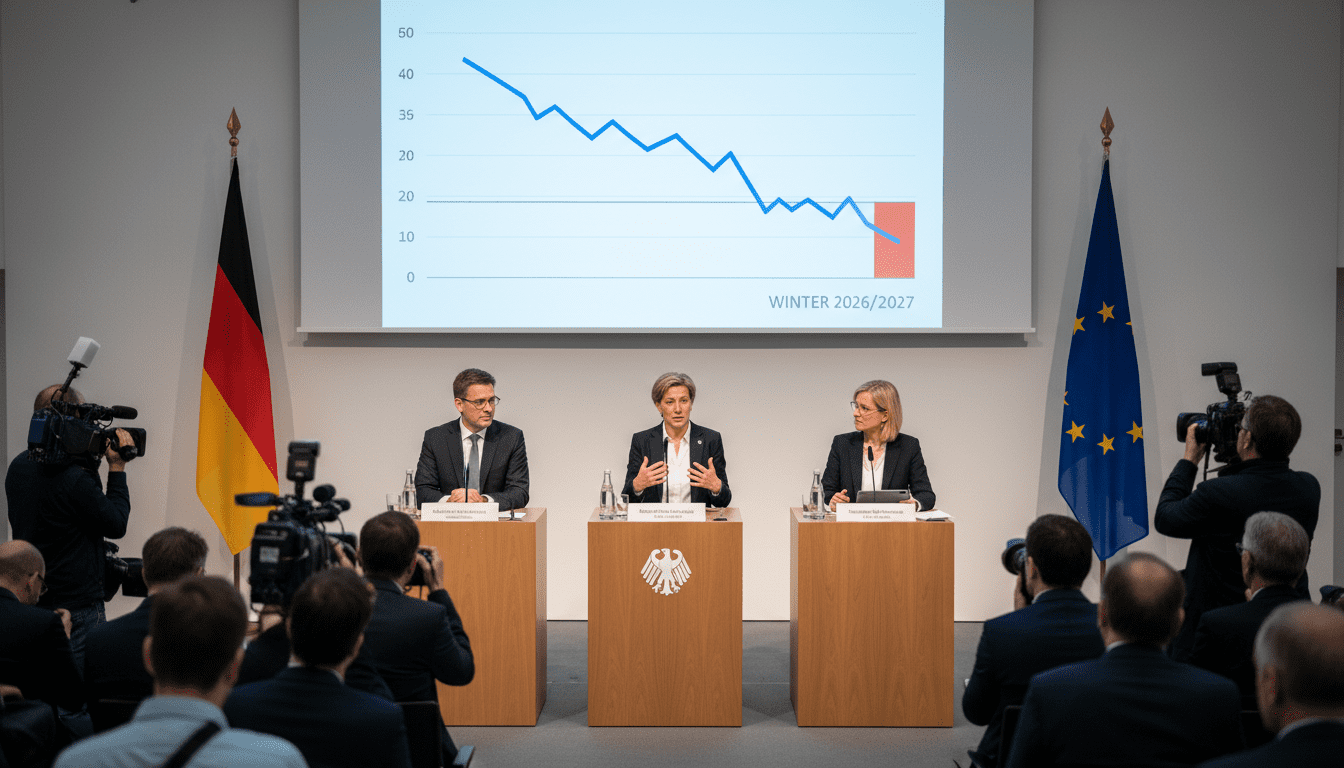
German gas storage operators warn of winter 2026/2027 supply risk
German gas storage operators warn of possible supply shortages in winter 2026/2027 if a 2010-level cold snap occurs; storages were 26% full on May 1, bookings uncertain.
The operators of Germany’s gas storage facilities have issued a warning that the country could face supply shortfalls in winter 2026/2027 if temperatures fall as low as they did in the exceptionally cold winter of 2010. The Initiative Energien Speichern (Ines) says the risk is concentrated in the core winter months and is driven by low current fill levels, high market prices and international supply pressures. German gas storage is at the center of the discussion as policy makers, industry and traders weigh how to avoid disruptions.
Operators signal low fill and uncertain bookings
The storage sector reports that on May 1, German gas storage sites were filled to only 26 percent of capacity, a level industry officials describe as unusually low for the spring refill season. Although storage bookings for the coming heating season showed capacity reserved — Ines cites bookings corresponding to roughly 76 percent for November 1 — the association stresses that reservations do not guarantee physical injections. Sebastian Heinermann, managing director of Ines, warned that booked slots must actually be filled to ensure resilience against a severe winter.
Storing gas now offers limited commercial incentive because current forward pricing makes Winter 2026/2027 contracts cheaper than summer supply, reducing the arbitrage benefit for traders. The resulting market signal has contributed to slower-than-normal injections into Germany’s storage facilities despite reservations for capacity.
Peak winter months identified as most vulnerable
Ines highlights January through March 2027 as the period most exposed to shortages if cold conditions arrive and storage volumes remain low. The association’s modelling, based on a weather scenario similar to the cold 2010 winter, indicates that supply gaps would be most acute during sustained cold snaps in that quarter. Operators are particularly concerned about consecutive cold days that drive up demand while making replacement imports and pipeline flows harder to secure.
The warning underscores a difference between capacity booking statistics and actual preparedness: even when capacity is reserved, shortfalls can occur if the physical volumes are not in place when temperatures plunge.
Model simulations point to potential daily deficits
According to Ines’s analysis, a winter as cold as 2010 could produce cumulative shortfalls in the first quarter of 2027 on the order of 20 terawatt-hours of gas. The association also states that in some modelled days more than 35 percent of projected daily gas demand might not be coverable from available supplies. Such gaps would force prioritisation of deliveries and likely increase the risk of rationing measures for certain sectors and large consumers.
Industry analysts caution that model outputs depend heavily on the timing and severity of cold weather, but they agree that the scenarios show how rapidly storage can become a limiting factor when demand spikes and import flexibility is constrained.
Prices and geopolitics are suppressing injections
High wholesale gas prices and recent geopolitical tensions are key drivers behind the slow refill. Ines specifically notes that disruptions linked to international crises, including tensions in and around the Strait of Hormuz, have pushed up global gas market prices and raised uncertainty about imports. Those elevated prices discourage market players from purchasing and storing extra volumes now, diminishing the safety margin heading into winter.
Domestic consumption also rose in 2025, with Germany using about 910 terawatt-hours of gas — nearly seven percent more than the previous year — after a cold January that drew down inventories. The combination of increased demand and expensive supply has complicated operators’ efforts to rebuild stocks at the usual pace.
Industry calls for EU monitoring and infrastructure development
To reduce the risk of shortages, Ines recommends an EU-wide monitoring framework that would track storage fill levels, daily consumption and import flows in real time. The association argues that better transparency across Member States would help identify emerging regional stress and enable coordinated responses. In addition, Ines urges accelerated development of gas and hydrogen infrastructure to improve flexibility and the ability to balance supply shortfalls.
The group also suggests public information campaigns and targeted measures to encourage temporary demand reduction during extreme cold spells, alongside investments to increase cross-border transmission and liquefied natural gas handling capacity.
Policy options and market measures under consideration
Policymakers face a limited menu of options in the near term, including regulatory steps to mandate minimum fill levels, targeted strategic purchases by the state or joint procurement at the EU level. Market measures could include incentives or temporary trading rules to encourage injections ahead of winter, and closer oversight of booking versus physical fill activity. Officials will need to weigh the costs of intervention against market discipline and budgetary constraints.
Energy companies and regulators are also exploring contingency plans for prioritising supplies and supporting vulnerable consumers if shortfalls materialise, but industry representatives stress that timely action to increase injections this year would be the most effective near-term mitigation.
The call from Germany’s storage operators adds urgency to a debate about how to ensure energy security while transitioning away from fossil fuels, and whether short-term market adjustments or coordinated policy tools should be used to bolster resilience before the next heating season.
