
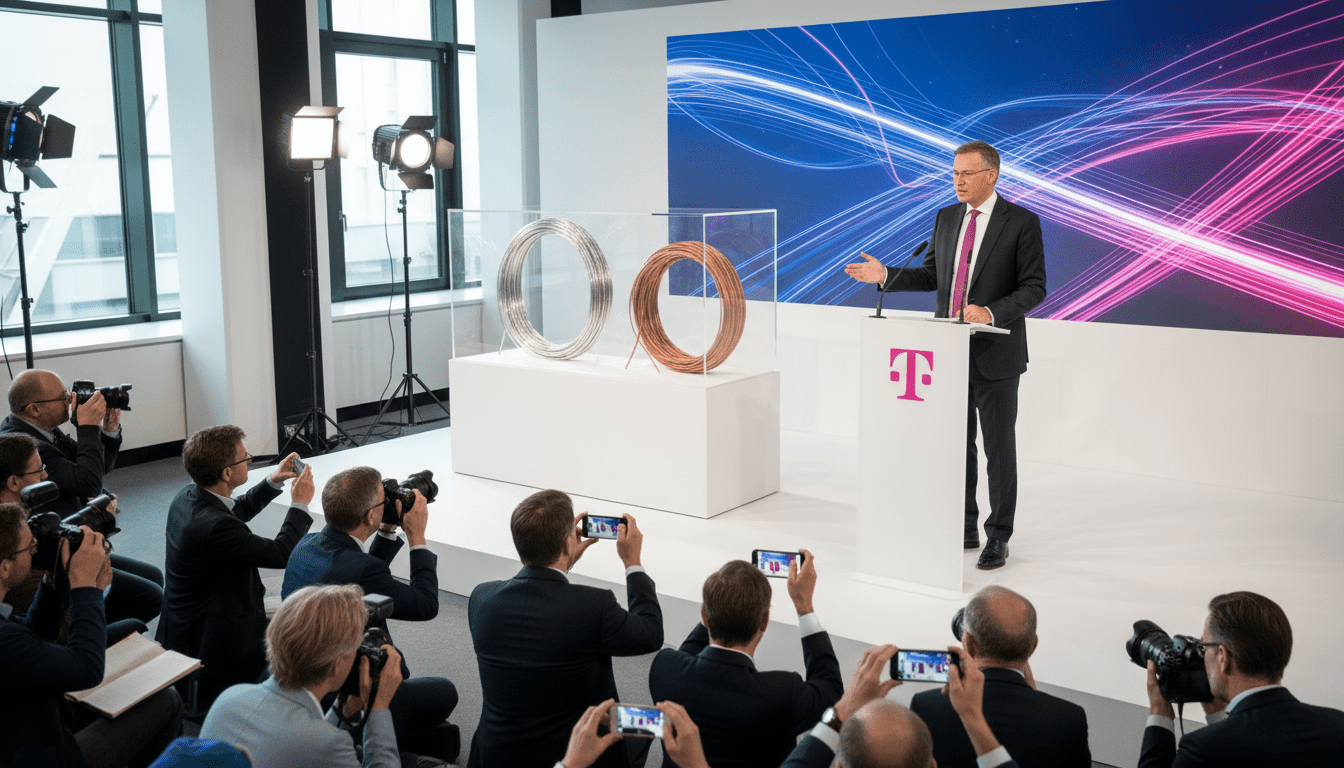
Deutsche Telekom broadband plan champions fiber but keeps copper in the mix
Deutsche Telekom broadband plan presented in a 1949 Darmstadt basement lab stresses phased fiber expansion while defending continued use of copper infrastructure.
The company unveiled its vision for the future of Germany’s internet in an unusually modest setting: a cellar laboratory in western Darmstadt that dates back to 1949. The presentation framed Deutsche Telekom broadband plan around an accelerated fiber rollout paired with pragmatic use of the existing copper network during the transition. Telekom executives argued the approach balances long-term modernisation with service continuity for households and businesses.
Basement lab in Darmstadt sets the scene
The venue for the announcement was a below-ground room beneath an ageing residential block, where meter-long cables in yellow, red and green hung from the ceiling. Fluorescent lighting revealed raw, unplastered walls and an atmosphere more workshop than showroom. Company officials said the setting was chosen deliberately to highlight the technical realities of network upgrades and the layered nature of legacy infrastructure.
Attendees were shown equipment racks and junction points that illustrated how fiber and copper lines currently intersect across local distribution networks. Telekom used the visual contrast to underscore the logistical complexity of replacing copper with fiber on a national scale.
Company frames fiber as long-term objective, copper as pragmatic interim
Telekom’s messaging was clear: fiber-to-the-home remains the superior technology for capacity and future-proofing, but copper still plays a functional role in the present network. Clemens Sieben, a Telekom manager, noted that fiber offers the best platform for rising demand while acknowledging the copper network’s continuing reliability. He argued the operator should not retire copper infrastructure precipitously given its current service value.
The company described its strategy as phased and targeted rather than sweeping and immediate. That stance indicates a hybrid approach where new fiber deployments will be prioritised while copper lines continue to carry significant traffic for the foreseeable future.
Technical and operational challenges outlined
Executives highlighted practical obstacles to a rapid, nationwide fiber rollout, including access to buildings, civil works requirements and the coordination of thousands of local construction projects. They emphasised the need to manage disruptions in dense urban areas and to secure wayleaves and municipal permits for trenching and ducting. Telekom portrayed these constraints as reasons to retain copper lines while fiber build-out proceeds.
The presentation also touched on interoperability and the need to integrate new fiber equipment with existing exchange and customer-premises technology. Engineers in the room pointed to the complexity of upgrading last-mile connections and the value of a staged migration to avoid service gaps.
Market and regulatory implications for German broadband
Telekom positioned its plan against the broader national debate over how quickly Germany should transition to full fiber coverage and who should shoulder the investment. The company acknowledged that regulators, municipalities and competitors will have differing views on timelines and funding models. Telekom urged a pragmatic, technology-neutral regulatory approach to facilitate investments and minimise stranded assets.
Analysts at the briefing said the company expects conversations with local authorities and regulators to shape deployment priorities and subsidy arrangements. Telekom indicated it will seek cooperative models where public funding or shared infrastructure can accelerate fiber access in harder-to-reach areas.
Implications for households and businesses
For residential customers, the company’s stance implies incremental upgrades and continuity of service rather than abrupt migrations or immediate fiber availability everywhere. Telekom suggested that many households will continue to rely on enhanced copper-based services for some time, while those in prioritized zones will see fiber installed sooner. The operator highlighted potential benefits for businesses in sectors that require high-capacity, low-latency links as fiber becomes more widely available.
Customer migration plans will likely factor in service guarantees, bundled offers and technical support to ease transitions. Telekom said it aims to limit disruption for end users while rolling out higher-capacity connections where demand justifies the investment.
Next steps and expected announcements
Telekom signalled that detailed rollout timetables and specific target areas will be published in subsequent communications rather than at the Darmstadt event. The company said it will present phased maps of fiber expansion and outline cooperation frameworks with local governments in the coming months. Executives also indicated that pilot projects and upgrade trials will inform broader deployment choices.
Observers will watch for how Telekom’s plan aligns with national broadband goals and competing proposals from other network operators. The immediate message, however, was one of measured transition: an accelerated push toward fiber accompanied by a prolonged, managed role for copper cabling.
The Deutsche Telekom broadband plan presented in Darmstadt thus frames the company’s strategy as both ambitious and cautious, aiming to scale fiber capacity while preserving day-to-day service through existing lines during a complex nationwide upgrade.
