
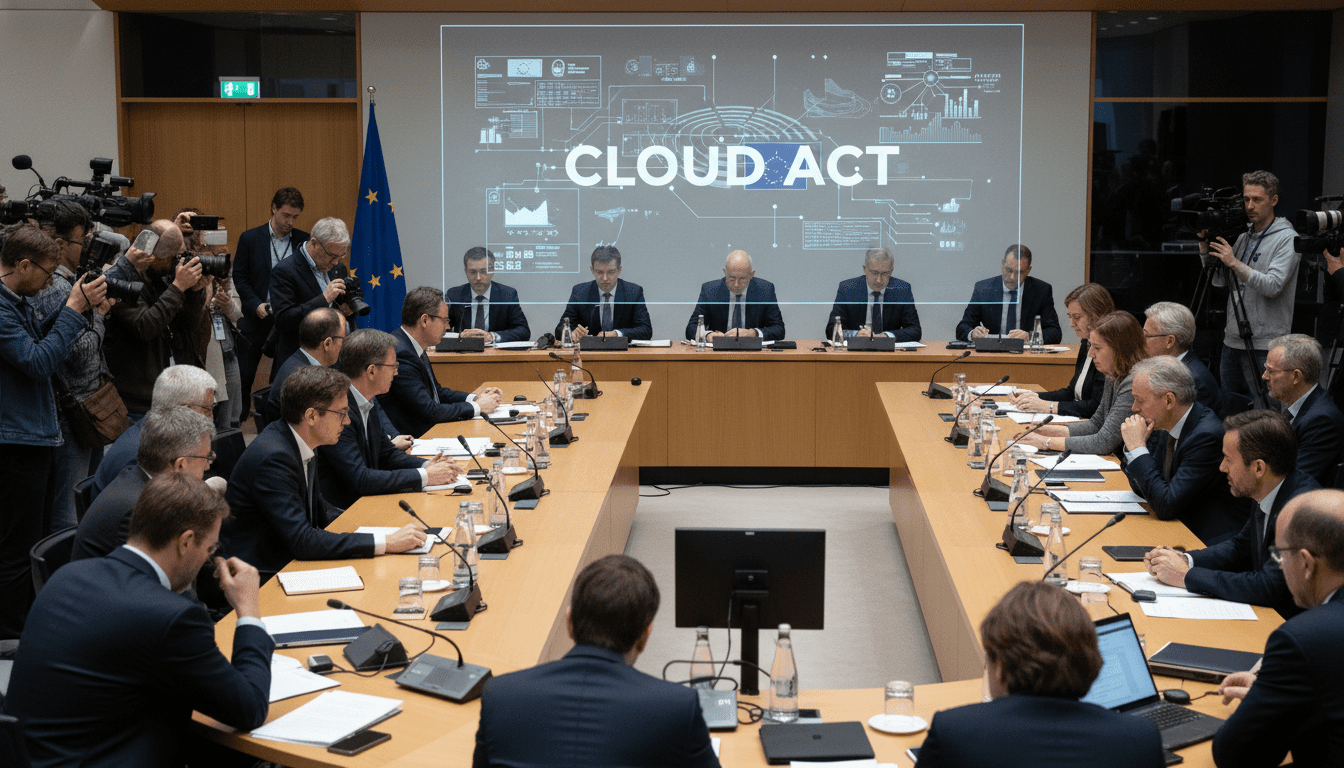
Cloud Act Fuels European Fears Over US Access to Data and Software Updates
European firms warn the US Cloud Act could let American authorities access overseas data and influence software updates, raising legal and security concerns.
Immediate concerns in European businesses
Since the inauguration of President Trump, executives across European corporations and public authorities have grown increasingly worried about the implications of the Cloud Act. The law, they say, creates a pathway for US authorities to seek data stored outside the United States and could force major cloud providers to cooperate. That prospect has intensified anxiety about control over sensitive customer and operational data held by firms such as Google and Amazon.
These concerns are not limited to privacy alone; they extend to business continuity and geopolitical risk. Companies fear that compliance with US orders might clash with European privacy rules and damage trust among customers and partners. For many firms, the possibility that foreign legal demands could reach into their infrastructure has prompted urgent reassessments of cloud strategies.
How the Cloud Act reshapes legal reach
The Cloud Act authorizes US law enforcement to obtain data from service providers under certain conditions, even when the data is stored on servers abroad. Legal experts note this can shorten the path for US agencies seeking access to electronic records without relying solely on slower mutual legal assistance treaties. That combination of extraterritorial reach and mandatory cooperation has caught the attention of international legal teams.
Officials and counsel in Europe argue the mechanism raises conflicts with domestic statutes and constitutional protections in several countries. Companies operating global services face a complex legal calculus: follow a US order and risk breaching local law, or resist and face potential penalties under US jurisdiction. That tension is central to ongoing debates about transatlantic data governance.
Risks to software updates and supply chains
Beyond data retrieval, the debate has expanded to include software updates and maintenance as potential vectors for political leverage. Observers warn that governments could, in theory, use access or influence over vendors to delay, block, or alter updates delivered to devices and systems outside their territory. Such interference could disrupt services, create security gaps, or be used as leverage in diplomatic disputes.
Supply chain specialists emphasize that modern IT ecosystems depend on regular patches and updates from a small set of global providers. Any perceived ability of a state to control or manipulate that flow risks sparking a broader scramble for alternative suppliers and more localized software development. For critical infrastructure operators, the prospect of politicized updates is seen as an unacceptable operational risk.
Corporate compliance dilemmas and reputational stakes
Cloud and software vendors face a dilemma between complying with US legal obligations and protecting customer data under European rules such as the GDPR. Corporate legal teams must weigh the costs of compliance, potential fines, and the long-term reputational damage from either refusing requests or appearing to capitulate. This balancing act has prompted some firms to explore contractual protections and technical workarounds, but those solutions are not universal.
Reputational harm is especially acute for companies that sell trust as part of their value proposition. A single high-profile disclosure or forced cooperation order could lead enterprise and consumer clients to migrate to providers perceived as more sovereign or privacy-preserving. That churn could reshape market dynamics in cloud services and enterprise software across the continent.
Regulatory and political responses in the EU
European regulators and policymakers have not been passive. Data protection authorities, political leaders, and industry groups have called for clearer safeguards and reciprocal legal frameworks that respect national sovereignty and privacy norms. Some EU governments are pushing for stronger contractual terms, greater transparency from providers, and legal mechanisms to challenge extraterritorial orders in court.
Debate in Brussels and national capitals has also included proposals to encourage data localization for particularly sensitive sectors and to foster homegrown cloud alternatives. Lawmakers are weighing whether additional statutory protections, certification schemes, or bilateral agreements with the United States could reduce uncertainty for companies and citizens.
Technical and corporate measures under consideration
In response, firms are pursuing a range of technical and contractual measures aimed at reducing exposure. These include increased use of end-to-end encryption, customer-controlled encryption keys, and architectural changes that minimize the amount of data accessible to providers. Some companies are also negotiating service agreements with explicit clauses about government requests and transparency reporting.
At the same time, corporate leaders are exploring diversification of suppliers and greater investment in European data centers and cloud platforms. Legal teams are preparing litigation strategies and compliance playbooks to respond to conflicting demands efficiently. The combined effect is a cautious shift toward resilience measures that can be implemented without undermining global operations.
Long-term implications for transatlantic digital trade remain uncertain, but the Cloud Act has already forced businesses and regulators to confront hard questions about jurisdiction, trust, and the stability of global software supply chains. The coming months are likely to see intensified legal challenges and policy proposals aimed at reconciling competing legal regimes.
European companies, regulators, and legal advisers now face a choice between relying on technical safeguards and diplomatic negotiation, or accepting continued ambiguity. How they proceed will shape not only commercial cloud contracts but also the broader architecture of digital sovereignty and cross-border technology governance.
