
US States Courting Investors Turn to Creative Incentives Amid Tariffs and ICE Enforcement
US states courting investors at a global trade fair counter tariffs and ICE enforcement with tax breaks, training and creative incentives to reassure capital.
Strong demand, shaky confidence
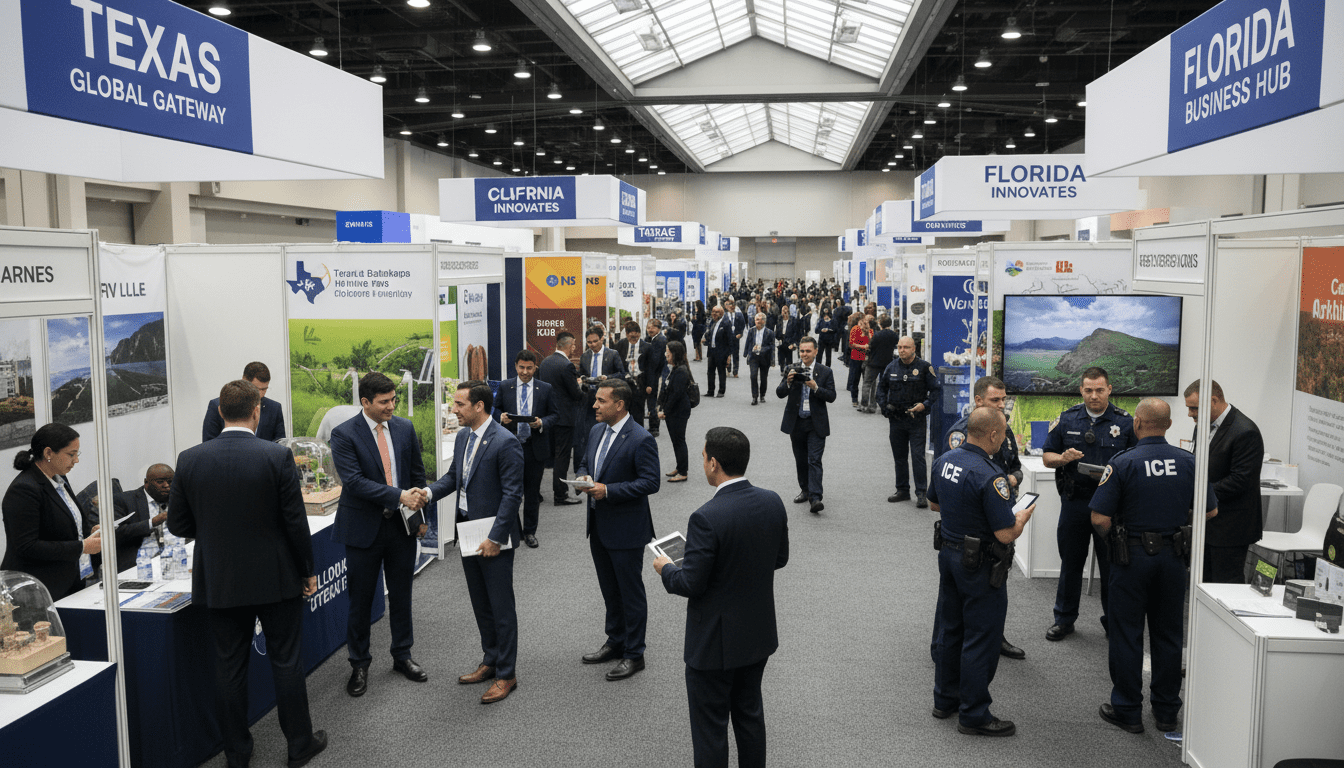
US states courting investors faced an uphill task at an international investment expo this week as delegates worked to reassure global firms unsettled by tariffs, immigration enforcement and political turbulence. State trade missions emphasized stability and opportunity while acknowledging that recent federal policies have complicated pitch narratives. Exhibitors reported smaller, more cautious inquiries from overseas companies than in previous years, with investors seeking concrete guarantees rather than broad promises.
Tariffs and federal enforcement reshape conversations
Conversations on the exhibition floor were frequently steered by concerns over tariffs and high-profile immigration enforcement actions that investors tied to broader regulatory risk. Delegations said prospective partners repeatedly asked about supply-chain costs and the security of cross-border operations under current federal measures. The presence of such questions shifted pitches away from abstract economic statistics toward defensible, contract-level assurances.
Tax credits, streamlined permits and workforce offers
To counterbalance unease, several states revamped their pitch playbooks to foreground tangible incentives. Representatives highlighted targeted tax credits, expedited permitting windows, and customized workforce-training packages designed to lower initial barriers for foreign entrants. Those measures were presented as immediate, verifiable benefits investors could factor into financial models rather than vague long-term prospects.
Soft power tactics and targeted messaging
Beyond fiscal tools, delegations leaned on soft power to rebuild trust, promoting quality-of-life factors, research partnerships and ties with local universities. Marketing materials emphasized regional clusters—advanced manufacturing corridors, renewable-energy hubs and logistics centers—that could offer synergies to incoming firms. Officials also scheduled follow-up meetings aimed at delivering legal and logistical clarity, recognizing that personal relationships remain central to investment decisions.
Regional creativity on the trade-show floor
Some state booths offered unusual demonstrations to stand out: virtual plant tours, hands-on skills workshops and live connections to local economic development agencies. These tactics were designed to shorten the distance between doubt and commitment by letting investors assess operations remotely and verify labor pipelines. Organizers said the most effective delegations combined hard incentives with on-the-ground proof that projects could be launched quickly and compliantly.
Investor reactions and risk calculations
Investor reactions varied by sector and home market; technology and life-sciences companies tended to scrutinize immigration and talent policies more closely, while industrial manufacturers focused on tariff exposure and input costs. Several delegations noted that inquiries often moved into advanced stages only after clear answers on customs, visas and local compliance were provided. Overall, attendees described a more transactional tone at the fair—interested buyers demanding specific protections before advancing.
What states say they will do next
Officials signaled plans to translate expo conversations into policy and procedural changes back home, promising faster response times to inward-investment inquiries and more robust post-sale support. Some states are preparing dedicated investor hotlines and single-point-of-contact teams to reduce friction during due diligence. Others are piloting cross-agency task forces intended to preempt the kinds of enforcement and regulatory surprises that have unsettled foreign capital.
Final decisions by investors will hinge on detailed assurances and measurable cost calculus, and for now many delegations regard the fair as a beginning rather than a close. The combination of tariff anxiety and enforcement headlines has made the global pitch a more granular exercise, forcing US states courting investors to prove that local benefits can outweigh federal uncertainty before capital moves.
