
Bohai Trimet Harzgerode Faces Collapse as Volkswagen Pulls Key Orders
Harzgerode foundry Bohai Trimet Harzgerode faces closure after Volkswagen announced it will move major orders in autumn, threatening more than 1,000 local jobs and the town’s industrial future.
The plant’s insolvency and Volkswagen’s decision have converged to put Bohai Trimet Harzgerode at the centre of an escalating local crisis that residents and officials say could unravel a long industrial tradition. Workers protested this week while regional leaders seek urgent talks with Wolfsburg to salvage a viable rescue plan.
Volkswagen to withdraw key orders
Volkswagen informed the insolvency administrator in recent weeks that it plans to transfer important production contracts away from Harzgerode in the autumn. That supply shift, officials and the administrator say, would render the rescue concept for Bohai Trimet Harzgerode commercially unviable.
Company statements say VW has supported the insolvent supplier with tens of millions of euros since the insolvency filing and remains “in close exchange” as it evaluates operational requirements and stakeholders’ interests. Despite that support, Volkswagen told the administrator it has opened alternative sourcing routes and found no economically sustainable solution tied to the current Harzgerode footprint.
Insolvency proceedings and investor efforts
Bohai Trimet entered insolvency just over a year ago after its Chinese owner filed for proceedings, prompting an emergency effort to find buyers and investors. The insolvency administrator, Olaf Spiekermann of Brinkmann & Partner, says three potential acquirers presented concepts, but all options hinge on continued orders from VW.
Creditors’ committees are expected to decide imminently whether to proceed with an orderly wind-down of production at Harzgerode and the sister plant in Sömmerda, which would affect roughly 100 additional positions. A scheduled creditors’ vote was briefly postponed to allow state leaders time to press Volkswagen for concessions.
Protests and community anger
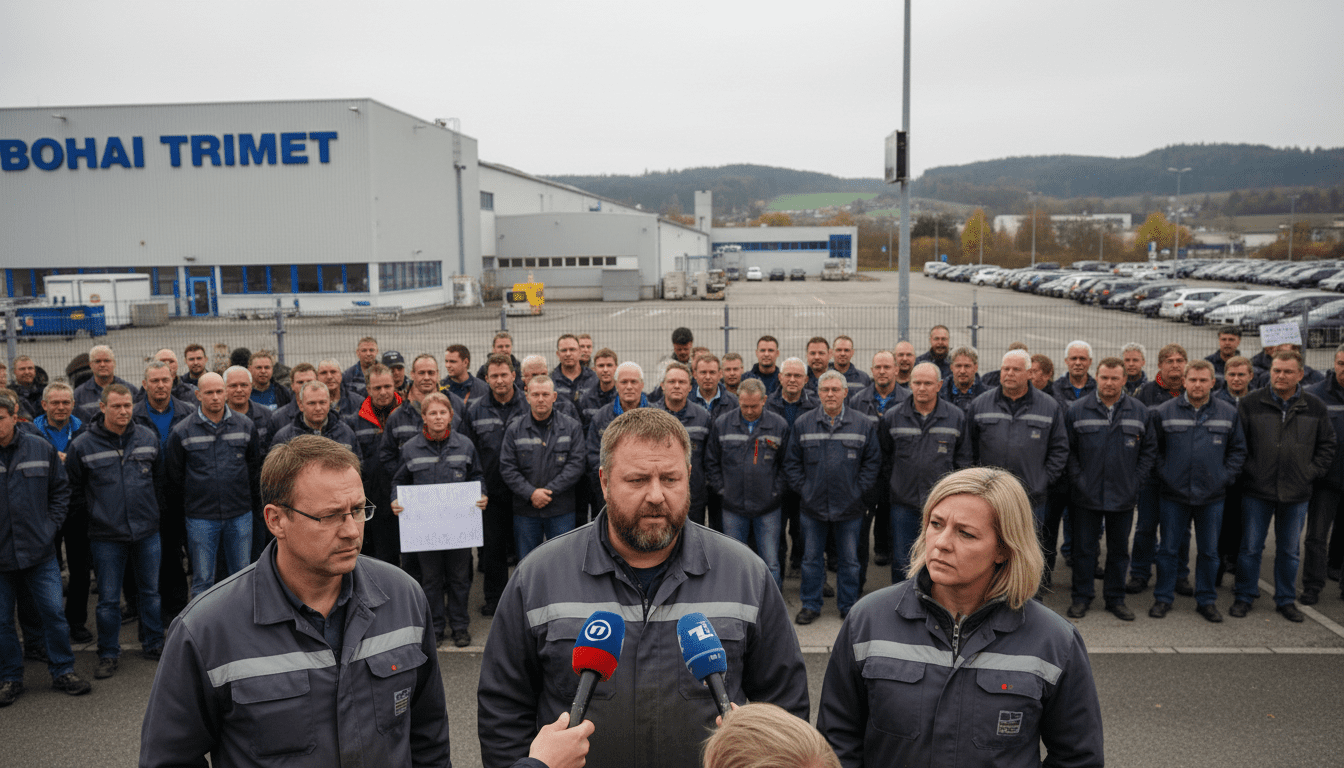
Several hundred employees and supporters gathered at the gates of the industrial park this week in a demonstration organized by IG Metall, conveying a mood of anger and despair. Workers’ representatives read letters from long-serving employees who described the impending loss as a blow to families and a community that has relied on metalworking for generations.
Bohai Trimet staff and union figures accused Volkswagen of abandoning a partner after years of dependence, while company managers warned that production of highly specialised aluminium die-cast components cannot be easily relocated without quality and cost implications.
Local economy and public services at risk
Harzgerode, a town of about 8,000 inhabitants, depends heavily on the cluster of suppliers around the Bohai Trimet site for municipal revenue and employment. Local officials fear that the loss of more than 1,000 jobs would reopen a demographic decline that the town had only recently halted.
The municipal budget is already under pressure; planned projects such as a new community swimming hall face funding gaps if business tax receipts fall. County leader Thomas Balcerowski warned that job losses would ripple through schools, kindergartens and volunteer services, deepening the social and economic impact.
Political stakes ahead of state election
The crisis arrives with the Saxony-Anhalt state election four months away, elevating the issue to a political flashpoint. Regional leaders including Minister-President Sven Schulze have scheduled talks with Volkswagen executives to press for continued commitments to the Harzgerode site.
Polling shows growing support for opposition parties in the region, and local politicians say the factory’s fate could influence voter sentiment by underscoring concerns about employment and regional investment. Officials are seeking immediate reassurances from automakers and potential rescue investors to avert a wider political fallout.
Technical capabilities and supply-chain realities
Bohai Trimet Harzgerode specialises in complex aluminium die-cast parts used in transmissions, chassis and body structures, components that the plant’s managers argue are difficult to replicate elsewhere. About 80 percent of the plant’s revenue has historically depended on Volkswagen, with additional sales to other premium carmakers including Daimler and Ferrari.
Plant leadership stresses that certain structural parts reach economic viability only at high annual volumes typically provided by large automakers. The nearby Trimet smelter supplies liquid aluminium to the presses, underscoring the site’s vertically integrated role in the supply chain and the challenge of maintaining operations without anchor contracts.
Historical roots and community identity
The Harzgerode operation traces its origins to 19th-century metalworking and grew through the twentieth century into a major die-casting centre, including a large state-owned works in the GDR era. The site changed hands after reunification, with Trimet acquiring it in 2001 and a Chinese partner joining in 2018 before a full takeover in 2022.
Employees point to a craftsmanship and institutional knowledge honed over decades as reasons to preserve the plant. Workers and local leaders say losing Bohai Trimet Harzgerode would erase a rare industrial capability from the region and scatter specialised skills that took generations to build.
The coming days will test whether negotiations with Volkswagen and last-minute investor interest can produce a pragmatic path forward, or whether the creditor committees will opt for a controlled closure that many residents fear would mark a long-term decline for Harzgerode.
