
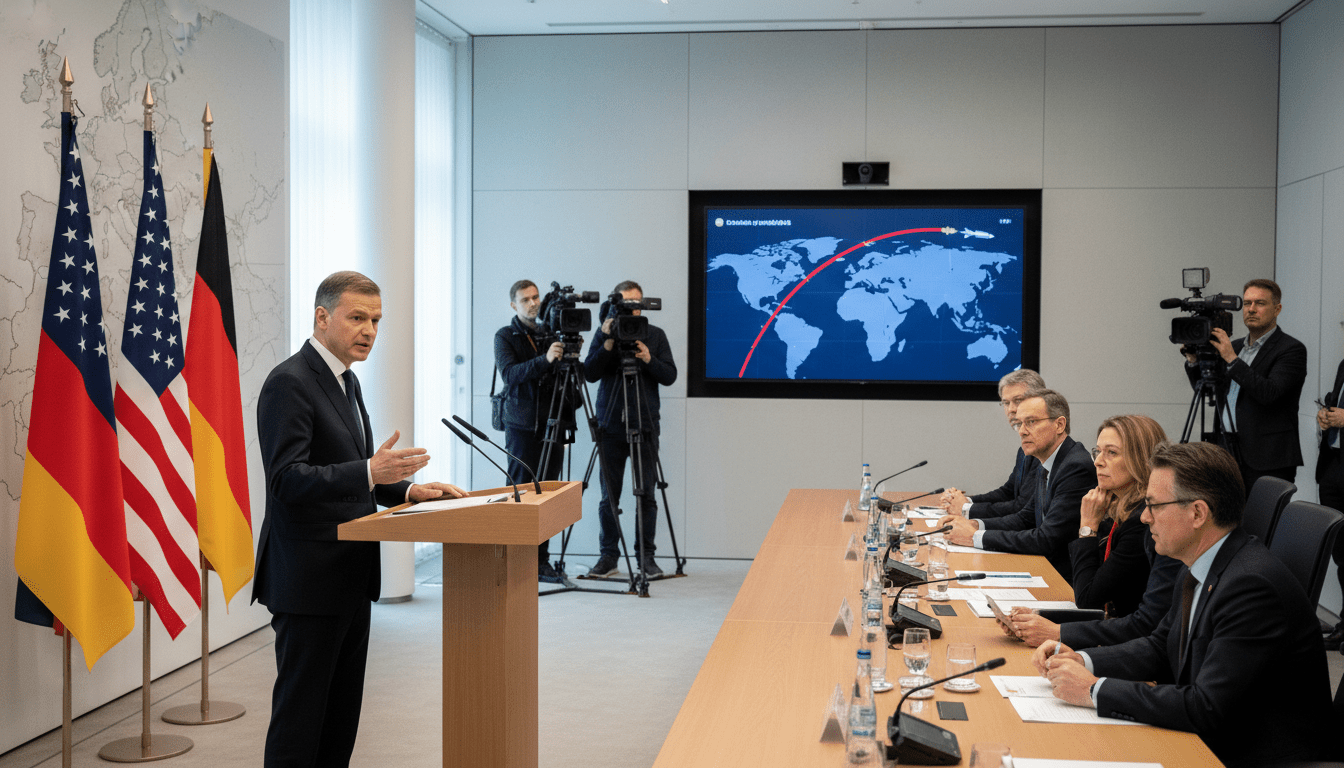
Germany Alarmed as Trump Rejects Tomahawk Missiles Deployment
Germany warns of a widening deterrence gap after the United States declined to station Tomahawk missiles in the country, abandoning a plan seen as a direct counter to Russian Iskander systems in Kaliningrad.
Boris Pistorius, Germany’s defence minister, said the U.S. decision to forgo stationing Tomahawk missiles in Germany makes the country’s deterrence posture “clearly larger” in the wrong direction, underscoring immediate concern in Berlin and across NATO over how to counter long-range Russian capabilities.
Pistorius warns of a larger deterrence gap
Germany’s defence minister framed the U.S. rejection of Tomahawk missiles as more than a political setback; he described it as a substantive weakening of NATO’s forward deterrence in Europe. The government had expected the deployment to be a tangible element of Germany’s response to Russian missile deployments, and officials say the omission will force a reassessment of capability plans.
Officials in Berlin emphasize that the issue is not only about the number of troops or platforms on German soil but about strategic signaling: the presence of long-range conventional strike systems was intended to raise the threshold for aggression by denying adversaries the ability to threaten NATO capitals with impunity.
2024 agreement between Scholz and Biden had set the expectation
The stationing of Tomahawk missiles was first announced in mid‑2024 after German Chancellor Olaf Scholz and then‑U.S. President Joe Biden agreed to the deployment as the first American conventional intermediate-range capability in Germany since the Cold War. That accord became a reference point for defence planners who saw forward-based cruise missiles as a corrective to Russian moves.
German policymakers argue the decision to back away from deployment represents a reversal of a high-profile bilateral commitment and complicates ongoing planning for joint NATO responses to Russian long-range systems.
Tomahawk missiles were pitched as a counter to Iskanders in Kaliningrad
Planners envisioned Tomahawk missiles, with ranges exceeding 1,600 kilometres, as a tool for Deep Precision Strikes against high-value targets should a conflict escalate. The stated logic was that such long-range conventional strike options could blunt the operational effect of Russian Iskander batteries based in Kaliningrad, which can reach Warsaw, Berlin and Copenhagen within minutes.
Proponents have argued that the mere availability of cruise missiles in Europe would create political and military effects beyond their battlefield use, deterring adversaries by threatening the systems that enable attacks, not only their munitions.
Debate over deterrence by denial versus deterrence by punishment
The Tomahawk debate has reopened an older strategic argument between deterrence by denial — investing in defenses that prevent attack success — and deterrence by punishment, which threatens significant retaliatory strike capabilities. Germany’s recent defence investments since 2022 have largely prioritized denial measures, such as enhanced air and missile defenses.
Some analysts contend that denial alone cannot be decisive against massed rocket and drone attacks, because even the most sophisticated layered systems will be overwhelmed by large salvoes. Supporters of strike options argue that the ability to target launchers, command nodes and production sites changes an adversary’s calculus without resorting to nuclear escalation.
Defensive limits and the economic cost of interceptors
The war in Ukraine and the Middle Eastern conflicts since 2023 exposed material and economic limits to air-defence‑centric strategies. Even high-performing systems fail to achieve perfect intercept rates under massed attack, and sustainment is costly: modern interceptor missiles carry multi‑million euro price tags that make large-scale, prolonged defense operations economically unsustainable.
Think tanks such as the International Institute for Strategic Studies and CSIS have highlighted that resupplying expensive interceptors can deplete inventories rapidly, leaving states vulnerable in successive waves. Policymakers in Europe are thus weighing whether investments in long‑range precision strike capabilities could offer a more cost‑effective complement to air defenses.
NATO cohesion and future planning under scrutiny
The U.S. decision not to station Tomahawk missiles in Germany raises questions about burden‑sharing and the alignment of strategic priorities within NATO. Allies will have to decide whether to pursue alternative basing arrangements, accelerate indigenous long‑range strike programs, or double down on cooperative European initiatives for layered defense.
Germany’s recent push on air‑defense initiatives — including procurement efforts and the European Sky Shield concept — will likely continue, but the debate over whether those measures suffice without complementary strike options is expected to shape alliance planning ahead.
The rejection of Tomahawk deployment crystallizes a broader policy choice for Europe: to rely primarily on defensive systems that aim to deny attacks, or to incorporate offensive conventional strike tools that change the balance of deterrence by threatening the means to conduct aggression.
