
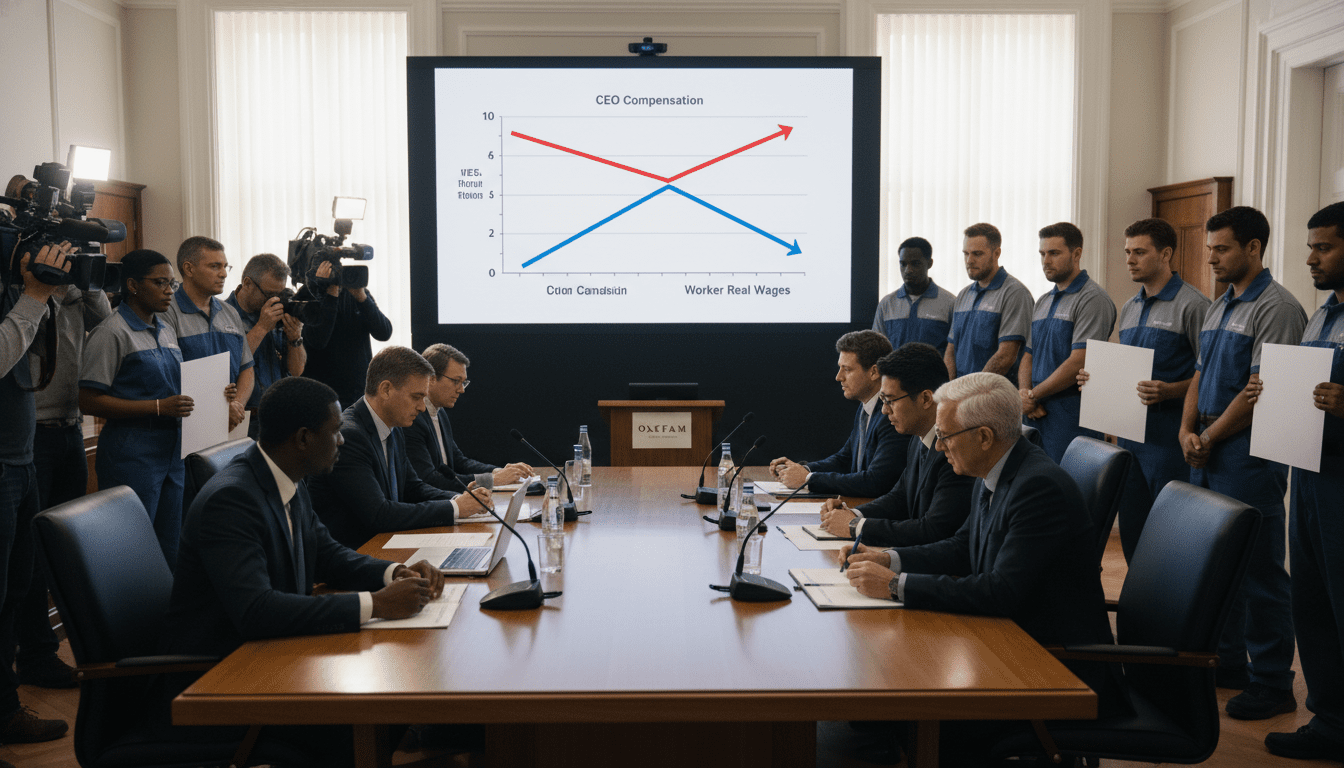
CEO pay gap widens sharply as Oxfam finds executive salaries soared while workers’ real wages fell
Oxfam analysis shows the CEO pay gap intensified since 2019, with global chief executive salaries up sharply while workers’ real wages declined.
The gap between top executives and ordinary workers has widened dramatically since 2019, according to a new analysis by Oxfam that coincides with International Workers’ Day. The report, cited by the development organisation, finds an inflation-adjusted 54 percent rise in average global CEO pay to about $8.4 million, while real wages for employees fell roughly 12 percent over the same period.
Oxfam figures reveal divergent pay trends worldwide
Oxfam’s analysis highlights a striking divergence: corporate leaders have seen large pay increases even as many employees lost purchasing power after the pandemic. The organisation calculated that, inflation-adjusted, the average pay for chief executives globally rose to approximately $8.4 million, an increase it describes as “explosive” compared with falling worker incomes.
The charity links the phenomenon to broader trends in wealth accumulation and calls attention to how compensation structures and market dynamics amplified gains at the top while wages for the majority stagnated or declined.
German executives among the fastest-growing earners
A focused review of 25 chief executives at DAX-40 companies shows the trend is evident in Germany as well. Oxfam reports those examined saw average pay rise 56 percent, from about €4.5 million in 2019 to nearly €7 million in the most recent assessment.
By contrast, the analysis says Germany’s inflations-adjusted wages remain slightly below pre-pandemic levels, underscoring an increasing decoupling between managerial pay and typical worker compensation in Europe’s largest economy.
Billionaire wealth surged to record levels
Oxfam’s findings also underscore a global expansion in billionaire fortunes that accompanied rising executive pay. The organisation estimates that billionaire wealth increased by roughly $4 trillion in the previous 12 months, bringing the total to an estimated $20 trillion worldwide.
That concentration of wealth, Oxfam argues, has important distributional and fiscal implications, because rapid asset gains at the top can deepen inequality and reduce the redistributive capacity of existing tax systems.
Policy prescriptions: higher taxes and a €15 minimum wage
Responding to the findings, Oxfam urged governments to strengthen taxation of the ultra-wealthy, proposing measures such as a global billionaire levy and substantially higher top income tax rates. The organisation also recommended a minimum wage of at least €15 per hour in countries like Germany to protect low- and middle-income workers from further erosion of living standards.
Oxfam frames these recommendations as tools to restore balance between pay at the very top and incomes for the broader workforce, arguing that fiscal policy must be adjusted to prevent inequality from becoming entrenched.
Political reactions and planned tax reforms in Germany
The debate over taxation and redistribution has entered Germany’s political mainstream. Figures from different parties have signalled varying degrees of support for taxing high earners more heavily. The article accompanying Oxfam’s release notes that CSU leader Markus Söder and Chancellor Friedrich Merz have both expressed openness to a higher tax on the wealthy.
On the legislative front, the ruling coalition plans an income tax reform slated for implementation on January 1, 2027, which aims to ease the burden on low and middle incomes. The Social Democratic Party (SPD) has pressed for offsetting measures that would increase the tax load on top earners to finance those reliefs.
Economic and democratic risks of widening pay disparities
Analysts and advocacy groups warn that growing pay disparities carry economic and political risks. When executive pay accelerates far faster than worker earnings, consumption patterns, social cohesion and trust in institutions can be affected, according to those who study inequality dynamics.
Oxfam framed the issue as more than a distributional challenge, saying that “extreme inequality” can pose a threat to democratic stability by disconnecting governing elites from the lived experience of a majority of citizens.
The widening CEO pay gap highlighted by Oxfam’s analysis has intensified calls for policy responses in Germany and beyond, with advocates pushing for both tax changes and stronger wage floors to narrow the divide and protect workers’ purchasing power.
