
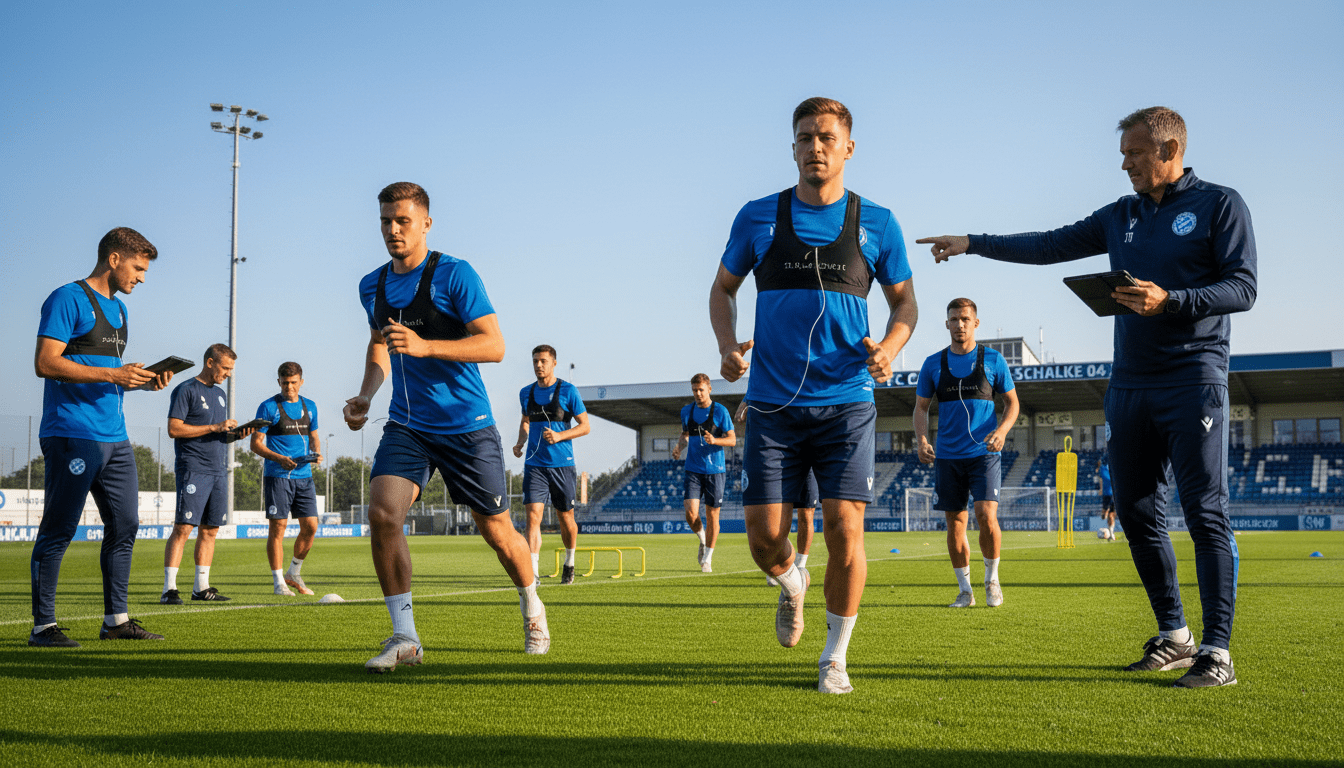
Schalke DNA sensors give FC Schalke 04 a biometric yardstick for intensity and style
Schalke DNA sensors: FC Schalke 04 uses chest-strap monitors to track intensity, sprints and distance, using data to reinforce the club’s playing identity.
FC Schalke 04 has begun deploying Schalke DNA sensors — chest-strap biometric monitors that quantify intensity, sprints and running distance — to measure how closely players adhere to the club’s defined playing identity. The devices are being used as a performance yardstick, aimed at embedding the club’s criteria of intensity, aggression and courage into daily training and match preparation. In a recent fixture against Münster, those numeric benchmarks took a back seat as the opponent’s defensive setup allowed Schalke to play with greater freedom.
Club Fits Players with Biometric Sensors
FC Schalke 04 has equipped first-team players with chest straps that log physiological and movement data during training and matches. These sensors collect metrics the club considers central to its identity: high-intensity runs, sprint frequency and overall running output. The collected data is aggregated to produce measurable indicators aligned with the club’s playing philosophy, often referred to internally as the “Schalke DNA.”
The initiative is positioned as a way to convert qualitative coaching expectations into quantifiable targets. By setting numeric thresholds for intensity and sprinting, the coaching staff can evaluate whether individual performances match the club’s prescribed style across a season.
Club Defines ‘Schalke DNA’ as Intensity, Aggression and Courage
Schalke’s leadership has articulated a set of playing criteria that emphasize aggressive pressing, rapid transitions and a willingness to take risk in possession. The DNA framework is intended to be both a tactical guideline and a cultural marker for players and staff. The biometric monitors are used to translate that framework into measurable performance indicators that can be tracked over time.
Coaches use these measurements not to replace tactical judgment but to supplement it, ensuring players meet physical outputs required by the style. When the data shows consistent adherence, it reinforces selection decisions and training emphases; when it falls short, it prompts targeted work on conditioning or tactical application.
Sensors Track Sprints, Intensity and Run Distance
The chest-strap sensors deployed by Schalke capture bursts of speed, repeated sprint efforts and cumulative running distances, producing a rounded picture of a player’s physical contribution. These metrics allow analysts to quantify how often a player initiates or sustains the kinds of high-intensity actions the club prizes. Aggregated team-level metrics also provide a snapshot of whether a match met the club’s expectations for tempo and aggression.
Technicians and analysts process the raw data into dashboards for coaching meetings, where thresholds for “intensity” are compared with the club’s targets. The approach helps identify which players consistently deliver the physical demands of the system and which require tailored conditioning programs to close gaps.
Münster Match Underscored Data’s Role
In the home fixture against Münster, the numbers showed an unusual pattern: many of the intensity metrics were lower than the club’s typical targets because the opposition adopted a compact, defensive posture. Münster’s decision to withdraw and defend deep reduced opportunities for repeated high-speed transitions, allowing Schalke to play with more ball control and less explosive pressing. On that afternoon, the sensors recorded fewer sprints and lower peak-intensity periods than would be expected in a high-press match.
Team analysts and coaches framed the data from the Münster game not as a failure but as context-dependent information. The readings highlighted how tactical context influences measurable output and reinforced the need to interpret sensor data alongside tactical film and scouting reports.
Coaches Use Metrics to Reinforce Playing Style
Coaching staff say the biometric feed is integrated into broader performance conversations rather than used as an isolated judgment. The data informs session planning, substitution strategy and individualized fitness work, providing concrete targets for players to hit in training. Over time, the staff expect the sensors to help create a more consistent realization of the club’s playing principles across different match situations.
The system also supports player development by offering objective feedback. Younger players and recent signings receive clear benchmarks for the physical demands expected of them in Schalke’s setup, shortening the adaptation curve and aiding selection transparency.
Club Balances Data Use with Practical Limits
Club officials stress that biometric measurement is a tool, not a mandate, and that tactical nuance must guide interpretation. Matches vary widely in tempo depending on the opponent and in-game developments, so data is always considered in context. There are also operational limits: sensors can miss context such as positional nuance, psychological factors and match-specific instructions that alter physical outputs.
Beyond coaching, the rollout raises questions about data governance and player consent. Schalke has signalled it will manage the biometric information internally and use aggregated measures where possible to protect individual privacy while extracting team-level insights.
FC Schalke 04’s experiment with Schalke DNA sensors illustrates a broader trend in modern football where clubs seek to codify identity through measurable criteria. The chest-strap monitors produce numbers that allow staff to compare intention and execution across players and games, and the Münster fixture was a reminder that numbers must be read alongside tactics. As the season progresses, Schalke will accumulate a larger dataset that the club expects to use to refine training, selection and the practical expression of its defined playing identity.
