
Klingbeil budget 2027 draws fire as Germany’s borrowing nears €200 billion
Lars Klingbeil’s budget 2027 blueprint is criticized for soaring borrowing, rising debt service and fiscal gaps projected to reach about €60 billion by 2030.
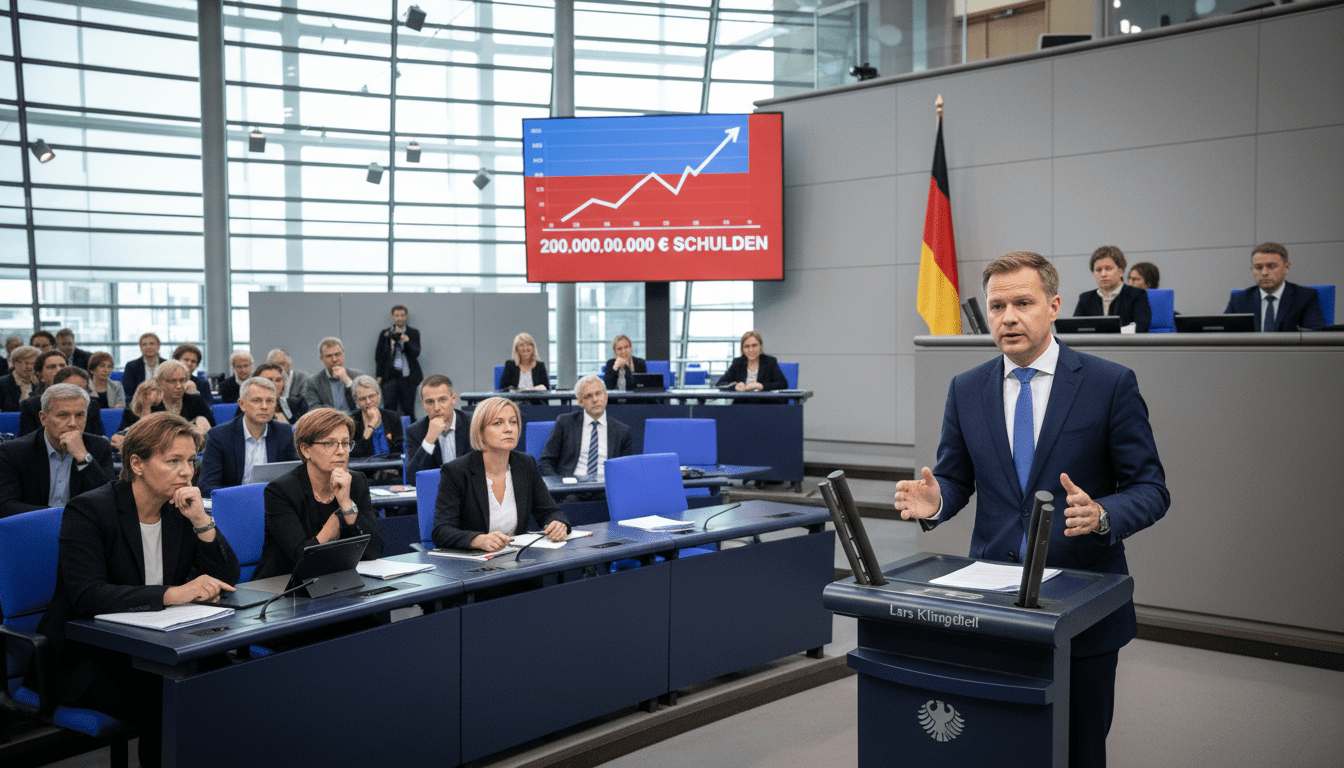
Germany’s finance minister, Lars Klingbeil, has presented a budget framework for 2027 that critics say leans heavily on fresh borrowing while leaving large parts of the medium-term fiscal plan unresolved. The so-called Klingbeil budget 2027 projects annual new federal borrowing on the order of €200 billion and relies on a still-undefined “global position” to close next year’s gap. Opposition voices and some fiscal analysts warn the package swaps short-term fixes for long-term fiscal strain.
Budget blueprint projects near-€200 billion annual borrowing
The draft framework indicates that new federal debt will climb significantly as the government funds security needs and a wave of investment projects. Much of the 2027 burden is expected to be financed through borrowing rather than immediate tax increases or spending cuts.
Finance ministry documents and commentary note that the scale of planned new debt creates a larger future interest bill, compounding fiscal pressure in subsequent years. The reliance on credit raises questions about how spending will be balanced against the constitutionally enshrined debt brake.
Defense spending lifts urgency but raises debt service
Klingbeil’s proposal acknowledges the need to rebuild Germany’s defense capabilities in response to Russia’s war in Ukraine, a step broadly endorsed across the political spectrum. Defense outlays are a significant driver of near-term borrowing, though only a fraction of weapons procurement counts toward the debt brake itself.
That distinction, however, does not prevent the overall increase in debt service costs. Estimates show interest payments on federal debt rising from roughly €34 billion today to about €84 billion by 2030, a jump that will crowd out other budget priorities if it materializes.
Medium-term fiscal gaps widen after 2027
Even with planned measures, the framework leaves sizeable shortfalls in later years: a gap of about €29 billion in 2028 that swells toward roughly €60 billion by the end of the decade. Officials have flagged those numbers as evidence that further adjustments will be necessary to avoid an unsustainable trajectory.
Klingbeil has said he aims to resolve immediate uncertainties before the next fiscal year, but his calculations depend on a €20 billion unspecified line item that has yet to be defined. That vagueness has intensified calls for clearer policy choices and concrete revenue measures.
Investments taper while entitlement costs rise
The finance plan allocates elevated investment spending—about €120 billion annually—through 2029, meeting one of Klingbeil’s stated ambitions to act like an “investment minister.” After that period, projected investment levels drop by approximately €10 billion, a reduction that prompts concern among proponents of sustained public capital spending.
At the same time, transfers to the pension system and other entitlements are set to climb, with pension-related outflows growing toward the €160 billion range. The divergence between falling investment and rising social spending presents a long-term policy trade-off for the coalition.
Tax and levies package seen as incremental and redistributive
The budgetary response includes a mix of tax adjustments and new levies intended to raise revenue without breaching political red lines. Klingbeil’s plan proposes a revenue-neutral reshaping of income tax, higher contributions to health insurance for middle earners and employers, and targeted levies on sugar, plastics, alcohol, tobacco and crypto transactions.
Critics argue those measures amount to redistributive tinkering rather than a coherent growth strategy. They warn that increasing the tax and contribution burden risks reducing private-sector resources at a time when the economy needs investment and productivity gains to support future social spending.
Coalition politics leave key choices unresolved
The budget exposes tensions within the governing coalition over priorities between social spending, investment and fiscal restraint. Parties backing the government have pressed for new social measures, while others advocate for stronger incentives for growth and clearer steps to rein in borrowing.
Negotiations in the coming months will determine whether the €20 billion “global position” is defined, whether further tax measures are introduced, and how the debt trajectory is adjusted. Lawmakers face a narrowing window to produce legally sound and politically sustainable choices before the next fiscal year.
Germany’s finance debate now focuses on whether short-term borrowing can be translated into long-term capacity without triggering an unsustainable rise in interest costs. The Klingbeil budget 2027 has opened that debate in stark terms, leaving policymakers to reconcile immediate security demands with the discipline required for stable public finances.
