
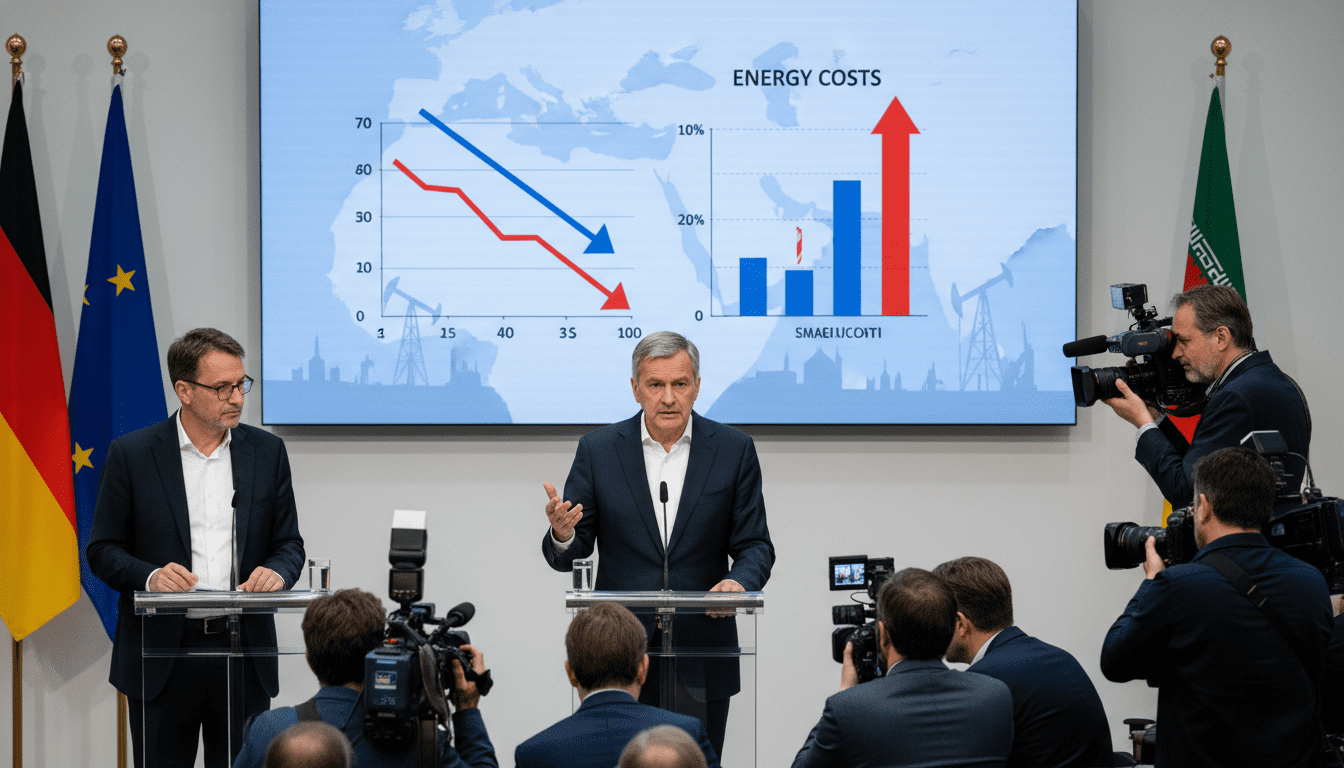
German economy’s recovery cools as DIW barometer flags Iran conflict impact
German economy shows only a slight April rise in DIW barometer; energy costs and uncertainty from the Iran war weigh on growth prospects.
The German economy’s recent upward trend has lost momentum as the DIW Konjunkturbarometer registered only a modest increase in April, leaving the indicator below its four‑year high reached in February. The German Institute for Economic Research (DIW) said the geopolitical escalation following the Iran conflict that began on February 28, 2026, has pushed oil and gas prices higher, increasing costs for firms and households. While the barometer remains above last year’s readings, DIW analysts warned that rising energy prices and elevated uncertainty are likely to temper the nascent recovery.
DIW barometer posts modest April gain
The DIW reported a slight uptick in its monthly economic barometer in April but emphasized the improvement was limited compared with the peak in February. The index continues to outpace levels from the previous year, indicating that the economy retains some underlying resilience. Nevertheless, the institute framed the increase as fragile given the new geopolitical headwinds.
Energy price surge follows Iran conflict
The onset of the Iran war has driven oil and gas markets upward, a development the DIW links directly to rising headline inflation and higher input costs for businesses. Those cost pressures are filtering through to producer prices, squeezing profit margins and complicating pricing decisions. The institute also highlighted the risk of renewed disruptions to global supply chains, which would further impair trade and industrial activity.
Manufacturing sentiment and investment intentions soften
DIW analysts noted that the mood in Germany’s manufacturing sector has deteriorated amid the heightened risk environment. Companies are showing less willingness to invest, citing greater uncertainty over energy prices and geopolitical developments that complicate planning horizons. That weakened investment appetite threatens to blunt the industrial rebound that had been supporting the broader economy.
Special government funds provide partial support
The institute acknowledged that government spending on defence, infrastructure and the climate transition is offering a stabilizing effect on demand. Special budgetary measures introduced to bolster investment are helping to offset some private‑sector weakness. However, DIW stressed that these fiscal buffers are being partially offset by the external shocks now hitting energy and trade, limiting their overall impact on growth.
Household purchasing power and services sector strain
Rising prices and mounting uncertainty are cooling consumer confidence, the DIW said, with households tightening spending as real incomes come under pressure. That dampening of consumption is already showing through in the services sector, where firms report weaker demand and more cautious expectations. A sustained squeeze on household purchasing power would curb one of the central pillars of the German economy’s recovery.
External trade and supply‑chain risks intensify
The institute pointed to weaker global demand and heightened risks for international supply chains as additional headwinds for Germany’s export‑oriented economy. Elevated transport and input costs can erode competitiveness and slow order books for exporters. DIW analysts warned that prolonged disruption abroad would amplify the slowdown and could feed back into domestic investment and employment decisions.
Near‑term projections hinge on how long energy costs remain elevated and whether geopolitical tensions escalate further or ease. DIW’s assessment suggests that while policy measures and solid fundamentals provide some protection, the outlook has become more uncertain and asymmetric. Continued monitoring of commodity markets, trade flows and business sentiment will be crucial for gauging the durability of the recovery.
The German economy faces a delicate balance: fiscal support and remaining domestic strengths offer a buffer, but the spike in energy prices and greater global uncertainty pose real risks to growth. Policymakers and firms will need to navigate this volatile environment carefully to preserve the gains seen earlier this year.
