
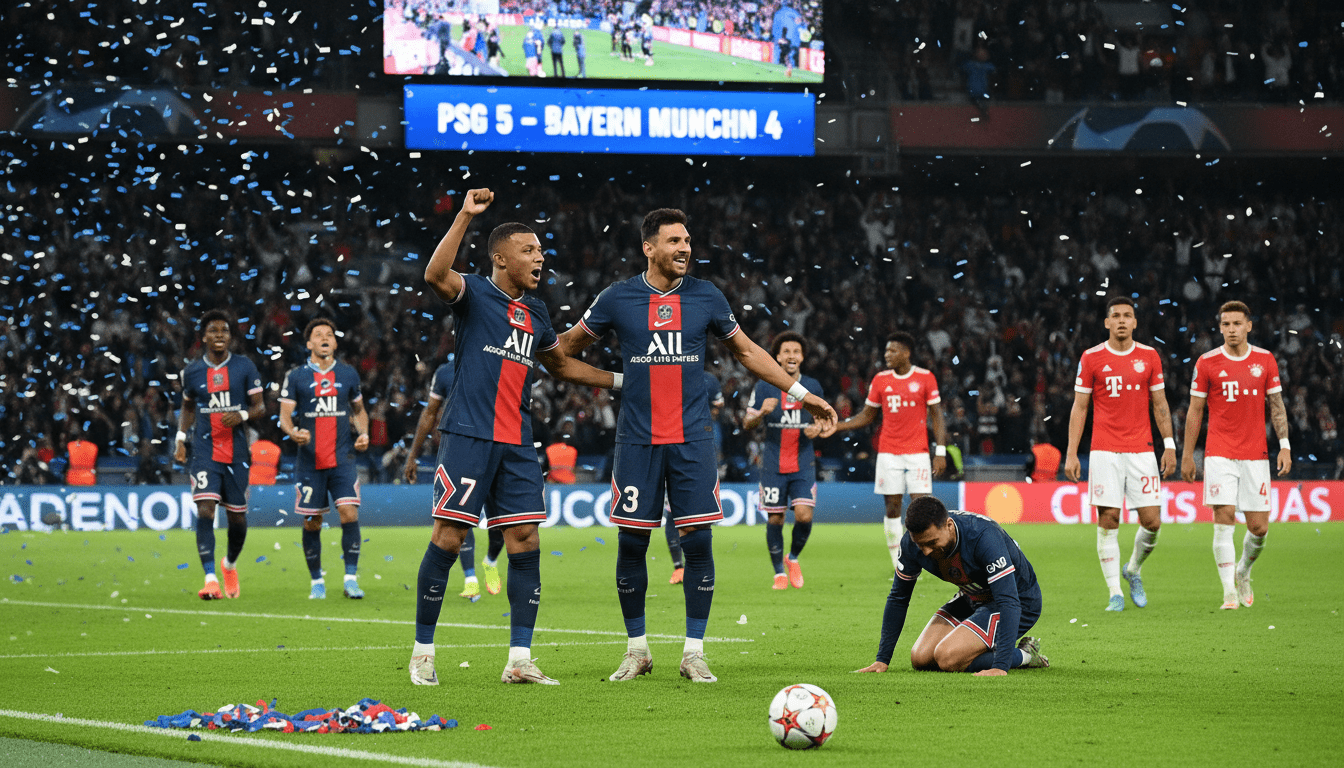
PSG vs Bayern 5-4: Parc des Princes erupts in nine-goal Champions League semi-final thriller
PSG vs Bayern ended 5-4 in a breathless Champions League semi-final first leg at Parc des Princes, a night defined by pace, tactical duels, and nine spectacular goals.
Parc des Princes delivers a nine-goal spectacle
Paris Saint-Germain edged Bayern Munich 5-4 in the first leg of their Champions League semi-final at Parc des Princes, producing a forward-heavy display that thrilled the stadium. The match unfolded as a relentless sequence of attacks and counterattacks that left defenders chasing sprint after sprint. With nine goals shared across both sides, the fixture stood out for its extraordinary intensity and entertainment value.
Speed dominated every duel
From the opening minutes the contest was decided by pace rather than positional finesse, with full-backs and wingers repeatedly outpacing opponents. Alphonso Davies, Achraf Hakimi and Nuno Mendes exemplified why speed has become an indispensable asset at the highest level. That raw acceleration repeatedly created overloads down the flanks and turned half-chances into clear opportunities within seconds.
Key moments and the goal sequence
Harry Kane’s early penalty gave Bayern a 1-0 lead after a foul on Luis Díaz, but PSG answered through Khvicha Kvaratskhelia to level. Michael Olise and Ousmane Dembélé added further clinical strikes to put PSG ahead 3-2 at halftime and then 5-2 after the interval. Bayern mounted a late recovery through Dayot Upamecano and Díaz to make it 5-4, leaving the tie finely balanced ahead of the return leg.
Tactical clash between Luis Enrique and Vincent Kompany
The match presented a clear contrast in approach from the two managers: Luis Enrique’s side committed to vertical speed and high pressing, while Vincent Kompany’s Bayern sought structural balance and moments of controlled build-up. Kompany defended the legitimacy of different philosophies, noting that teams and fans embrace varied styles. The encounter felt less like a debate over a single “correct” method and more like an experiment in which velocity has become a decisive variable.
Individual performances that shaped the night
PSG’s front line combined blistering sprints with technical sharpness; Dembélé, Kvaratskhelia and Olise repeatedly punished space in behind. Bayern’s Harry Kane remained ruthlessly effective from the spot, while Luis Díaz provided sustained threat with both pace and craft. Defensively, Marquinhos offered leadership and intervention, but even his presence could not fully stem PSG’s high-octane attacks on the night.
Standout patterns and tactical lessons
The game underlined a broader trend: elite teams are prioritizing attacking tempo to unsettle opposition defenses and force rapid decision-making. Wide players and quick full-backs created numerical advantages that finite defensive structures struggled to contain. The match suggested that a perfect defensive setup is vulnerable when opponents combine speed with precise transitions and direct finishing.
Implications for the tie and the season ahead
With PSG holding a one-goal aggregate advantage, the return leg promises another tactical chess match with more emphasis on tempo control and defensive adjustments. Bayern will need to manage the wide spaces that PSG exploited and find ways to neutralize quick exchanges. For PSG, the result reinforces confidence in a strategy that pairs explosive wing play with incisive finishing.
The first leg at Parc des Princes offered a dramatic case study in how speed reshapes modern elite football, leaving both clubs to recalibrate ahead of the deciding match.
