
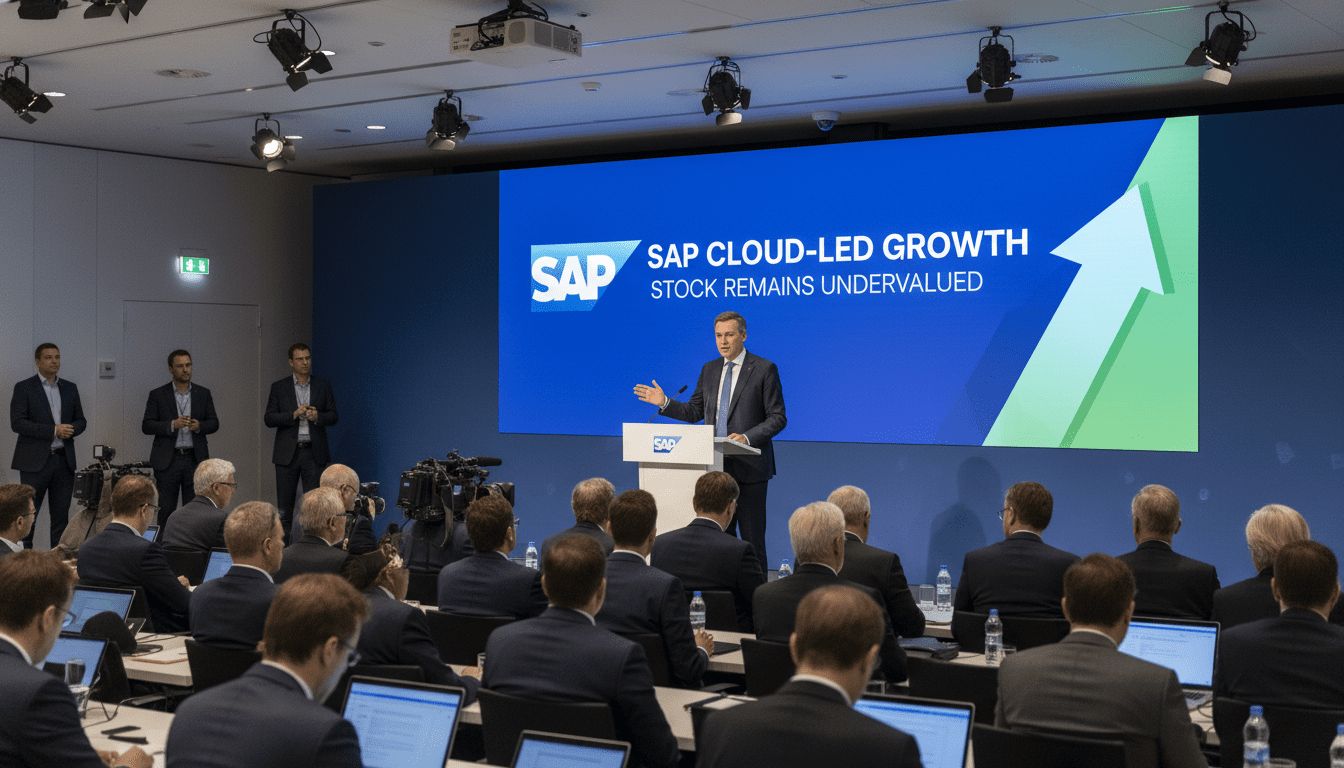
Analysts Say SAP Stock Is Undervalued as AI Fears Prove Overstated
Bank analysts say SAP stock is undervalued after robust quarterly results: cloud revenue rose ~25% and nearly €2bn profit tempers AI-related market fears.
SAP stock surged on the back of quarterly figures that, analysts say, reinforce the company’s resilience in a shifting technology landscape. Bank analysts’ average price targets sit well above current levels, signaling a valuation gap that investors are watching closely. The company reported currency-adjusted cloud revenue and cloud order intake growth of about 25% year-on-year and nearly €2 billion in profit for the quarter. Market reactions were volatile, but the underlying message from the results was that SAP’s core enterprise franchise remains intact.
Analysts’ Average Targets Signal Undervaluation
Bank analysts, largely in unison, rate SAP as undervalued relative to those recent targets and the company’s fundamentals. Their consensus outlook places the stock noticeably above the prevailing market price, reflecting expectations for continued cloud expansion and margin recovery. This collective view has not fully translated into share-price gains because investors remain cautious about the speed and scale of AI disruption in enterprise software. Still, the analyst community’s confidence provides a counterweight to the market’s short-term nervousness.
Quarterly Results Show Cloud Momentum
SAP’s quarterly report offered concrete evidence of cloud momentum, with cloud revenue and cloud order intake both rising about a quarter year-on-year on a currency-adjusted basis. Those growth rates far outpace many traditional industrial peers and underscore the company’s transition toward subscription and recurring revenue models. Management framed the results as validation of its cloud-first strategy and argued the business continues to scale without obvious signs of a near-term slowdown. The numbers gave investors a tangible basis to reassess growth expectations for the coming quarters.
AI Concerns Drive Market Volatility
Despite the upbeat metrics, fears about an “AI apocalypse” for established software vendors have amplified market swings and pressured valuations across the sector. Investors worry that large language models and new AI platforms could displace parts of the conventional enterprise-software stack, eroding margins and long-term relevance. SAP’s stock has experienced pronounced volatility, including a roughly one-third decline over the past year, as traders reassess risk and opportunity amid this technological shift. The company’s quarterly beat prompted a rebound, but the underlying unease about AI’s effects on incumbents persists.
SAP’s Data Advantage Seen as Competitive Moat
Analysts and company leaders point to SAP’s data assets and domain expertise as a structural advantage against AI-driven disruption. The firm controls extensive customer data sets, long-standing transaction histories, and deep models of complex business processes that AI systems must learn to operate effectively. That data quality, along with industry-specific workflow knowledge, is touted as a moat that is difficult for newer entrants to replicate quickly. For many analysts, those strengths make SAP more likely to adapt productively to AI integration rather than be displaced by it.
Profitability and Cash Position Strengthen Defense
Net income approaching €2 billion in a single quarter demonstrates that SAP’s cash generation remains robust even during a period of strategic transition. The company’s balance sheet and recurring revenue streams provide flexibility to invest in AI, cloud infrastructure, and potential consolidation moves in the sector. Executives presented the results as evidence that SAP can navigate an industry consolidation phase from a position of financial strength. Market participants note that durable profitability reduces the risk of short-term distress and supports longer-term strategic options.
Market Leadership Shifts as Share Price Falls
SAP no longer holds the title of Germany’s most valuable listed company after its share price retreated, with Siemens surpassing it in market capitalization amid the recent decline. The drop reflects both sector-wide concerns about technology incumbents and company-specific reassessments related to AI and growth pacing. Still, losing the top spot on market-cap lists does not change SAP’s operational scale: it remains the world’s largest maker of enterprise resource planning software with deep penetration across finance, supply chain, and customer management functions. Observers see the change in ranking as a reminder of how sentiment can alter perceptions of market leadership quickly.
Industry analysts caution that the path forward will depend on execution as much as on strategic vision. SAP must demonstrate that it can integrate AI capabilities into its product suite in ways that enhance customer value while preserving data governance and transaction integrity. Investors will also watch whether management can translate cloud momentum into sustained margin improvement and predictable recurring revenue growth.
In the near term, SAP stock will likely be driven by a mix of quarterly performance, signs of AI productization within enterprise suites, and broader market appetite for technology names. The recent quarter gave the company tangible evidence to counter the most dire narratives, but the transition to AI-enhanced enterprise software remains a work in progress.
