
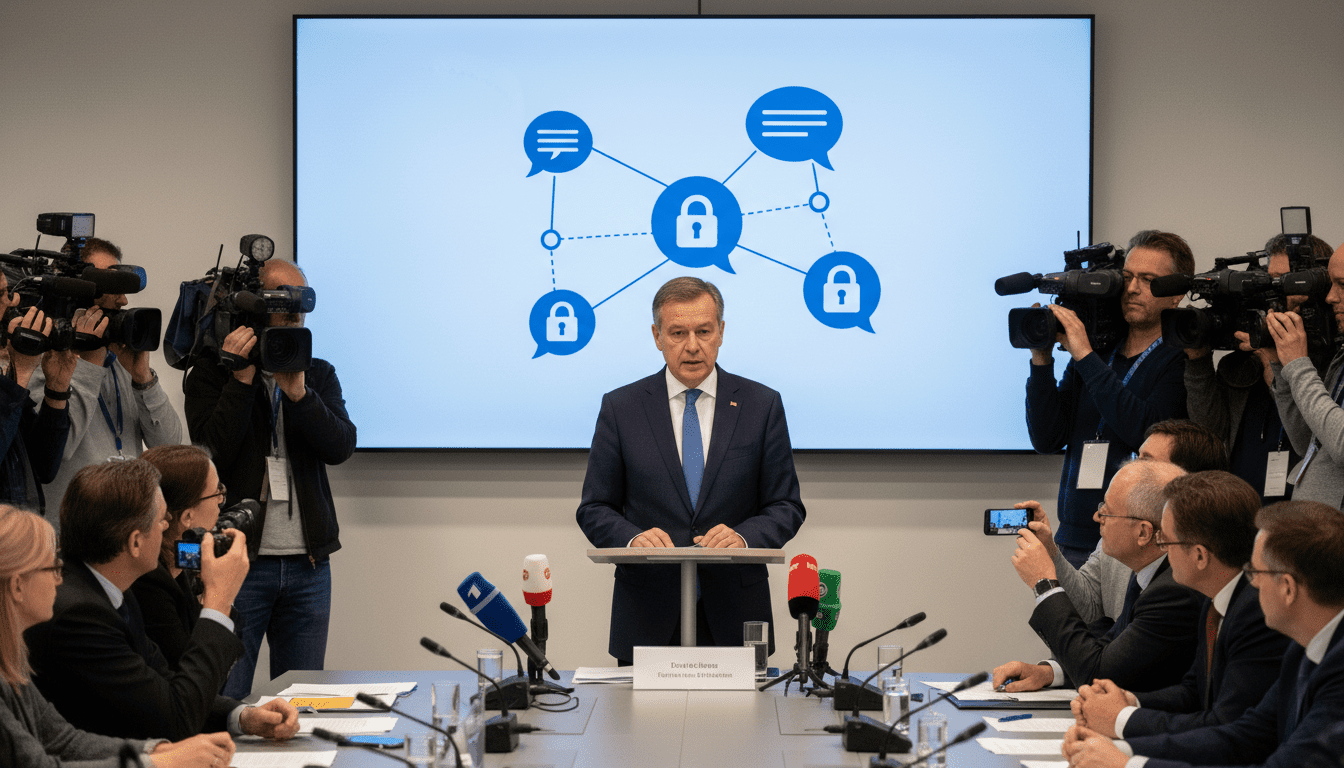
German Espionage Attack on Politicians’ Chats Sparks Federal Probe
A federal investigation has been launched into an alleged espionage attack on politicians’ chats, prompting urgent inquiries by the Generalbundesanwalt and sparking debates over security and accountability. The espionage attack on politicians’ chats is the headline issue this Friday evening, alongside the government’s approval of a fuel discount and the unveiling of advanced battery technology at the Beijing motor show. Political leaders, law enforcement and industry representatives are responding as authorities work to establish the facts.
Federal Prosecutor Opens Espionage Probe
The Federal Public Prosecutor’s office confirmed it has opened formal investigations after reports of unauthorized access to private messaging channels used by elected officials. Prosecutors said the inquiry will examine whether criminal offenses under espionage and data protection laws occurred and identify any perpetrators or foreign influence.
Investigators are reportedly prioritizing forensic analysis of affected devices and server logs, while seeking cooperation from telecommunication providers and cybersecurity agencies. Officials have not yet disclosed the identities of targeted politicians or the full technical scope of the intrusion.
Alleged Targets and Scale of the Breach
Sources indicate that the compromised conversations included both local and national-level figures, raising concerns about the potential misuse of sensitive deliberations. The breach appears to have focused on chat platforms popular among political circles, though authorities have not confirmed the specific services involved.
Security analysts warn that even limited leaks from closed channels can have outsized political consequences, influencing public debate and eroding trust in digital communications. The prosecutor’s office is expected to issue updates as investigative milestones are reached and legal thresholds for charges are evaluated.
Government Approves Fuel Discount ‘Tankrabatt’
In parallel to the probe, the federal cabinet approved a temporary fuel discount — widely referred to as the “Tankrabatt” — aimed at reducing pump prices for consumers. The measure will lower fuel levies for a defined period, according to government statements, with the objective of easing household and transport-sector costs amid inflationary pressures.
Finance and transport ministries will now outline implementation details, including the duration of the discount, eligible fuel types and mechanisms to ensure rapid pass-through to motorists. Lawmakers from across the political spectrum have signaled both support for targeted relief and concerns about long-term fiscal impacts.
Political Response and Fiscal Questions
Opposition parties criticized the Tankrabatt for favoring drivers over other households and for its potential to blunt incentives for energy efficiency. Some lawmakers have called for complementary measures to help low-income families and public transport users who do not benefit directly from lower fuel prices.
Budget analysts caution that subsidising fuel at the pump can be costly and may complicate climate policy objectives unless carefully designed with sunset clauses and compensatory green measures. The government faces the challenge of balancing short-term relief with longer-term commitments to emissions reduction and fiscal prudence.
Beijing Motor Show Highlights High-Energy ‘Wonder Batteries’
Meanwhile at the Beijing motor show, manufacturers showcased new battery chemistries and prototypes billed as “wonder batteries” for electric vehicles, claiming higher energy density and faster charging. Exhibitors emphasized breakthroughs in cell design and materials that could extend EV range and reduce dependence on rare components.
Industry experts applauded incremental advances but urged caution about commercial readiness, noting that laboratory performance does not always translate immediately into mass-production reliability. Automakers attending the show underscored the strategic race over battery innovation and the implications for global supply chains.
Connections Between Cybersecurity, Energy Policy and Industry Trends
Observers say the three developments — the espionage probe, the Tankrabatt and advances in battery technology — reflect intersecting pressures on security, economic policy and technology transitions. The intrusion into politicians’ chats has renewed calls for hardened communications protocols at the highest levels of government, while the Tankrabatt highlights immediate economic stresses shaping policy choices.
At the same time, the push for improved battery technology underscores how energy innovation remains central to industrial competitiveness and climate goals. Policymakers now face a complex calculus: addressing short-term cost-of-living concerns, safeguarding sensitive information, and supporting technological shifts that will reshape transport and energy systems.
The coming days are likely to produce further detail as prosecutors reveal investigative findings, ministers publish the Tankrabatt’s implementation plan, and manufacturers provide technical documentation for new battery claims. Each development will be watched closely for its legal, political and economic consequences.
