
California startup pitches a “space cannon” to launch small satellites from a 10-km tube
Mike Grace’s Longshot unveils a ‘space cannon’ – a 10-km launch tube to send small satellites and station cargo into orbit, drawing military interest.
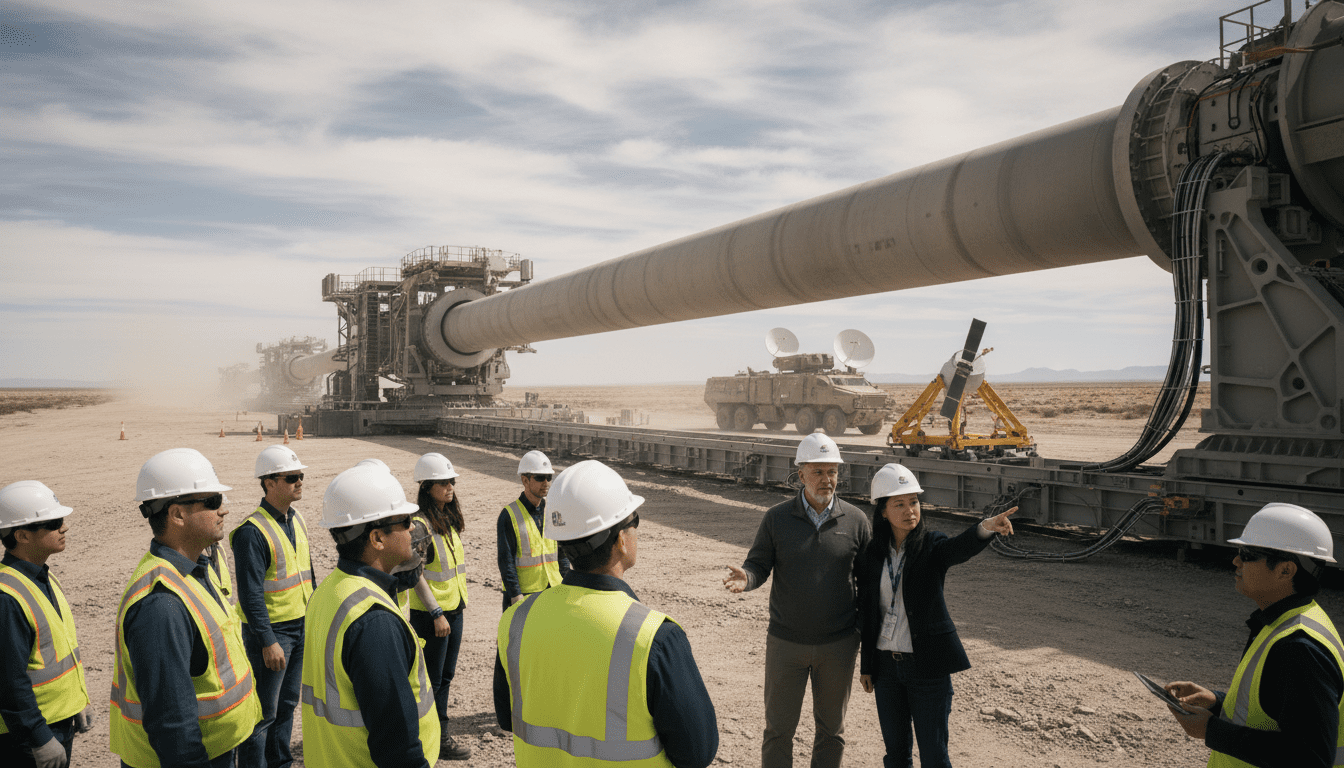
Mike Grace, a California entrepreneur, is proposing a “space cannon” concept that would accelerate small satellites and station supplies through a horizontal tube instead of using conventional rockets. The plan centers on a ten‑kilometre acceleration tube and seeks a roughly 200‑kilometre safety corridor where no people would be endangered by projected flight paths. Longshot Space Technologies, Grace’s startup, says the system could cut launch costs for specific small payloads, though key technical and regulatory questions remain.
Design and operational concept
Longshot’s proposal calls for a long, sealed acceleration tube stretching horizontally over desert or coastal terrain, in which a capped payload would be accelerated to multiple times the speed of sound. After exit from the tube the vehicle would climb and separate from its cap, using its own small propulsion or aerodynamic lift to reach orbital insertion for low‑mass payloads.
The company envisions the system servicing small satellites, resupply items for orbital platforms and cargo that can tolerate high launch acceleration and atmospheric stress. The concept relies on staging, heat shielding and careful trajectory control to transition from hypersonic exit to orbital rendezvous.
Engineering challenges and safety concerns
Accelerating a cargo to hypersonic velocities inside a confined tube produces extreme heating, pressure and structural loads that engineers must manage to avoid catastrophic failure. Designers must solve for air friction, shock waves, material fatigue and the g‑forces that any payload will experience during the rapid acceleration phase.
Beyond the technical questions, Grace’s plan requires expansive safety buffers and precise control of flight corridors; the startup is reportedly seeking an area roughly 200 kilometres long to ensure no populated areas are endangered. Regulators, aviation authorities and range safety officers would need to sign off on launches, adding layers of permitting and oversight.
Historical precedents and policy implications
Proposals for mass‑accelerating projectiles into space are not new and trace back to early 20th‑century experiments and wartime research in Germany and elsewhere. Advocates argue that revisiting those concepts with modern materials and guidance systems could unlock new, lower‑cost access for particular payload classes.
Policy observers warn that a novel launch mode raises legal and strategic questions, including airspace control, environmental impacts and the potential dual‑use nature of hypersonic launch technologies. International norms for space safety and debris mitigation would also apply to any non‑rocket launch method.
Military interest and strategic uses
The concept has attracted attention from defence circles because the same technologies could inform hypersonic weapons, long‑range strike capabilities or missile‑defence testing. US military agencies have reportedly shown interest in how a launch tube might support high‑speed flight experiments or rapid payload deployment.
Longshot’s dual‑use potential is a double‑edged sword: military partnerships could supply funding and testing access, but they could also complicate public acceptance and export‑control compliance. Observers say transparency about civilian versus defence applications will be critical if the project moves forward.
Expert skepticism and technical appraisal
Some space industry veterans remain skeptical about whether a tube launcher can reliably and economically place payloads into sustained orbit. Experts, including former NASA officials who have critiqued similar proposals, emphasize the difficulties of guidance, thermal protection and the final velocity and altitude needed for orbital insertion.
Longshot’s claims of dramatically reduced launch costs have yet to be demonstrated in flight tests, and prototypes must prove survivability of payload electronics and structures under extreme accelerations. Independent testing and peer review will be necessary before customers or regulators accept the system’s viability.
Market potential and business model
If technical hurdles can be overcome, a focused market exists for low‑mass satellites, rapid experimental flights and cargo that tolerates high g‑loads, where conventional rocket margins are inefficient. Startups and small‑sat constellations seeking low per‑unit launch fees could be early customers if price and reliability targets are met.
Longshot’s business case depends on securing a testing range, institutional partners and capital for full‑scale prototypes, and on convincing insurers and customers that the new launch environment is safe and predictable. The company will have to demonstrate repeatability to win market share from established small‑launch providers.
The pitch for a “space cannon” places Longshot in an experimental corner of the emerging launch industry, blending historical concepts with modern materials and military interest. Whether the company can translate theory into operational launches will depend on solving hard engineering problems, navigating complex regulation and proving a viable economic model in the years ahead.
