
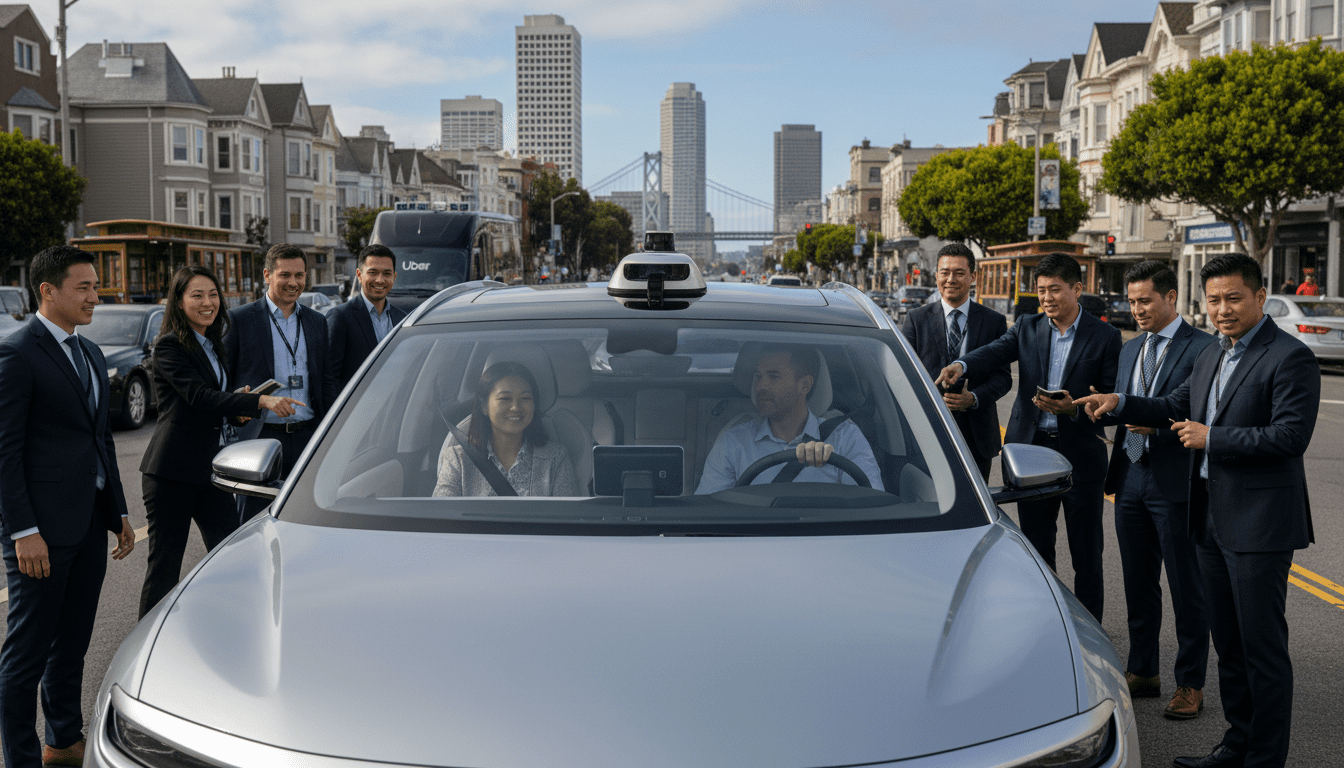
Lucid Gravity robotaxi begins Uber employee test rides in San Francisco
Uber begins employee test rides in a Lucid Gravity robotaxi powered by Nuro’s self-driving system in San Francisco, ahead of a planned public launch soon.
Select Uber staff in San Francisco can now summon a Lucid Gravity robotaxi through the Uber app, marking a new phase of on-road testing for the Lucid Gravity robotaxi program. The vehicles are operating in autonomous mode with a human safety operator available as backup, according to company updates and participant accounts. The trials are intended to validate how the vehicle, autonomy stack and rider experience perform together in live urban conditions.
Employee test rides begin in San Francisco
Uber employees are being offered rides in modified Lucid Gravity SUVs running Nuro’s autonomy software in a controlled deployment across parts of San Francisco. Riders request trips through the regular Uber interface, and company representatives say the initiative is limited to a select group as teams gather operational data.
Nuro has described the exercise as an opportunity to observe passenger interactions, pick-up and drop-off logistics, and system behavior in complex city traffic. A human safety driver remains on board during these trips to intervene if necessary while engineers monitor performance remotely.
Vehicle systems and sensor suite
The Lucid Gravity robotaxi combines Lucid’s electric vehicle architecture with Nuro’s autonomous driving stack and NVIDIA Drive AGX Thor compute hardware. The cars are equipped with high-resolution cameras, solid-state lidar and radar sensors designed to build a detailed, redundant perception of the environment.
Engineers say that the layered sensor array and the on-board compute platform enable the vehicle to detect other road users, lane markings, and obstacles at range, while the autonomy software orchestrates planning and control. The integrated setup is intended to support sustained autonomous operation in varied urban scenarios.
Investments and commercial commitments
The initiative follows a multi-front financial tie-up between the companies and Uber, which invested $300 million in Lucid and agreed to purchase at least 20,000 of the Gravity SUVs over a multi-year period. Uber also made a significant, undisclosed investment in Nuro to accelerate the deployment of the robotaxi service.
Under the current plan, Uber intends to own and operate the premium robotaxi fleet, a model that could include third-party partnerships for vehicle production, maintenance and local operations. The purchase commitment and capital injections aim to align vehicle supply with Uber’s broader mobility ambitions.
Testing fleet scale and data collection
Nuro reports an engineering fleet of around 100 Lucid Gravity SUVs fitted with its self-driving system that are being used to collect real-world data across multiple U.S. cities and states. The company progressed from closed-course trials to limited public road testing late last year as part of the development cycle.
That fleet is being used to stress-test behaviors tied to urban ride-hailing, including curbside operations, passenger ingress and egress, and short-route navigation. Data gathered during employee rides will feed iterative software updates and vehicle calibration efforts.
Operational challenges and pickup/drop-off logistics
Companies developing robotaxi services identify pickups and drop-offs as among the most complex maneuvers for autonomy to master, given curbside congestion, double-parked cars and pedestrian unpredictability. The current trials are explicitly assessing how reliably and safely the Lucid Gravity robotaxi can perform these tasks in dense city environments.
Feedback from pilots will inform adjustments to routing, approach angles, and curbside positioning, as well as potential software and hardware changes. Safety teams are monitoring near-term performance metrics to determine readiness for broader public use.
Production timetable and regulatory context
A regulatory filing indicates production of the modified Lucid Gravity vehicles is expected to begin in late 2026, with the companies positioning the employee test rides as a precursor to a wider commercial rollout. Uber has signaled plans for a public robotaxi launch later this year, contingent on technical progress and regulatory approvals.
Licensing, local permitting and operational compliance remain key variables for the timeline, and both companies are engaging with regulators as testing expands. The presence of on-board safety drivers during current trials reflects a staged approach to scaling up fully driverless service.
As testing continues, the Lucid Gravity robotaxi program will be judged on safety outcomes, vehicle reliability and the durability of its sensor and computing stack in everyday city traffic. The current employee ride phase offers a controlled step toward resolving operational kinks before committing the service to paying passengers.
