
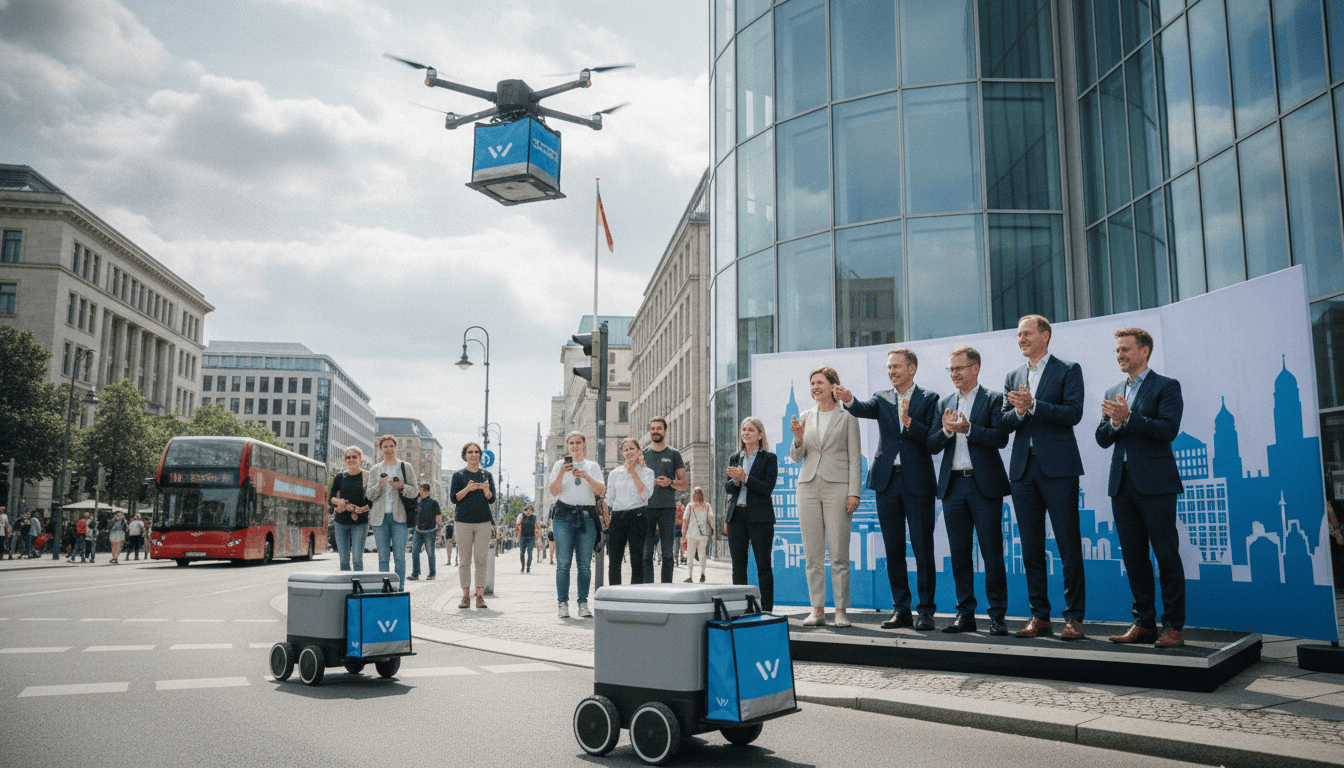
Wolt expansion in Germany: CEO Marianne Vikkula targets robots, drones and quick-commerce growth
Wolt expansion in Germany aims to scale quick-commerce through robot delivery trials, drone tests and Wolt Markets as CEO Marianne Vikkula pushes into a price-sensitive market.
Marianne Vikkula, who joined Wolt eight years ago and has led the company as chief executive for the past nine months, announced plans to accelerate Wolt expansion in Germany by broadening services beyond restaurant orders. She told reporters the company will enlarge its footprint with virtual supermarkets, local fulfilment hubs and trials of autonomous delivery to reduce costs and improve speeds. The strategy puts technology at the center of Wolt’s push into one of Europe’s most competitive and price-conscious markets.
Vikkula’s growth blueprint for Germany
Wolt will add Wolt Markets and increase local partnerships to make quick-commerce a regular option for German consumers. Company executives say more than half of Wolt users still order only restaurant food, and converting those customers is the immediate priority. To do that Wolt plans targeted marketing, deeper retail assortments and faster fulfilment from micro-warehouses placed near urban demand centres.
Wolt executives describe Germany as a market with high potential but tougher unit economics than many other countries. To reach half of the German population, Wolt estimates it must operate in more than 400 towns and cities, a scale that requires national logistics, local partnerships and flexible supply arrangements. The company currently serves roughly 60 to 70 German locations and intends to expand that footprint using both in-house couriers and third-party fleets.
Wolt’s shift from food delivery to quick commerce
Founded in Helsinki more than a decade ago as a restaurant delivery platform, Wolt has become a multi-category quick-commerce operator in more than 30 countries. The platform now offers groceries, household goods, cosmetics and medicine alongside restaurant menus, and has developed virtual supermarket formats called Wolt Markets. Executives say these Markets let customers shop a curated assortment online and receive near-instant delivery or in-store pickup.
The pivot mirrors a wider industry trend: food-delivery platforms evolving into general-purpose logistics and retail marketplaces. Wolt’s parentage and past deals — including acquisition by a U.S. operator four years ago — have shaped its strategy to combine local scale with technology-enabled fulfilment. Management argues that turning occasional users into multi-category customers will raise lifetime value and improve margins over time.
Robot deliveries tested in Helsinki, with mixed results
Autonomous ground robots are already in use in Helsinki, where Wolt has piloted four-wheeled units designed for urban sidewalks and short road crossings. Company demonstrations highlight the robots’ ability to operate in harsh winter weather, navigate curbs and pause at pedestrian crossings. Wolt says these trials are intended to drive down per-delivery costs in high-labor markets.
Observers and footage from pilots show limits: robots sometimes become stuck at curbs or require human intervention, and cyclists or riders often complete the same route faster. Wolt’s CEO acknowledges that while robots reduce labour exposure and can operate round-the-clock, they currently run slower than car or bicycle couriers. The company plans further engineering improvements and scaled trials, then regulatory outreach in Germany to permit safe neighbourhood operation.
Drones face payload and regulatory limits
Wolt has experimented with drone deliveries but maintains that aerial vehicles remain a secondary avenue because of payload and regulatory constraints. Company tests demonstrated drones can carry only a few kilograms, which limits their usefulness for grocery deliveries or larger orders. For now, Wolt views drones as complementary for small, high-priority items rather than a mass-market fulfilment solution.
Industry analysts note that autonomous options can reduce delivery costs but are not yet a panacea. Financial models from investment banks project modest near-term savings from robots and drones in high-wage markets, with broader adoption potentially lowering single-order costs significantly only over the long term.
Competition, consumer habits and geography complicate expansion
Wolt expansion in Germany will contend with entrenched competitors and consumer behaviour. Platforms such as Lieferando and Uber Eats have broadened assortments to include everyday items, intensifying competition on price and speed. Yet Wolt executives say their biggest rival is habitual shopping — the refrigerator — and that changing ingrained behaviour will be harder than beating a specific competitor.
Germany’s urban landscape poses operational challenges: the prevalence of medium-sized cities means networks must be dense to deliver profitably. Wolt plans to mix its own couriers with third-party fleets to better match demand peaks, but that model has drawn criticism from unions alleging weak labour protections and precarious contracts for some delivery workers.
Regulatory shifts and labour rules add uncertainty
European legislation meant to rebalance platform labour relations is reshaping the operating environment. The EU directive on platform work, approved in 2024, flips the burden of proof onto platforms to demonstrate independent-contractor relationships, a change that national governments must implement. Wolt has said it welcomes clearer rules but warned disparate national interpretations could fragment the single market and complicate cross-border scaling.
In Germany the labour ministry is preparing national transposition of the framework, and Wolt signals it will engage with federal and municipal authorities as it seeks permission to expand robotic delivery. Executives caution that a patchwork of local regulations, combined with differing enforcement of labour rules, could slow deployment of new technologies and raise compliance costs.
Wolt’s management frames the push into Germany as a long-term investment in changing shopping habits and building local infrastructure. The company will continue testing robots and drones, roll out Wolt Markets more broadly, and pursue regulatory talks to enable autonomous delivery at scale. Whether technology and competitive pricing can overcome geography, consumer habits and patchwork regulations will determine how far Wolt expansion in Germany advances in the coming years.
