
China’s undervalued yuan costs Germany billions, IW study shows
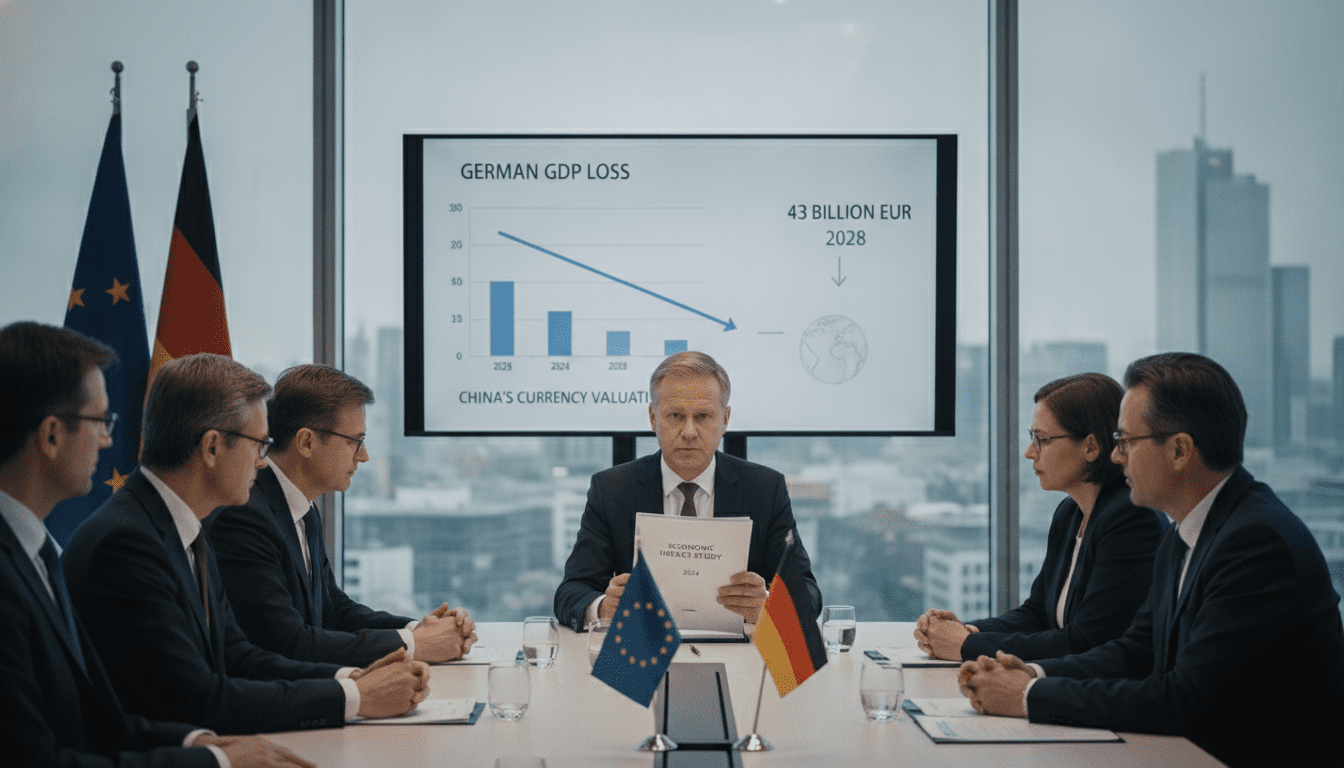
A new study by the German Economic Institute (IW), funded by the Federal Foreign Office, finds that an undervalued yuan has shaved billions off German growth; a 40% revaluation scenario could raise Germany’s real GDP by up to 0.3% in 2028. The report estimates a cumulative gain of roughly €43 billion for Germany across 2026–2028 under that scenario, and it highlights a rising trade deficit with China that reached about €90 billion in 2025. The findings renew debate over Beijing’s currency management and potential policy responses in Europe.
Study quantifies GDP loss from undervalued yuan
The IW model adjusted the yuan by 40% to approximate what analysts describe as a fairer market valuation and then simulated macroeconomic impacts through 2028. Under that scenario, Germany’s price-adjusted gross domestic product could be up to 0.3 percentage points higher in 2028 than in the baseline with the current managed exchange rate.
The institute reports the €43 billion figure as the cumulative difference in real GDP over the three-year window 2026–2028, driven largely by stronger export performance and improved terms of trade. The study’s publication, backed financially by the Foreign Office, frames the currency issue as a structural factor weighing on Germany’s industrial competitiveness.
Simulation details and methodological assumptions
The IW simulation isolates exchange-rate effects by holding other macroeconomic variables constant and focusing on price-adjusted output and trade flows. Analysts applied a uniform 40% appreciation of the yuan against a basket of currencies and then traced the knock-on effects on exports, imports and domestic demand in both countries.
Researchers flag that the outcome depends on transition dynamics, policy responses and how quickly markets and businesses adjust to new price signals. The report notes uncertainty around pass-through rates and the speed at which export-oriented sectors would respond to a steeper yuan.
Trade patterns reflect currency-driven distortions
According to the IW analysis, persistent undervaluation makes Chinese exports artificially cheap on world markets while raising the domestic-currency cost of imports. That dynamic is associated with a marked reduction in the value of German exports to China and a surge in imports of Chinese goods, contributing to a widening bilateral deficit.
The trade imbalance reached roughly €90 billion in 2025, the study says, a figure the authors use to illustrate the scale of adjustment that might follow under a fairer exchange rate. German manufacturers and policymakers have increasingly raised concern that currency management, rather than pure competitiveness or product quality, is distorting trade outcomes.
Projected effects on China’s economy and domestic demand
The IW team argues that a more balanced yuan would force a short-run contraction in Chinese export volumes, but that effect would be partly offset by stronger domestic consumption. As Chinese goods become less competitive abroad, more output would be absorbed by the home market, exerting downward pressure on prices and encouraging household spending.
In the simulation, this rebalancing leads China’s economy to approach, and in some cases nearly recover, the baseline growth path by 2028 despite the initial export shock. The institute sees such an outcome as evidence that currency realignment could support China’s longer-term objective of shifting away from export dependence.
German and European policy options enter the debate
IW trade experts argue the current exchange-rate policy gives Chinese exporters an unfair advantage and call for measures to level the playing field. The institute’s outside-trade specialist, Jürgen Matthes, says Europe should consider targeted countermeasures—such as compensatory tariffs—if Beijing does not allow a market-determined exchange rate.
German policymakers face trade-offs between pressing for change multilaterally—through the WTO or G20 frameworks—and adopting unilateral remedies that could provoke trade retaliation. The report’s release is likely to intensify discussions in Berlin and Brussels over whether to pair diplomatic pressure with trade policy tools.
Potential diplomatic spillovers and industry responses
Beyond immediate economic calculations, a shift in currency policy could reshape diplomatic relations and industrial strategies across the EU. German exporters who have lost market share may lobby for stronger safeguards, while import-dependent sectors could face cost adjustments if the yuan strengthens significantly.
Industry groups in Germany are already weighing the business implications of different scenarios, from gradual realignment to sudden exchange-rate shifts that would require rapid supply-chain and pricing adjustments. European institutions will also assess legal and political avenues before moving on measures that could escalate tensions with Beijing.
The IW study adds fresh empirical weight to longstanding concerns about China’s managed exchange-rate regime and its effect on European trade. Policymakers in Germany and the EU must now weigh the study’s projected economic gains against the diplomatic and market risks of pressing for rapid currency adjustments, while businesses prepare for a range of potential outcomes.
