
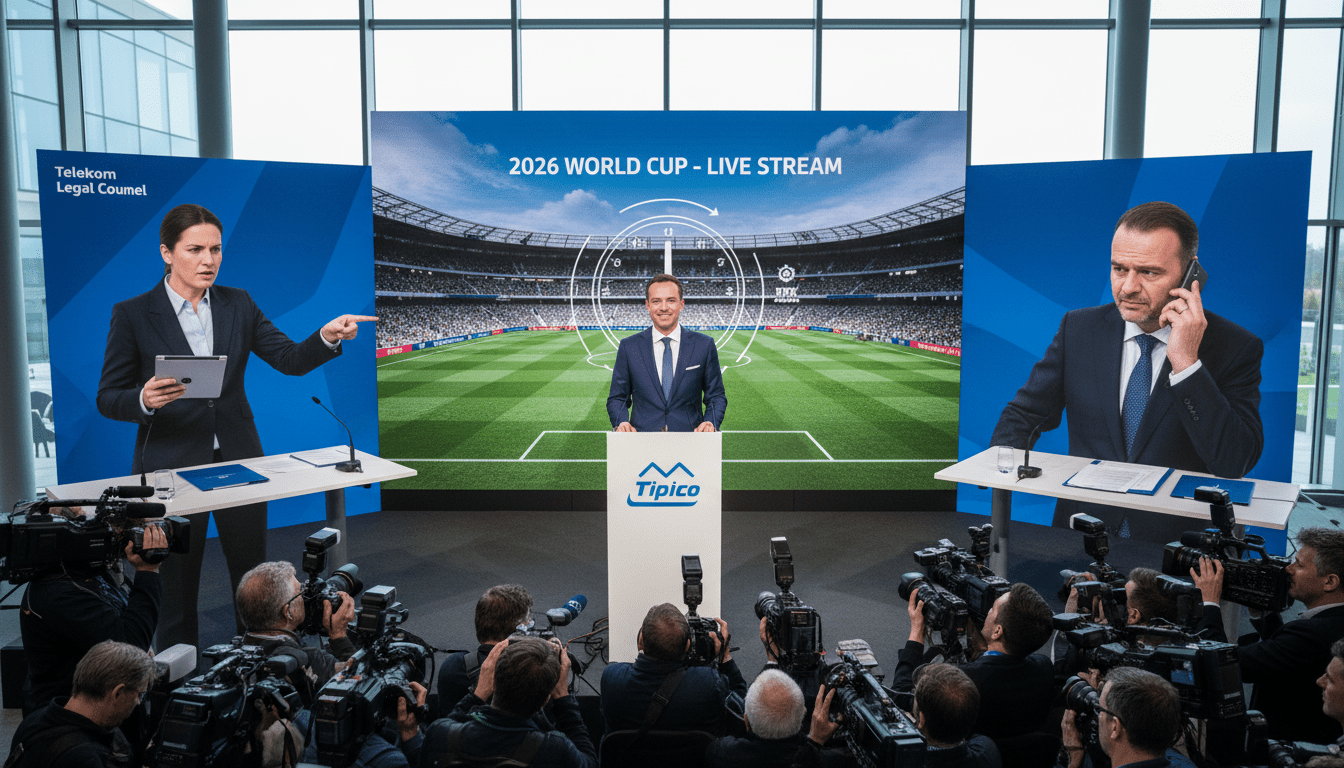
Tipico World Cup livestream claim sparks rights dispute with Telekom and FIFA
Tipico World Cup livestream announcement promised all matches but was removed after questions from Telekom and FIFA about streaming rights and technical limits.
The betting firm Tipico briefly announced it would show every match of the 2026 FIFA World Cup in a new Tipico World Cup livestream available in its app and on tipico.de, then pulled the claim from its website within hours. The notice said only “qualified users”—those with account credit or a bet placed within 24 hours—would be able to view the streams, a condition that immediately drew scrutiny from rights holders and competitors. Telekom, which holds primary broadcast rights for the tournament in Germany and distributes matches via Magenta.TV, registered surprise and contacted FIFA after the Tipico notice appeared.
Tipico announcement appears and then disappears
The Tipico statement described a promotion promising live access to all games in the United States, Mexico and Canada for users who meet its account criteria. Within hours the emphatic language on Tipico’s site was removed and replaced by an acknowledgment that viewers seeking the full TV-quality experience should turn to the Telekom streaming service. Tipico, however, continued to point to a press release it had distributed by email that touted “a new level of live experience.”
The rapid retraction left partners and consumers seeking clarity about what licence, if any, Tipico believed it held and what technical or contractual limits would apply to its service. Tipico did not publicly reverse the emailed press materials at the time the online announcement was withdrawn, further complicating the public record.
User eligibility and age checks for streams
Tipico’s published conditions said the Tipico World Cup livestream would be available only to “qualified users” defined as account holders with positive balance or users who had wagered within the previous 24 hours. The company set a minimum stake threshold of one euro to place a qualifying bet, while a balance as small as one cent would suffice to gain access.
The firm also said that standard gambling regulations apply: viewers must be at least 18 years old and provide identity documentation when opening an account. Those safeguards are in line with German youth protection and anti-money-laundering rules, but they also raise questions about how broadly betting operators may now link live sports access to wagering activity.
Telekom emphasizes Magenta.TV exclusivity and quality differences
Telekom, which purchased broadcast rights from FIFA, stressed that rights for betting operators are handled separately and typically permit only lower-quality, restricted-format retransmissions. A Telekom spokesperson told journalists that those sublicences do not equate to full television quality and reiterated that Magenta.TV will remain the destination for viewers who want the complete, high-resolution World Cup experience.
Telekom holds the primary package of 104 tournament matches for the German market, with 44 matches exclusive to Magenta.TV and 60 matches sublicensed to public broadcasters ARD and ZDF, including the opening game, all German team matches and the final. The company framed its position around a “different quality standard” it says distinguishes full broadcast licences from the betting-focused streams.
FIFA points to Stats Perform agreement on betting streams
FIFA declined to comment directly on the Tipico posting but referred to an existing commercial arrangement with British firm Stats Perform, which FIFA says has been authorised to distribute live streams for licensed sports-betting operators. That contract, in place since January according to FIFA statements, designates Stats Perform as the provider of betting-feed services and the manager of sublicensing to licensed bookmakers.
According to FIFA, the moving images supplied under that agreement are generated through a Stats Perform “AI-assisted Bet-LiveStreams” service, which is positioned as a lower-resolution alternative to full broadcast feeds. FIFA’s public framing suggests that licensed betting partners may receive derivative streams subject to strict technical and display limitations.
Technical constraints on display and resolution
Reporting by the Deutsche Presse-Agentur indicates those derivative streams have materially lower resolution than the television feeds on Magenta.TV and other broadcasters. The permitted broadcast window for betting streams is also restricted by visual size: streams may be shown on no more than half of a mobile display or one third of larger screens, according to the technical descriptions circulated with the sublicence arrangements.
These constraints are intended to protect the value of full broadcast rights while allowing licensed wagering platforms to offer a supplementary live view for customers. The limits on resolution and screen real estate will mean that the Tipico World Cup livestream, if activated, will provide a markedly different viewer experience than conventional TV or streaming packages.
Commercial and regulatory implications for betting platforms
The episode highlights the evolving commercial landscape where sports federations, tech vendors and broadcasters segment rights across platforms and use cases. For betting operators, limited live feeds are a commercial tool to engage customers, but the arrangement also raises regulatory and reputational questions about tying access to wagering activity.
Consumer groups and regulators will likely watch how operators implement age verification and whether promotional incentives to place bets are framed in ways that comply with responsible-gambling rules. Broadcasters, meanwhile, have an interest in policing any offerings that could undermine the exclusivity and revenue value of full broadcast packages.
Tipico’s retreat from its on-site headline and the contrasting statements from Telekom and FIFA leave several details unresolved, including whether Tipico will formally launch a restricted-stream service and under what exact technical and contractual terms. The dispute underscores how rights fragmentation and new streaming technologies are reshaping the commercial boundaries around major sporting events, even as viewers seek simple access to live matches.
