
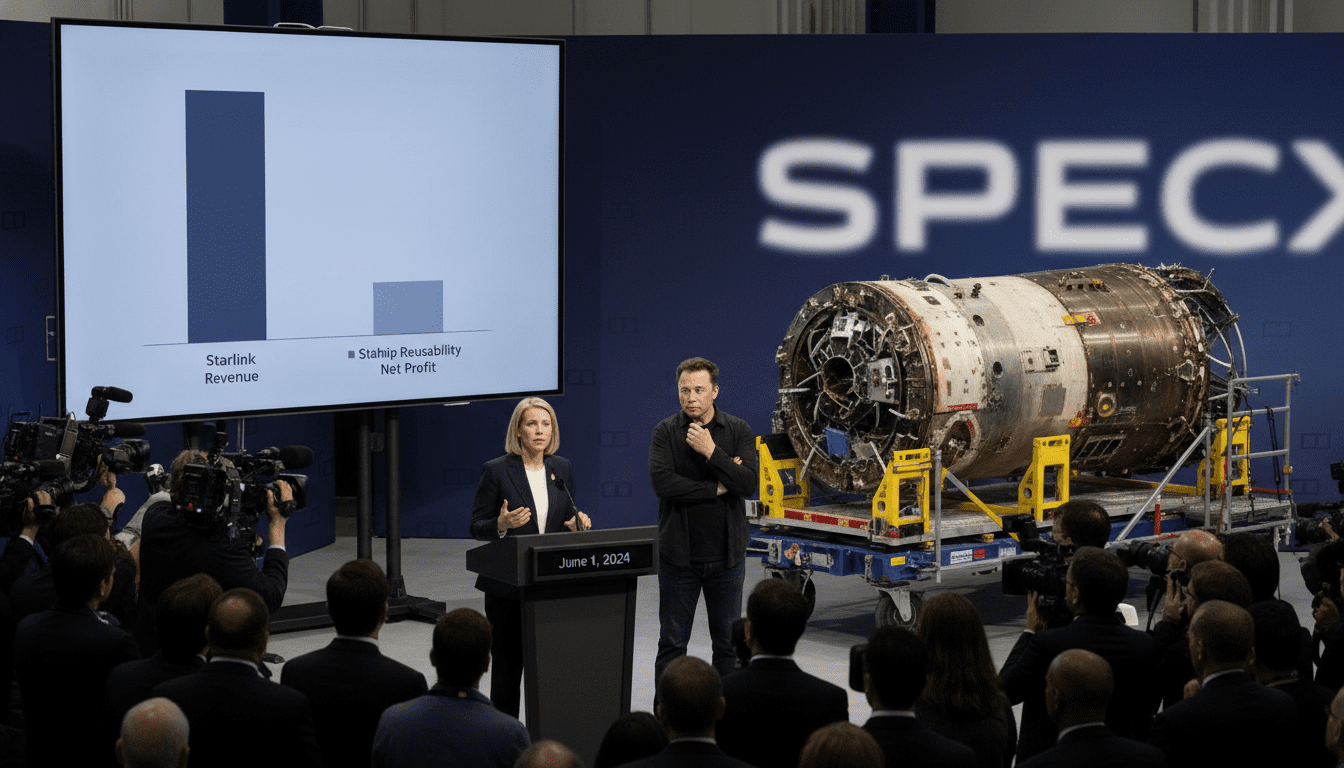
SpaceX Starship test and S-1 show Starlink revenue strength but reusability shortfall risks higher launch costs
SpaceX Starship test highlights reusability limits while the company’s S-1 filing confirms Starlink as the primary revenue engine, raising questions about launch economics and long-term growth.
Test flight exposes Starship reusability gap
Last week’s Starship test flight demonstrated progress in payload deployment but underscored persistent challenges with engine relight and controlled return. SpaceX succeeded in placing dummy satellites and two test payloads into orbit, but the inability to reliably relight Raptor engines on both stages weakens the case for full reuse. That deficit matters because the company’s cost forecasts hinge on a reusable second stage returning to service and dramatically lowering per-launch expenses. Without that capability, Starship may operate initially as an expendable heavy lifter rather than the cost-transforming vehicle Elon Musk has long promised.
S-1 filing centers Starlink as the revenue backbone
SpaceX’s IPO filing makes clear that Starlink is the dominant source of the company’s reported revenue and the financial justification for its capital plans. The filing shows robust top-line results from the connectivity business, which accounted for the vast majority of revenue in the period disclosed. At the same time, the document reveals sizeable capital expenditure demands to maintain and expand the constellation, highlighting a heavy replacement cadence for satellites. Those disclosure details frame the company’s broader argument that launch-cost reductions are essential to stabilize Starlink’s long-term economics.
Capital expenditure pressures and replacement cadence
SpaceX faces a sustained capex treadmill as it replenishes aging satellites and scales services internationally. The filing indicates that a meaningful portion of the constellation must be replaced each year merely to sustain current service levels, which drives ongoing manufacturing and launch commitments. Starlink investment since early 2023 has been substantial, and the company has already spent heavily on satellites relative to Starship infrastructure to date. If Starship operates non-reusably at first, launch costs per kilogram will remain significantly higher, worsening the return on those ongoing satellite investments.
Subscriber growth softens and ARPU declines
Despite leading the market with the largest consumer satellite subscriber base, Starlink is showing signs of slower user growth and falling average revenue per user. The filing and related analyst commentary indicate that quarterly subscriber additions decelerated, and international expansion has reduced the company’s aggregate ARPU. New customers in lower-priced markets lower the overall revenue mix, meaning each additional satellite contributes less revenue than earlier deployments. Those trends make rapid scale even more important, because slower growth and lower ARPU constrain the revenue pool available to amortize heavy infrastructure costs.
Competitive dynamics and market sizing questions
Emerging competitors and differing market assumptions add uncertainty to SpaceX’s projections for space broadband demand. Other players developing low-Earth-orbit constellations are approaching scales that could exert pricing pressure, and regulatory timing remains a risk for some entrants. Analysts have also cautioned that if the market leader is seeing demand moderation, the total addressable market for satellite broadband may be smaller than many forecasts anticipated. That potential re-sizing of demand amplifies the importance of lowering launch costs and improving unit economics to preserve profitability under increased competition.
SpaceX’s near-term business outlook thus rests on two linked developments: the pace at which Starship achieves reliable reusability and the company’s ability to translate Starlink’s current revenue strength into sustainable margins. Successful reusable operations would materially reduce the cost of replacing and expanding satellites, alleviating the capex treadmill and supporting broader ambitions such as higher-throughput launches and future services. Conversely, an initial expendable Starship model would leave launch costs closer to existing alternatives and could delay or constrain planned initiatives that depend on ultra-low orbital logistics costs.
For investors and industry observers, the S-1 and the latest flight test together provide a clearer, if more sober, picture of what SpaceX must accomplish to justify some of its loftier projections. The company’s connectivity business is sizable and profitable at scale, but its future trajectory is tightly coupled to technological milestones that remain unproven at full operational tempo. How quickly SpaceX can demonstrate repeatable reusability on Starship will determine whether the firm can unlock the cost reductions required to sustain aggressive satellite deployments and new frontier business models.
SpaceX now faces the twin tasks of refining Starship’s reusability systems while managing Starlink’s growth profile and capital needs, and the next tests and quarterly disclosures will be pivotal in assessing whether those objectives remain achievable.
