
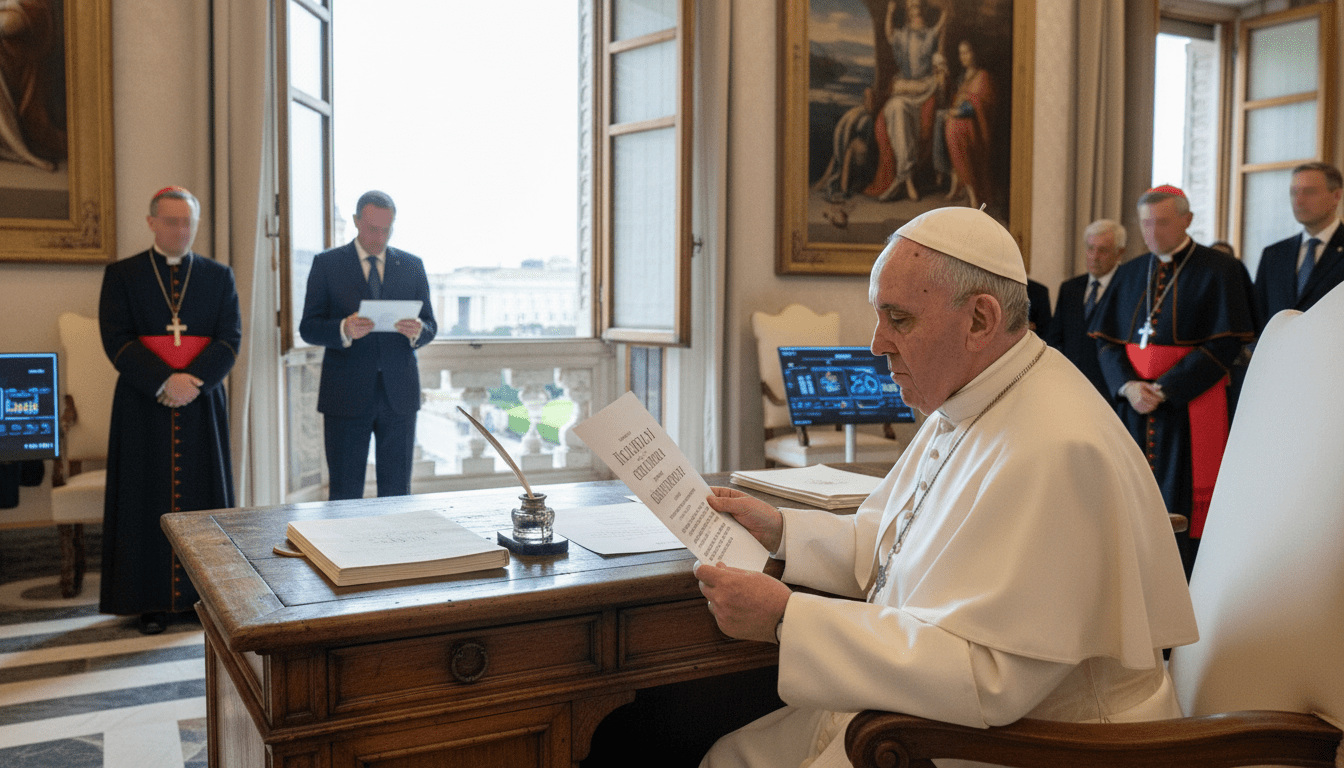
Pope Leo XIV’s encyclical on AI, ‘Magnifica Humanitas,’ warns of concentrated power and calls for oversight
Pope Leo XIV’s encyclical on AI, Magnifica Humanitas, calls for new moral and regulatory guardrails as artificial intelligence reshapes social, political and economic life. The 200-page document warns that AI tends to magnify inequalities and concentrate power in the hands of a few, and it urges “clear criteria and effective oversight” and broader community participation. The pope presented the encyclical alongside Chris Olah, co‑founder of Anthropic, underscoring the Vatican’s engagement with contemporary technology debates.
Papal message and central argument
Magnifica Humanitas frames the rise of advanced AI as an ethical and civic challenge, not merely a technical one. The encyclical contends that systems created and governed by a narrow elite cannot reliably serve the common good. It stresses that unchecked concentration of technical power risks new forms of exclusion, manipulation and dependency across societies.
The document links AI’s disruptive capacity to longstanding social problems such as economic inequality, threats to democratic institutions and the militarization of technology. The pope calls for principles that privilege human dignity and solidarity in the governance of these systems.
Calls for oversight, participation and disarmament
A central demand in the encyclical is for oversight mechanisms grounded in participation by those most affected. The pope urged governments, companies and civil society to adopt “clear criteria and effective oversight” that are transparent and democratically accountable. He also proposed ending what he called the AI arms race — the competitive drive to build ever-larger models and datasets for geopolitical or commercial advantage.
The encyclical frames disarmament as a moral prerequisite: to disarm, the pope wrote, is to reject the assumption that sheer technical power equals the right to govern. That language signals a push for international cooperation to limit escalatory dynamics in AI development.
Context: tech, politics and the timing of the document
The release of Magnifica Humanitas comes amid intense political and industry debates over AI governance. The encyclical followed a recent US episode in which President Donald Trump delayed signing an executive order that would have required government review of new AI models before release, a move reported to have been influenced by advice from investor David Sacks. The pope’s intervention lands as lawmakers and regulators around the world strain to match policy to rapidly advancing capabilities.
The Vatican’s public presentation of the document with Chris Olah, a leading AI entrepreneur, signaled an attempt to bridge moral authority and technical expertise. The timing reflects broad anxieties about how AI may reshape information ecosystems, labor markets and electoral politics.
Warnings about information integrity and cognitive freedom
The encyclical raises particular alarm about AI’s role in degrading shared understandings of truth. Notre Dame Law professor Paolo Carozza, a member of the Pontifical Academy of Social Sciences, has warned that AI-driven misinformation and deepfakes have eroded the public’s capacity to distinguish fact from fabrication. The pope describes how control over data, algorithms and distribution channels can allow elites to shape consumption and information flows to political and economic ends.
The document frames unrestricted data harvesting and targeted manipulation as direct threats to cognitive freedom and to democratic deliberation, arguing that safeguards must protect individuals’ ability to form opinions free from systematic manipulation.
Historical parallels and moral lineage
Magnifica Humanitas situates its argument within a longer papal tradition addressing technological and economic upheaval. The encyclical draws a line to Pope Leo XIII’s 1891 Rerum Novarum, which responded to the social dislocations of the Industrial Revolution. The new text argues that while technologies change, the moral stakes remain similar: who holds power and how that power is exercised.
By invoking that lineage, the Vatican aims to make the case that ethical frameworks developed for past technological transformations can be revised and applied to contemporary digital challenges.
Potential policy and industry implications
The encyclical stops short of prescribing specific laws, but its appeals for oversight, participation and disarmament are likely to bolster calls for stricter governance from civil society and some policymakers. Regulators in Europe and elsewhere are already debating rules for model transparency, safety testing and data governance; the Vatican’s intervention lends moral pressure to those efforts.
Industry reactions may be mixed. Some AI developers and advocates favor voluntary standards and rapid innovation, while others have signaled willingness to support limits on particularly risky uses. The encyclical’s critique of concentrated technical power could prompt renewed discussion of antitrust, data portability and mandatory impact assessments.
Pope Leo XIV’s text is likely to influence public debate by reframing AI decisions as ethical as well as technical. Its emphasis on community participation creates space for labor groups, marginalized communities and grassroots organizations to demand a seat at the table.
The encyclical makes a direct moral appeal to political leaders, technology firms and citizens to protect human dignity as AI systems are deployed. Whether that appeal translates into binding international agreements or new domestic regulations will depend on political dynamics and the capacity of civil society to sustain pressure. The Vatican’s intervention, presented alongside a prominent AI entrepreneur, ensures Magnifica Humanitas will be part of the global conversation about how societies govern powerful digital tools.
