
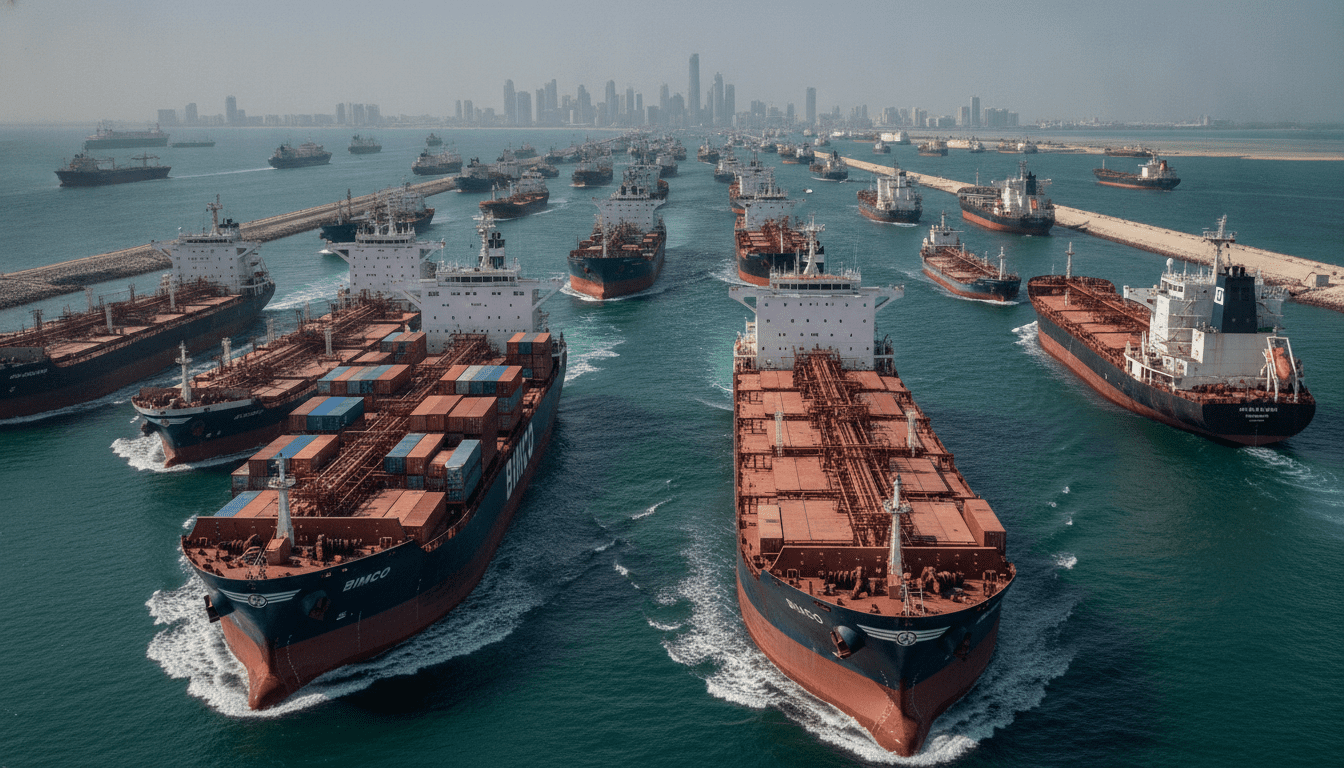
Strait of Hormuz: 600 Vessels Trapped as U.S.-Iran Deal Signals Passage Reopening
About 600 ships, including roughly 250 oil tankers, await transit through the Strait of Hormuz after a U.S.-Iran accord; mines and coordination gaps leave maritime safety in doubt.
The announcement of a U.S.-Iran agreement to reopen the Strait of Hormuz has prompted a mass attempt to transit a narrow, mined waterway where roughly 600 vessels are currently anchored or stalled. Shipping industry officials say about 250 of those vessels are oil tankers, and they warn that simultaneous departures could produce collisions, damage from leftover ordnance, and new security incidents. Jakob P. Larsen, head of security at global shipowners’ association Bimco, issued a public warning that attempting a mass transit now would be “very risky,” underscoring the precarious balance between political progress and maritime safety.
Scale of the backlog
Several hundred vessels are concentrated in choke points along the Persian Gulf as operators await clearances to pass through the Strait of Hormuz. Port approaches and sheltered anchorages have become congested, with commercial, bulk and tanker tonnage clustered in limited waters. Logistics planners say the volume and density of ships far exceed routine traffic peaks, increasing the chance of navigational incidents even in calm weather.
Ships from a range of national registries and operators are involved, and many are laden with crude or refined products destined for international markets. Owners and charterers must now weigh commercial pressure to resume voyages against safety advice from maritime authorities and insurers, who remain cautious about authorizing transit through waters that still show the effects of recent hostilities.
Mines and unexploded ordnance remain a threat
Naval sources and industry briefings indicate that mines and unexploded ordnance remain in parts of the strait and adjacent approaches. Even if surface mines have been cleared in declared lanes, underwater remnants and improvised devices can persist and are harder to detect. The presence of these hazards elevates the potential consequences of any collision or groundings that could rupture tankers and trigger fires or major pollution.
Clearing mines to internationally accepted standards is time-consuming and requires specialist vessels and coordinated naval support. Until sweep and clearance operations are completed and verified, military and commercial authorities are unlikely to endorse unrestricted movement through narrow channels where the margin for error is small.
Coordination and command remain unclear
Despite political statements suggesting blockades will be lifted, there is no publicly confirmed, single authority in charge of sequencing vessel movements through the strait. Effective transit at this scale requires a clear traffic management plan, assigned pilotage or convoy procedures, and reliable communication among local navies, commercial fleet operators and port authorities. Sources tell reporters that such mechanisms have not been fully established.
Ship masters and owners expect written notifications, secure routing instructions and time windows to reduce crossing conflicts. Without a centralized scheme, multiple vessels attempting to transit at once could create squeeze situations in the narrowest passages, leading to emergency manoeuvres that increase collision risk.
Bimco warning and industry response
Jakob P. Larsen of Bimco has publicly cautioned owners and masters against initiating transit without confirmed assurances from relevant authorities and adequate security measures. His warning stresses that the physical and operational environment remains volatile and that individual decisions to proceed could endanger crews and cargo. Industry groups are urging clients and members to update risk assessments continually and to defer departures until clearances and demining reports are provided.
Some shipping companies have already signalled they will await written confirmation from insurers and flag-state authorities before authorizing movement. Others face commercial pressure to discharge or deliver cargo, which adds urgency and complicates industry-wide coordination.
Options for shipowners and insurers
Shipowners and insurers now confront three main options: await full verification of safe passage, attempt coordinated convoy transits under military escort, or reroute via longer alternatives that bypass the strait. Each choice carries economic and safety trade-offs. Waiting imposes storage and demurrage costs; convoys require military assets and reduce scheduling flexibility; rerouting through the Cape of Good Hope or around the Arabian Peninsula significantly lengthens voyages and increases fuel costs.
Insurers are closely watching the situation and may demand enhanced premiums or explicit exclusions until danger is demonstrably reduced. Legal exposure in the event of an incident—pollution, crew injury, or cargo loss—will hinge on whether operators followed available advisories and obtained any required clearances.
Local picture and civilian normality
On shore, life in coastal cities such as Bandar Abbas presents a contrasting image: residents continue daily activities even as shipping waits offshore. Photographs and local reporting show some normalcy along the beaches and port areas, while offshore anchorages remain crowded. That juxtaposition highlights how geopolitical shifts and maritime hazards converge unpredictably, affecting global energy markets and local economies alike.
The civilian presence ashore also complicates any large-scale naval or clearance operation, which must avoid disrupting ports and coastal communities while addressing the security tasks at sea.
The coming days are likely to test how rapidly political agreements can be translated into safe, operational plans at sea; until mines are cleared, transit corridors verified and a single coordinating authority established, many shipowners and insurers will err on the side of caution.
