
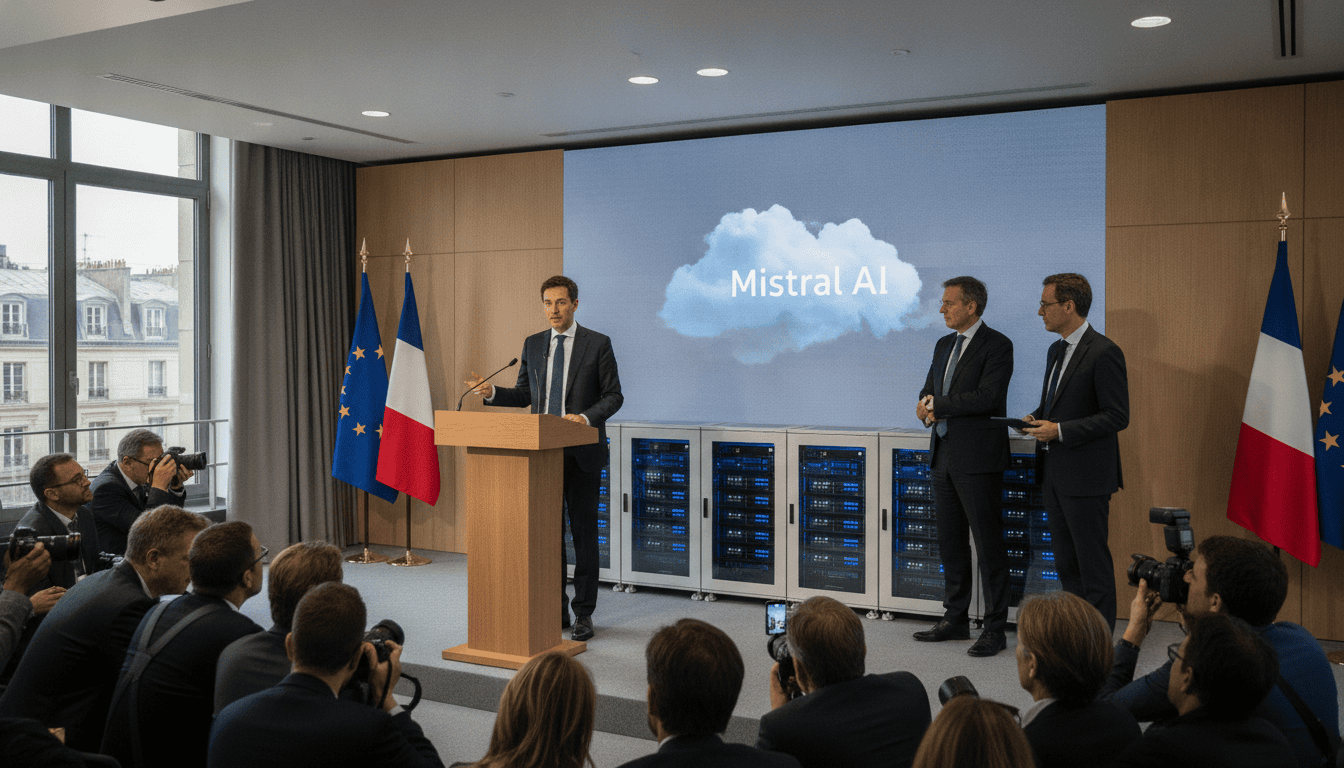
Mistral AI Faces Scrutiny as It Ramps Enterprise Deployments, Infrastructure and an Open-Weight Model
Mistral AI clarifies its strategy amid scrutiny, focusing on enterprise deployments, an open-weight model due in July, a €4B infrastructure plan and rapid revenue growth.
Mistral AI has become a focal point in debates over sovereign technology and the global AI landscape as the Paris-based startup scales revenue and infrastructure while preparing a widely anticipated model release. The company’s name has circulated in political and commercial discussions after regulatory moves in the United States and renewed calls in Europe for reduced dependence on U.S. software. Mistral’s response has been to emphasize tailored enterprise deployments, research investment and a plan to expand compute and data-center capacity across Europe.
Mistral AI’s growth and finances
Mistral AI’s revenue trajectory has accelerated sharply, moving from tens of millions to hundreds of millions of dollars in a single year. The company disclosed annual recurring revenue above $400 million and projected further rapid growth toward a billion-dollar ARR, reflecting demand for customized enterprise AI solutions. Investors have backed that momentum through multiple funding rounds and mixed debt financing that together approach several billion dollars in capital raised.
The firm’s funding history includes a rapid seed raise shortly after founding, larger venture rounds led by prominent investors, and a later multibillion-euro Series C led by a strategic industrial partner. Sources have also reported ongoing fundraising talks that would further increase the company’s valuation, underscoring confidence in its commercial potential despite a competitive global market. Mistral’s financing strategy combines equity and debt to support both R&D and the capital-heavy buildout of infrastructure planned in Europe.
Enterprise-first deployment and Forge
Mistral AI has prioritized an enterprise-first deployment model in which engineers work closely with clients to integrate and customize models on customer infrastructure. That field-driven approach mirrors a consultancy-style playbook, with teams deployed at customer sites to adapt models, tune performance and ensure secure operation for sensitive use cases. The company sells both hosted and on-premise options and offers Forge, a platform enabling customers to train custom models using their own data.
This operational emphasis positions Mistral as a provider of tailored AI stacks rather than a purely consumer-facing chatbot brand, even as it maintains public-facing products. The hands-on deployment model has helped land contracts with governments, large industrial groups and service providers that require both technical integration and regulatory compliance. By embedding engineers with customers, Mistral aims to convert demonstrations into sustained revenue and long-term contracts.
Model strategy and the upcoming release
Mistral AI develops a diversified portfolio of models spanning large language models, multimodal systems, audio and document-processing tools, with particular attention to efficiency and edge deployment. The company has released smaller, optimized weights for phones and edge devices and has open-sourced selected agent components to foster an ecosystem of compatible tools. CEO statements indicate an open-weight flagship language model is planned for early access in July, which the company says will narrow the gap with larger frontier models while remaining transparent about capabilities.
The firm’s roadmap balances research investments with commercially pragmatic engineering, emphasizing areas that are less compute-bound such as vision and voice where it claims state-of-the-art results. Mistral’s dual focus on open weights and enterprise privacy aims to appeal to clients that want auditable, locally operated models rather than fully closed cloud services. Public anticipation around the July release has also amplified scrutiny, with market observers watching for benchmarks and licensing terms.
Sovereignty and infrastructure investments
Mistral AI is advancing a €4 billion investment plan to build data centers in France and Sweden, a move framed as strengthening European technological sovereignty and local control over critical AI infrastructure. The acquisition of an infrastructure startup earlier this year underpins ambitions to offer a regional AI cloud stack that combines compute, data governance and service delivery. Company leadership has argued that making secure, affordable AI infrastructure widely available is essential if organizations are to adopt advanced systems without ceding control to distant providers.
The infrastructure push dovetails with broader European policy conversations about digital autonomy and data residency, and it has attracted state and institutional attention. By locating data centers in Europe and partnering with local stakeholders, Mistral seeks to present a competitive alternative to major non-European cloud providers for regulated industries and public-sector clients.
Partnerships, acquisitions and customer wins
Mistral AI has forged strategic partnerships across cloud, chip and enterprise services sectors, and it has expanded via acquisitions aimed at bolstering cloud and industrial capabilities. Corporate partnerships span established technology companies, system integrators and industrial clients, reflecting a deliberate strategy to embed Mistral models into business processes. The purchase of an infrastructure-focused startup and an industrial-focused AI company strengthens the firm’s ability to deliver full-stack solutions from model training to deployment.
Commercial agreements with large organizations in media, logistics, defense-related technology and professional services have helped validate Mistral’s enterprise approach. These collaborations provide both revenue and testing ground for tailored offerings, while also signalling to governments and regulators that the company can support high-assurance, mission-critical deployments.
Leadership, founders and public profile
Mistral AI was founded by a team with backgrounds in leading AI research groups and quickly positioned itself as a European champion in the field. The company’s CEO has taken a visible advocacy role in public debates about AI policy and industrial strategy, promoting both openness and regional autonomy as pillars of the firm’s mission. That public profile has helped the company secure political and commercial audiences, but it has also raised expectations about technological performance and governance.
Senior hires in finance, marketing and partnerships reflect a scaling organization preparing for broader market expansion and possible public markets activity in the medium term. Executives have signalled that an IPO remains the intended path for long-term independence, while short-term priorities emphasize product readiness, customer delivery and infrastructure completion.
Mistral AI’s trajectory illustrates the tension between public visibility and the technical, commercial work required to industrialize AI for enterprise customers. As the company rolls out new models, expands compute capacity and deepens client integrations, observers will judge whether its blend of open-weight ambitions, localized infrastructure and hands-on service can translate into lasting market share.
