
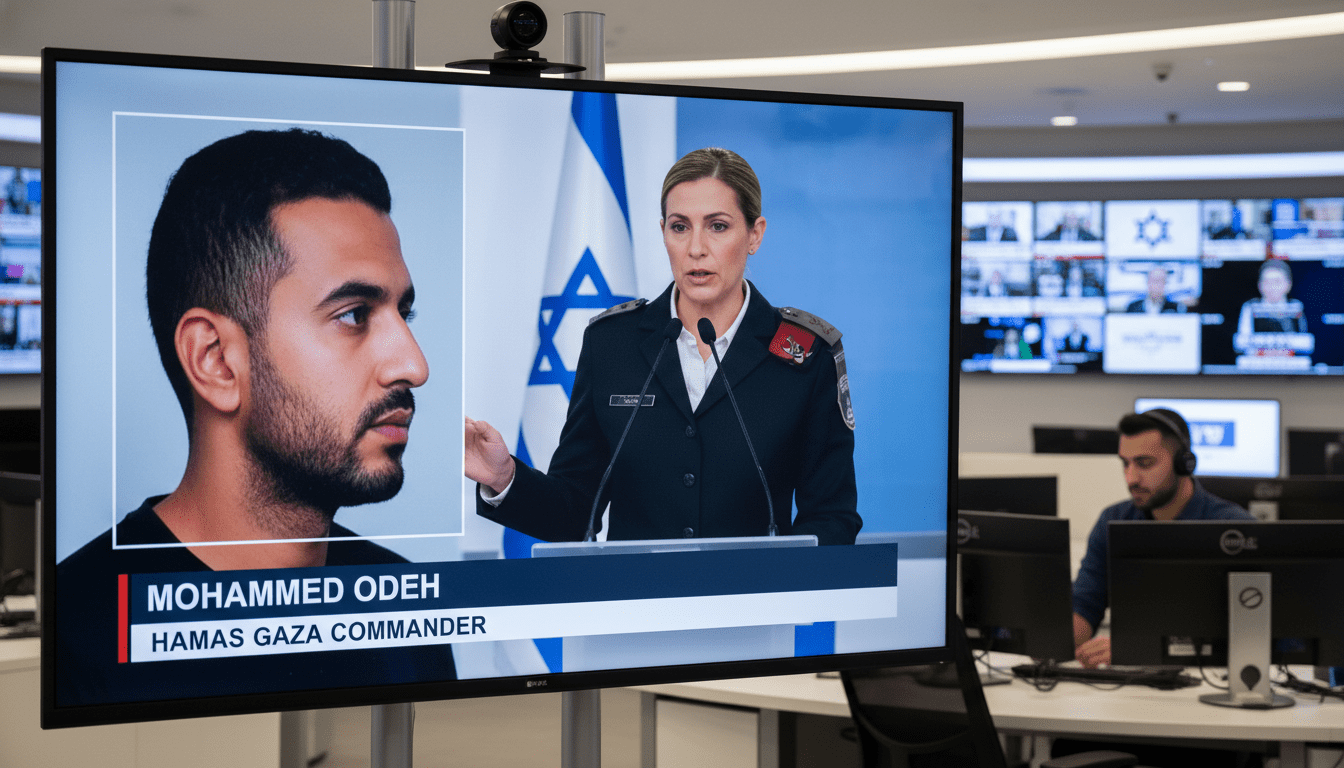
Israel says it killed Hamas military leader Mohammed Odeh in Gaza City
Israel says it killed Hamas military leader Mohammed Odeh in Gaza City after months of surveillance; Gaza medics report multiple fatalities and the strike raises ceasefire tensions.
Israeli forces and domestic intelligence agency Shin Bet said on Tuesday that Mohammed Odeh, identified by officials as the senior military commander of Hamas in the Gaza Strip, was killed in an airstrike in Gaza City. Prime Minister Benjamin Netanyahu and Defence Minister Israel Katz acknowledged the operation, with Israeli authorities saying Odeh had been under months of surveillance and was targeted in a deliberate strike.
The Israeli statement described Odeh as one of the last senior commanders involved in planning and carrying out the October 7 attacks that ignited the current hostilities. Shin Bet and the Israel Defense Forces (IDF) said the operation followed intelligence that linked Odeh to planning roles, and that the strike aimed to disrupt remaining Hamas military command capabilities.
Gaza medical sources report casualties
Gaza medical personnel reported that Mohammed Odeh and four family members were among those killed in the strikes, and that a total of six people died in Gaza City during the operation. Hospital and emergency service statements that reached international outlets described chaos after the overnight raids and confirmed multiple fatalities, though reporting from Gaza is restricted and verification remains limited.
Local medical officials said bodies were recovered from strike sites and that hospitals treated wounded civilians, but access and independent corroboration are constrained by security conditions. The casualty figures released by Gaza medics differ from the precise toll offered by Israeli authorities, underscoring the difficulty of verifying battlefield reports in the enclave.
Israel cites months-long surveillance before the attack
Israeli military briefings said Odeh had been tracked for months before the strike and that intelligence showed his elevated role after the death of a predecessor. Officials portrayed the operation as the culmination of a concerted intelligence effort to locate a figure they described as central to recent Hamas military planning.
Israeli authorities emphasized the timing of the strike as deliberate, saying it targeted a person they held responsible for past attacks and who posed an ongoing operational threat. The IDF statement framed the action within a broader campaign to degrade Hamas’s military leadership in Gaza.
Predecessor Iss al-Din al-Haddad killed weeks earlier
About one and a half weeks before Odeh’s reported death, Israel confirmed the killing of Iss al-Din al-Haddad in a separate airstrike, naming him as another senior commander. Israeli officials at the time characterized al-Haddad as a key planner of the October 7 assaults and said his killing removed one of the group’s chief operational figures.
Israeli statements have said Odeh assumed command of the Gaza military wing shortly after al-Haddad’s death, though Hamas has not formally acknowledged either leadership succession. The rapid succession of reported strikes on senior commanders has unfolded amid persistent tensions along the ceasefire lines.
Hamas sources report deaths but give no formal confirmation
Hamas-affiliated sources relayed to regional media that Mohammed Odeh had been killed, but the organization did not issue an immediate, formal confirmation. The absence of an official Hamas statement leaves room for uncertainty, even as multiple local reports and intelligence assessments align with Israeli accounts.
Both Israeli officials and Hamas representatives routinely release competing narratives in the wake of such operations, and independent verification remains challenging. Analysts caution that wartime information environments are often fragmented and that claims from any side need corroboration.
Ceasefire in place since October 2025, but violations persist
An official ceasefire has been in effect since October 2025, yet both Israel and Hamas have repeatedly accused the other of violations, and isolated strikes and skirmishes have continued. Israeli officials framed the strike on Odeh as a targeted counterterror measure, while critics warn that such actions risk undermining the fragile truce.
International and regional actors have repeatedly urged restraint to prevent a broader escalation, noting that leadership decapitation campaigns can provoke retaliatory attacks. Diplomatic channels remain active but strained, with ongoing concern that renewed exchanges could prompt a wider surge in violence.
The reported killing of Mohammed Odeh marks another high-profile removal of a figure Israel alleges was central to the October 7 attacks, and will figure in assessments of whether the ceasefire can hold. Verification of the details rests on further reporting from Gaza and statements from Hamas, both of which are likely to emerge in the coming days.
