
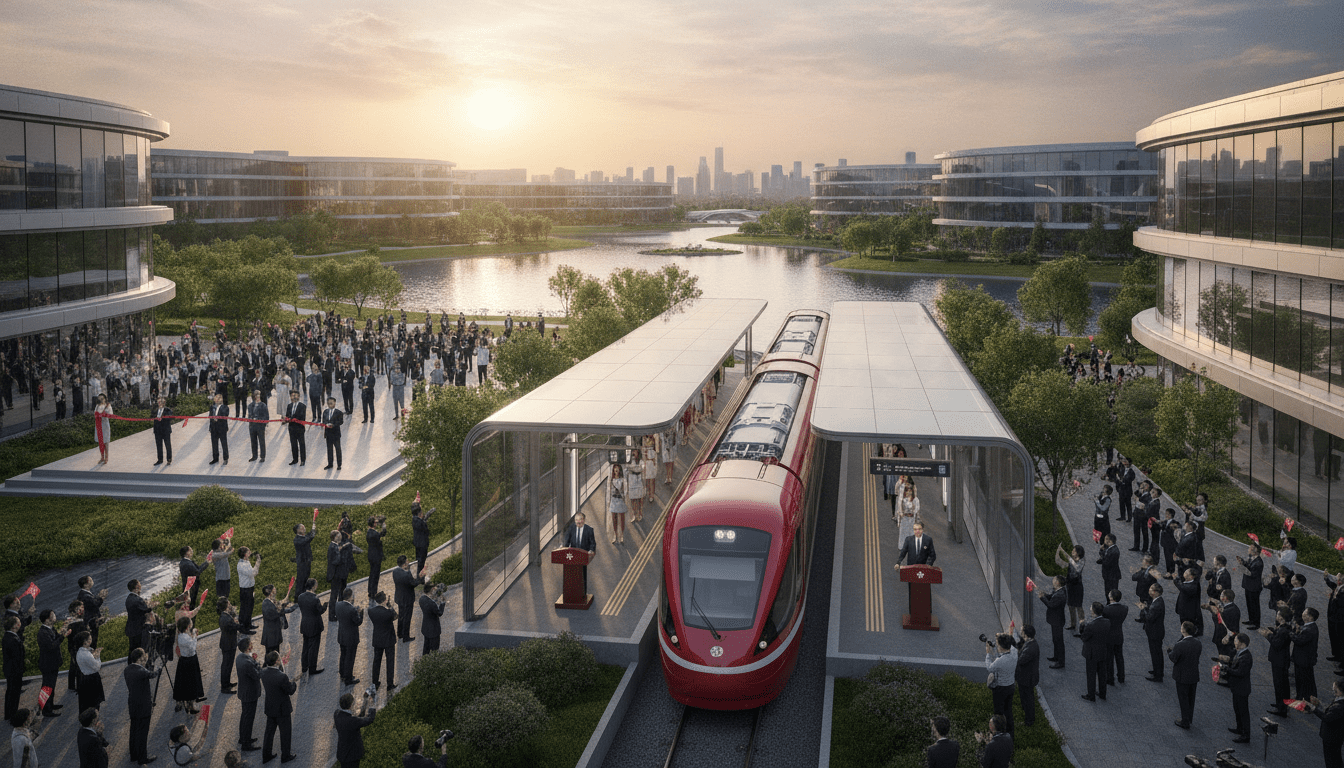
Huawei Shanghai R&D campus debuts eclectic design with Swiss-style shuttle
Huawei Shanghai R&D campus opens with eclectic architecture and a Swiss-style shuttle train, aiming to centralize research and improve employee mobility.
Huawei unveiled a striking new research and development site in Shanghai that blends playful architecture with practical transport links, the Huawei Shanghai R&D campus serving as the headline feature of the rollout. The campus pairs an Austrian castle facade and a tower with Soviet-era references with a bright red Swiss-style train that circulates at frequent intervals. The design and internal circulation are intended to knit disparate office clusters into a single R&D ecosystem.
Design mixes European castle motifs and industrial tower
The campus incorporates an array of architectural references that visitors describe as unexpected for a corporate research center. One wing resembles an Austrian castle while another rises as a blocky tower with austere lines that recall midcentury industrial towers. The juxtaposition signals a deliberate aesthetic choice to make the campus visually distinctive in Shanghai’s dense urban fabric.
Red Swiss-style shuttle runs on frequent schedule
At the center of daily movement is a red train described as Swiss in style that loops through the site on a tight timetable. The shuttle serves employees in short intervals and connects office clusters to internal hubs named Central Station and Watertown. Company planners say the frequent service reduces walking time between research groups and helps maintain punctuality for collaborative meetings.
Central Station and Watertown act as campus anchors
Two labeled hubs, Central Station and Watertown, serve as the focal points for internal navigation and amenities across the campus. Central Station functions as a transport interchange and orientation point for visitors and staff, while Watertown groups social spaces and services near research floors. The arrangement underlines an effort to combine mobility and amenity planning as part of a single campus strategy.
Huawei casts the site as a research and innovation nucleus
The complex is presented as a concentrated R&D facility that supports cross disciplinary collaboration among engineering, software and product teams. Huawei has emphasized research investment in recent years and the campus architecture appears to reinforce that narrative by creating physical spaces meant to encourage informal interaction. Interior circulation, shared hubs and predictable transport all support the company’s stated goal of accelerating product development cycles.
Urban impact and public perception in Shanghai
Observers note that such large private research campuses reshape how corporations interact with urban neighborhoods by introducing gated internal networks and branded public faces. The Huawei Shanghai R&D campus adds a new architectural landmark that will be visible to commuters and may influence nearby real estate and local services. Local planners and residents will watch how the site integrates with Shanghai’s wider transit and commercial patterns over time.
The campus demonstrates a blend of design risk and operational intent that reflects broader trends in corporate research facilities, where identity and employee experience are engineered alongside technical capacity. The red shuttle and contrasting building styles make the site immediately recognizable, while the internal hubs aim to convert visual distinctiveness into daily operational efficiency. Overall, the Huawei Shanghai R&D campus presents a clear example of how modern tech firms use architecture and logistics to shape research culture and talent retention.
