
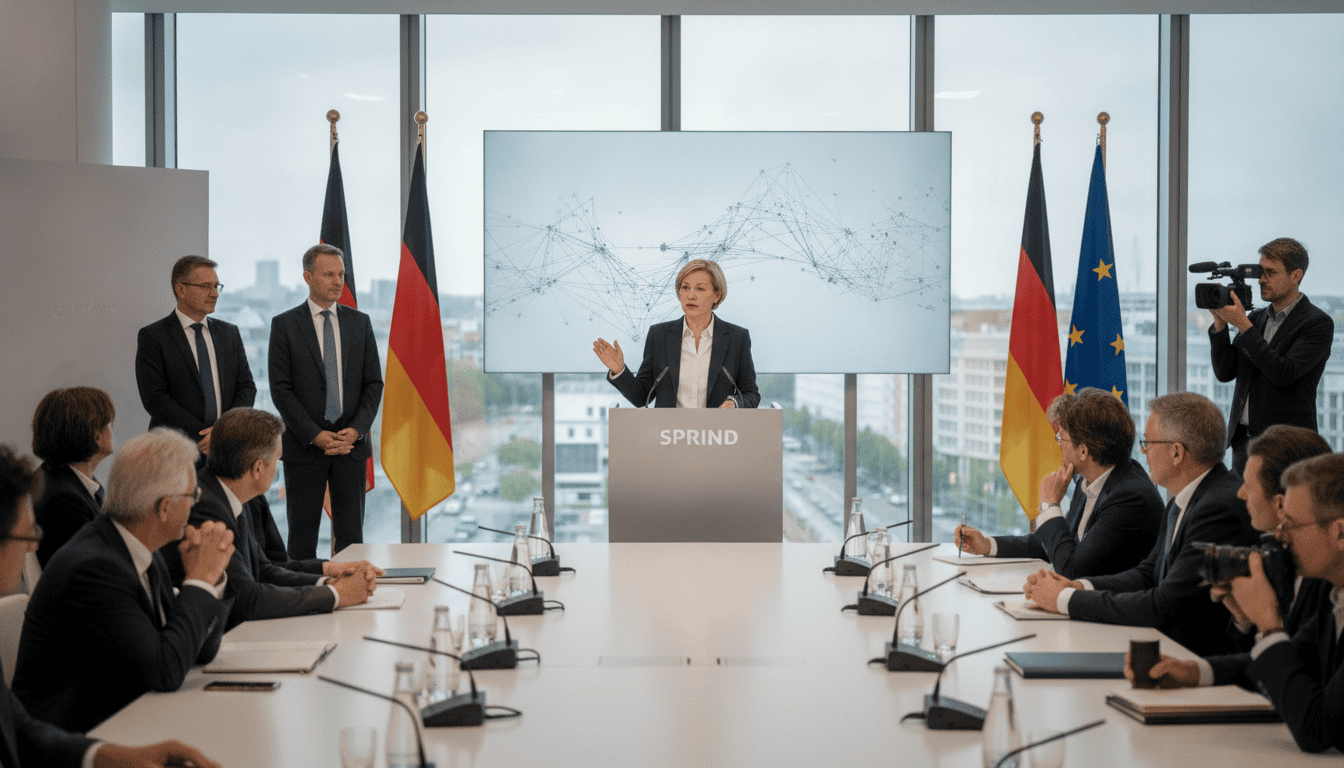
Sprind’s Strategy: Can Innovation in Germany Be Restarted?
Sprind, led by Rafael Laguna de la Vera, backs breakthrough tech to revive innovation in Germany, examining AI’s role and turning inventions into businesses.
Germany’s economy faces a difficult stretch marked by layoffs, insolvencies and an innovation shortfall, and the question of how to reignite innovation in Germany has taken center stage. The federal agency Sprind, founded to fund “sprung” or leap innovations, is positioning itself to bridge the gap between laboratory ideas and marketable enterprises. In a recent discussion on the ZEIT business podcast, Sprind’s director outlined the agency’s methods while journalists weighed in on where Germany stands in artificial intelligence and commercialisation.
Sprind’s mandate and approach
Sprind was established to finance high-risk, high-reward technologies that could transform daily life and competitiveness. Its remit covers projects that traditional funders often dismiss as too speculative, and it operates with the explicit aim of accelerating prototypes into scalable ventures.
Under Rafael Laguna de la Vera, the agency has emphasized hands-on support alongside funding, seeking to reduce bureaucratic hurdles and connect inventors with industry partners. The approach reflects a shift from incremental grant-giving to active portfolio development and targeted follow-through.
From invention to company: the commercialization challenge
Germany continues to produce scientific breakthroughs, but those breakthroughs infrequently become startups or new business lines, industry observers say. Structural factors — risk-averse investors, complex regulatory regimes, and a conservative corporate culture — are often cited as obstacles to translating research into market activity.
Sprind’s strategy focuses on the commercialization gap by offering not only capital but also coaching, pilot facilities and access to networks that can validate and scale early-stage concepts. The agency aims to reduce the time between proof-of-concept and first customer, thereby improving the odds that an invention becomes a sustainable enterprise.
Evidence of decline and the urgency for action
Recent industry surveys and economic analyses indicate a decline in the number of “very innovative” firms and a marked drop in innovation activity among small and medium-sized enterprises over the past two decades. Several major companies have relocated research and development abroad, intensifying concerns about lost capabilities and future value creation.
Those trends underscore the urgency behind Sprind’s mission: preventing further erosion of domestic R&D capacity and reviving a pipeline of commercially viable technologies. Policymakers and business leaders now face pressure to coordinate incentives and remove barriers that discourage entrepreneurial risk-taking.
The nationwide idea drive and public engagement
Sprind organized a large-scale solicitation of ideas that gathered roughly 30,000 suggestions from citizens, researchers and practitioners across Germany. The campaign was designed to surface practical problems and inventive solutions that might otherwise be overlooked in formal research channels.
The volume and variety of proposals highlighted both latent creativity and the need for systems that can triage, test and scale promising concepts. Sprind’s leaders say the initiative is intended to reveal real-world priorities and to channel grassroots innovation toward projects with societal impact.
Artificial intelligence and Germany’s competitive position
Experts on the podcast argued that artificial intelligence is both an opportunity and a test of Germany’s capacity to catch up with global competitors. While German researchers contribute to foundational AI work, commentators said the country lags in deploying AI at scale within industry and forming startups that can compete internationally.
Closing that gap will require targeted investments, faster regulatory clarity, and stronger linkages between research institutions and entrepreneurial ecosystems. Sprind views AI as one of several domains where leap innovations can generate disproportionate economic and social returns if supported aggressively.
Industry and policy responses under consideration
Business groups and government agencies are debating complementary measures to strengthen innovation in Germany, from tax incentives and procurement strategies to streamlined funding pathways. Some proposals emphasize convening cross-sector consortia to tackle national challenges, while others call for more permissive risk capital regimes.
Industry leaders stress that public initiatives must be predictable and patient, matching the long horizons required for transformative technologies. Sprind’s model of sustained engagement with selected projects is presented as an example of how state support can be structured to produce tangible outcomes.
The recent podcast episode brought these debates into sharp relief by pairing Sprind’s operational perspective with journalistic analysis of where Germany stands on AI and commercialization. Listeners heard both the optimism of targeted public backing and the sober realities of a shifting global innovation landscape.
If Germany is to rebuild a robust pipeline of marketable inventions, the conversation now moves from diagnosis to coordination: aligning funding, regulation, corporate practice and talent development to make leap innovations feasible at scale. Only with that alignment can many of the country’s scientific strengths be converted into businesses that create jobs, exports and resilient growth.
