
Germany pushes modular construction with new subsidy plan and digital reforms
Berlin to boost modular construction with a new bonus scheme, centralised new-build funding and digital planning measures to cut costs and speed delivery.
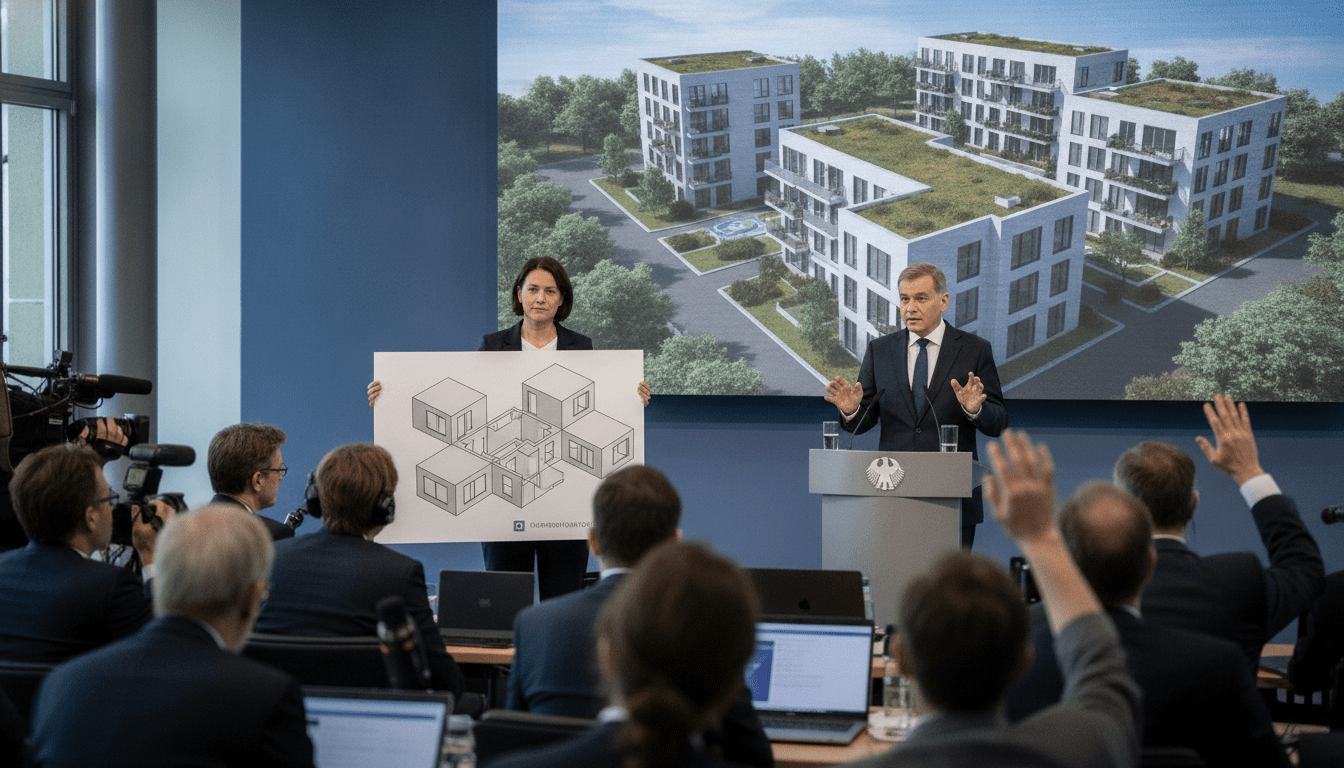
Germany will step up support for modular construction as part of a broader reboot of federal housing policy, government ministers told investors and industry representatives this week. The initiative aims to reward serial and modular building methods that prefabricate structural elements in factories to reduce on-site time, lower costs and improve quality, officials said at an investors’ conference in Frankfurt. Housing minister Verena Hubertz announced plans to consolidate and rework existing subsidies into a single, modular programme expected to start next year, while Finance Minister Lars Klingbeil highlighted existing investments and the potential scale of factory-based housing. The policy push responds to sharp declines in new housing completions and rising development costs, and it places modular construction at the center of the government’s strategy to accelerate delivery.
Federal bonus for modular construction proposed
The housing ministry intends to introduce a bonus system that gives financial credit to projects using serial or modular methods, linking support to demonstrable reductions in build time and cost. Officials say the scheme will not exclusively favour a single technical approach because EU state-aid rules limit targeted support, but it will reward efficiency gains across eligible projects. The aim is to make prefab components — from complete apartment modules to standardized façades and service cores — more attractive to investors and local authorities. Proponents argue that higher off-site quality control and shorter site durations will also reduce construction-site disputes and weather-related delays.
Centralised new-build funding to launch next year
Hubertz outlined plans to merge the current patchwork of federal incentives into one central programme for new construction, scheduled to begin next year and designed to be modular in structure. The new framework is intended to make funding simpler for municipalities, housing associations and private developers by consolidating existing instruments and introducing clearer eligibility criteria. The ministry expects the central programme to streamline administrative burden and to target public money more effectively toward projects that can deliver homes quickly and at lower overall cost. Details on exact incentive levels and application windows are being prepared and will determine how rapidly local projects convert to prefab approaches.
Digital building permits and regulatory changes targeted for 2028
As part of the cost-reduction drive, the ministry proposed making the digital building application mandatory by 2028 and expanding digital planning tools to cut administrative overhead. The plan includes a public platform called “Cost-Reduced Building” to showcase best practice projects and to promote repeatable, scalable solutions. Hubertz also proposed legal adjustments, such as introducing a new building type category and simplifying parts of the federal building code to reduce transactional friction. Officials say these digital and regulatory reforms are essential to capture the full efficiency potential of modular construction and to give developers greater predictability.
EH55 Plus climate programme extended with remaining funds
The ministry confirmed an extension of the EH55 Plus programme for particularly climate-friendly new builds and provided an update on uptake through mid-June. As of June 15, some 33,700 housing units had been supported with combined loans and grants totaling roughly €3.2 billion, and approximately €343 million remained available for further approvals. Eligible projects under EH55 Plus must plan for 100 percent renewable heat generation, a requirement the ministry says will accelerate low-carbon building practices alongside prefab delivery. At the same time the ministry signaled fiscal discipline, preparing cuts to housing benefit that are expected to reduce expenditures by about €1 billion in the federal budget.
Political and financial backing, and industry pushback
Finance Minister Lars Klingbeil pointed to a broader 500 billion euro infrastructure modernization fund that can channel additional resources into housing and related works. Klingbeil and other officials rejected caricatures of modular construction as synonymous with monotonous panel estates, noting positive examples of high-quality prefab projects in Germany and abroad. Still, industry representatives at the conference cautioned that financing costs and local permitting processes remain major hurdles, and that scaled prefab production requires stable demand signals from public and private clients. The ministry intends to use the new central programme and bonus mechanisms to create those signals and to attract investors back into large-scale housing delivery.
Housing shortfall and a missed target
Supply-side indicators underscore the urgency: housing completions fell by 18 percent last year to about 206,600 new units, leaving a substantial gap in urban areas where demand is highest. The previous federal coalition had set an aspirational aim of 400,000 new homes per year, a target that was not met and that the current minister has not re-established as a precise numerical goal. Hubertz told attendees the government had already mobilized record funding for housing programmes but stressed that costs must be driven down and that federal, state and municipal governments must work closely with the private sector. The emphasis on modular construction is presented as one practical lever among several to restore momentum.
Germany’s new-build strategy now rests on aligning subsidy architecture, digital permitting, climate standards and industrialized building techniques to shorten delivery times and control escalating costs. If implemented as described, the package could accelerate adoption of modular construction and channel remaining climate funding into renewable-heated housing, but success will depend on clear programme design, compliance with EU rules and close cooperation between governments and developers. The next months will test whether the proposed bonus system and regulatory changes can translate factory-made efficiency into more affordable homes on the ground.
