
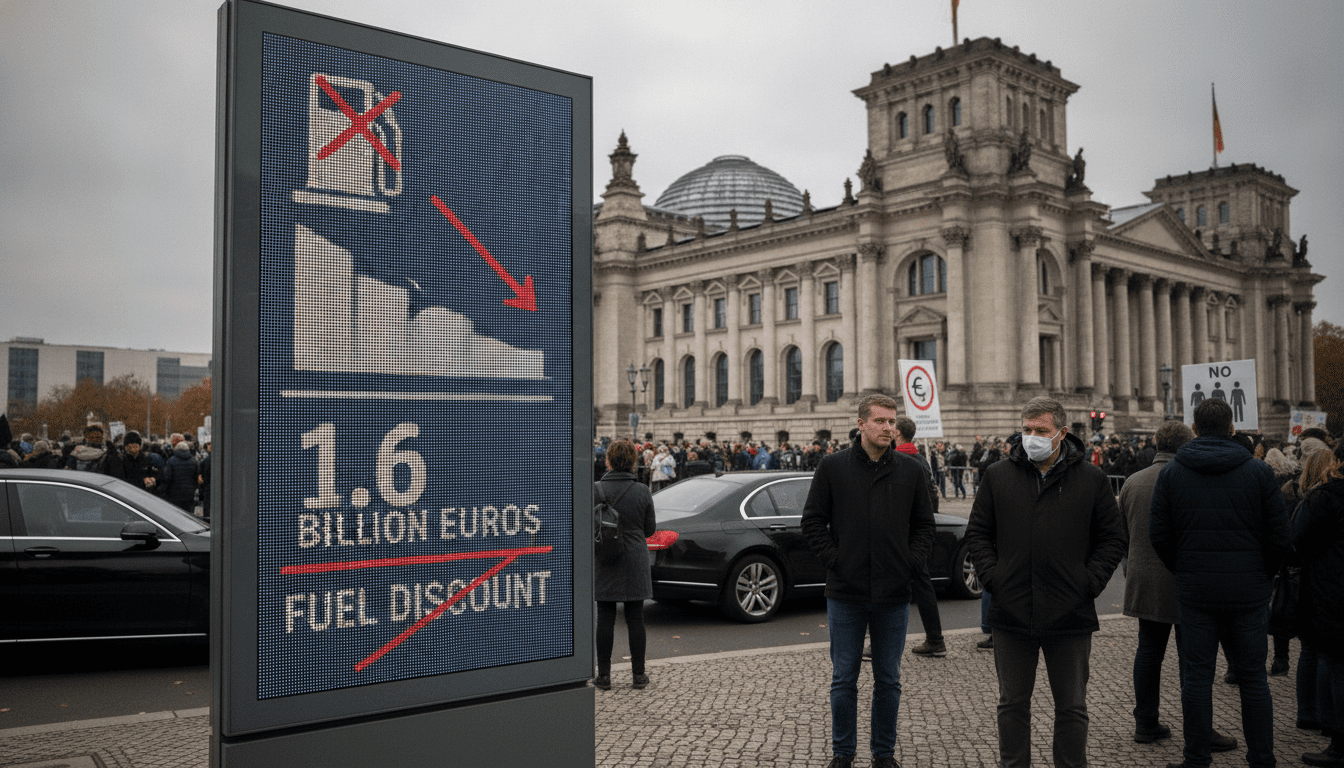
Germany to Let 1.6 Billion Euro Fuel Discount Expire at Month-End, Coalition Says
Germany will let a 1.6 billion euro fuel discount expire on June 30, 2026, the Union-SPD coalition has agreed, with no immediate replacement planned amid ongoing oil-price uncertainty.
Germany’s coalition government has decided not to extend a 1.6 billion euro fuel discount that was introduced in response to high global oil prices, sources in the Union and SPD told the Süddeutsche Zeitung. The subsidy will expire on June 30, 2026, and officials say there is currently no substitute measure. Lawmakers and ministers stressed they will monitor energy markets closely and stand ready to act should conditions in the Persian Gulf escalate and send crude prices sharply higher.
Coalition Decision and Effective Date
The Union and SPD reached a consensus within coalition circles to allow the temporary fuel discount to lapse at the end of June 2026. Cabinet insiders described the choice as pragmatic, framed by current market assessments and budgetary constraints.
Officials said the government’s immediate focus is on targeted fiscal measures rather than extending broad consumer subsidies, which would add to public spending at a time of competing priorities. Sources emphasized that the decision was taken with the caveat that crisis-driven reinstatement remains possible if external risks intensify.
Origins and Financial Scale of the Discount
The fuel discount was introduced earlier in response to spikes in global oil prices that were squeezing household budgets and business costs. The government allocated roughly 1.6 billion euros to the measure, aiming to blunt the impact of elevated pump prices for motorists and freight operators.
Economists and fiscal officials have debated the effectiveness of such measures, noting that temporary price interventions can provide immediate relief but carry distributional and fiscal trade-offs. The program’s cost and limited duration were key factors in the coalition’s assessment of whether an extension would be justified.
Contingency Planning and Monitoring
Ministers said they will continue to monitor developments in crude markets, with particular attention to geopolitical flashpoints in the Persian Gulf. The government has set internal thresholds and review points that would trigger emergency action if a rapid escalation pushed oil prices to levels that threaten domestic economic stability.
Officials declined to specify precise price triggers, saying instead that any response would balance timeliness with fiscal prudence. The coalition signaled it prefers reserve measures that can be deployed quickly rather than broad, open-ended subsidies.
Market and Consumer Implications
Analysts warned that removing the fuel discount could increase costs at the pump for households and businesses, although the exact impact will depend on prevailing wholesale oil prices and refining margins. Motorists in Germany could see modest price increases if global crude remains elevated, while logistics and transport sectors flagged tighter margins in an already cost-pressured environment.
Retail fuel prices are influenced by taxes, refinery margins and exchange rates as well as crude costs, so the net effect for consumers may be smaller than the full value of the expired subsidy. Still, consumer groups urged the government to keep vulnerable households in view and to consider targeted support if fuel price shocks materialize.
Political Responses and Parliamentary Outlook
The decision not to renew the fuel discount drew mixed reactions across the political spectrum. Opposition parties accused the coalition of abandoning drivers, while some lawmakers within the governing parties argued that one-off consumer subsidies are not a sustainable long-term policy. Coalition leaders defended the step as a measured response that preserves fiscal flexibility.
Parliamentary debates are expected in the coming weeks as MPs press for clarity on contingency plans and possible compensatory measures for low-income households. The finance ministry has signaled it will provide updated assessments if market conditions deteriorate.
What happens next will depend on developments in global oil markets and the geopolitical situation in energy-producing regions. The government has left the door open to temporary relief if crude prices spike again, but any reintroduction of a fuel discount would likely be targeted, time-limited and tied to clear emergency criteria.
The coalition’s decision to let the fuel discount expire reflects a balancing act between immediate consumer relief and longer-term fiscal priorities, with officials keeping contingency options available should external shocks demand renewed intervention.
