
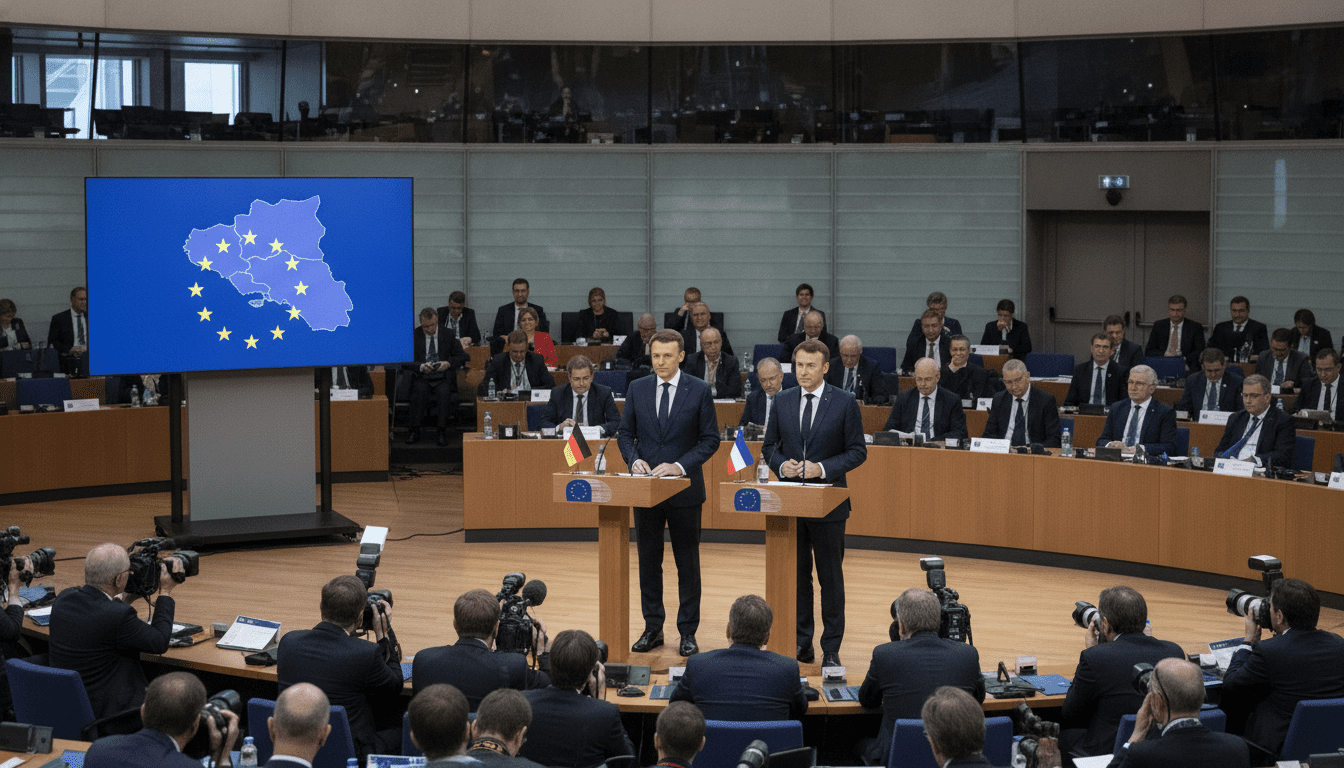
Germany and France Propose Stepwise EU Enlargement with Early Single-Market Access for Western Balkans
A Franco-German paper unveiled at the West Balkans summit in Tivat outlines a stepwise EU enlargement plan that would grant prepared candidate states privileged access to the EU single market before full membership. The proposal, aimed at accelerating reforms and consensus on EU enlargement, was circulated as an informal position paper and immediately drew attention in capitals across the region.
Diplomatic Push at the Tivat Summit
The paper, presented as a bilateral initiative by Germany and France, arrived as leaders met in Tivat for an EU–Western Balkans meeting. French President Emmanuel Macron and German Chancellor Friedrich Merz framed the idea as a way to revive a stalled enlargement agenda and to reward tangible reform progress. Berlin described the move as intended to inject momentum into accession talks, while Paris cast it as a pragmatic step to link incentives to outcomes.
Blueprint for Gradual Market Integration
At the core of the proposal is a staged model that prioritises privileged access to the EU single market and elements of Schengen for candidates that demonstrate substantive progress. The document proposes conditional, incremental rights — including “full participation in the single market” for states that complete required reforms and implement them in practice. drafters stress that this pathway is not meant to replace or delay full EU membership, but to create incentives for faster compliance with accession criteria.
Regional Leaders’ Responses and Expectations
Responses among Western Balkan capitals were mixed from the outset, reflecting divergent expectations about accession. Montenegro publicly insists it is on track for full membership by 2028 and rejects interim arrangements that might be perceived as substitutes for full EU status. Meanwhile, earlier interventions by regional figures — notably Albanian Prime Minister Edi Rama and Serbian President Aleksandar Vučić, who co-authored an op‑ed earlier this year calling for accelerated integration — appear to have informed parts of the German‑French thinking.
Risk of New Fault Lines within the Balkans
Analysts warn the plan could unintentionally deepen divisions if uptake is uneven across the six Western Balkan economies. Serbia, Albania and Montenegro have already opened accession talks and could rapidly qualify for privileged access if they accelerate reforms, while North Macedonia, Bosnia-Herzegovina and Kosovo face political and diplomatic obstacles that block their progress. That divergence could produce a de facto split: a trio of states integrated with the single market and three others remaining outside, with consequences for regional cohesion.
Borders that are today porous could become de facto harder lines if some states acquire single-market rights while neighbors do not. Increased customs and regulatory controls could alter longstanding patterns of cross-border movement for trade, work and family ties. Observers caution that creating visible economic tiers within the region risks fuelling grievances and complicating conflict-prone local dynamics rather than reducing them.
Mechanisms to Avoid Fragmentation
To blunt those risks, the paper and regional interlocutors have floated measures to broaden eligibility beyond states with open accession chapters. One suggestion is to allow countries that have not formally opened EU accession talks to qualify for single-market entry if they achieve specified reform benchmarks, subject to certification by the European Commission. Proponents argue that extending the opportunity would reduce incentives for a two‑tier Western Balkans and preserve regional integration efforts.
Opponents counter that granting market access without formal accession timelines could be interpreted as creating a long-term substitute for full membership, undermining the promise that EU membership remains the ultimate objective. Berlin and Paris insist their proposal is not a replacement for accession, but uncertainty remains about how implementation rules and political oversight would be structured.
Questions over Moldova and Ukraine’s Place in the Plan
The German‑French paper explicitly cites the Western Balkans and the Republic of Moldova as potential beneficiaries, but it does not extend the same language to Ukraine. That omission has prompted questions about the proposal’s scope and whether the offer of early single-market participation would apply selectively. Kyiv has repeatedly demanded a clear path to full membership; excluding Ukraine or leaving its status ambiguous would add another diplomatic fault line at a time when EU solidarity over the war remains a central political issue.
Moldova’s inclusion signals an interest in stabilising states at Europe’s eastern flank that are already in advanced relationships with the EU, but the absence of Ukraine from the proposal will likely become a focus of debate in Brussels and member-state capitals in the coming weeks.
The German‑French initiative now faces a delicate political test: it must persuade a broad range of EU governments and the European Commission that conditional early market access both accelerates reforms and preserves the integrity of the accession promise. How the EU balances incentives, safeguards and regional cohesion will determine whether the plan becomes a practical tool for enlargement or a new source of regional tension.
