
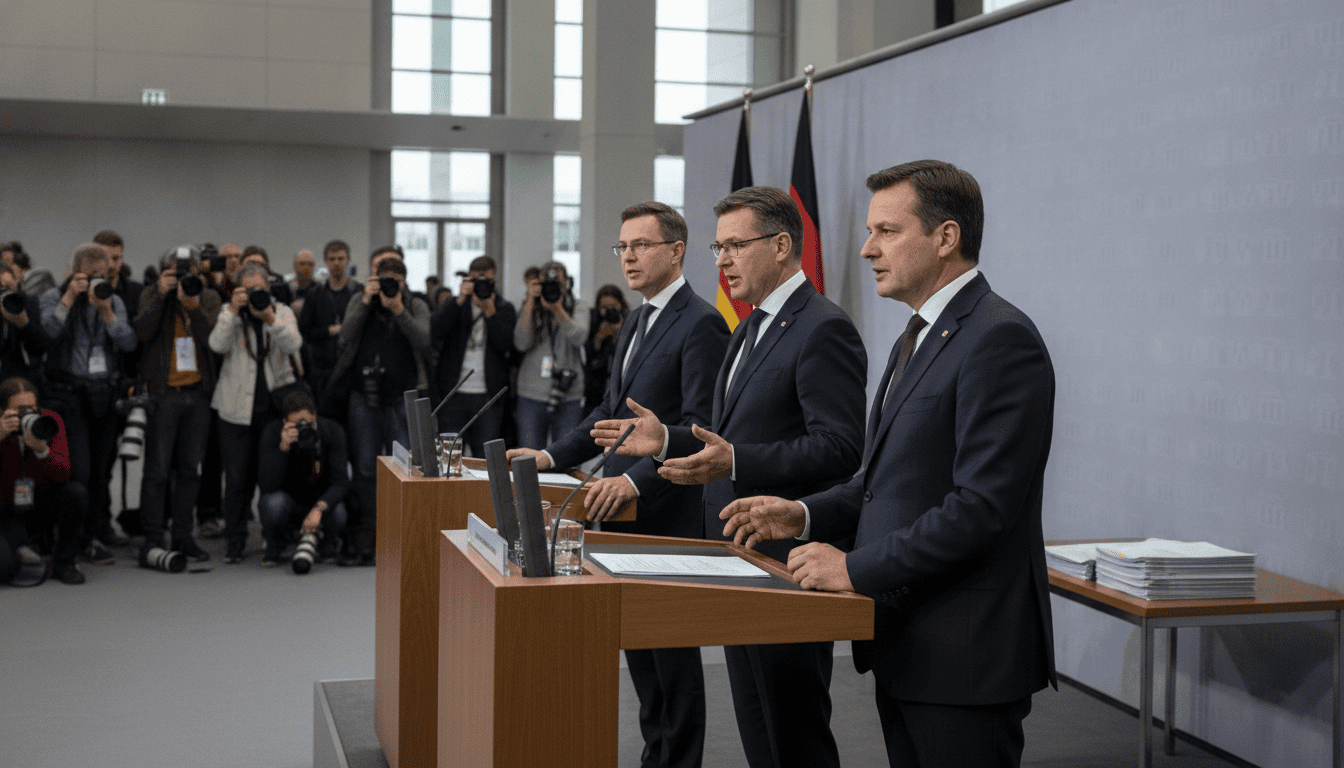
German pension reform faces collapse after eastern CDU leaders push for penalty-free early retirement
Germany’s pension reform is in jeopardy as a campaign by three CDU state premiers in the east pushing for an reinstated penalty-free early retirement threatens to unravel the comprehensive package agreed at the end of June. Chancellor Friedrich Merz’s broader plan, which sought to stabilize contributions and introduce a new capital-based retirement element, risks becoming unaffordable if the early-retirement concession remains in place.
Campaign by eastern CDU premiers derails agreement
The coordinated push by the three CDU ministers-president in eastern Germany has rapidly shifted the political calculus around the pension plan. Their public campaign for an immediate return to the Abschlagsfreie Frührente — a form of penalty-free early retirement — has amplified intra-party tensions and energized opposition to key trade-offs in the June agreement.
Pressure from these regional leaders has turned what were previously manageable policy debates into a direct contest over the reform’s central financing mechanisms. By foregrounding the costly early-retirement option, they have made it far harder for federal negotiators to reconcile the package’s fiscal and distributional aims.
Cost implications threaten the capital-based component
A core element of the June deal was the introduction of a new capital-based retirement instrument intended to relieve pressure on pay-as-you-go social contributions. That device depended on savings generated by tightening access to early retirement and moderating pension outlays.
Reinstating penalty-free early retirement would consume a large portion of those projected savings, officials warn, leaving little room to fund the planned capital-paid benefits. Analysts argue that without the early-retirement restriction the package’s fiscal math breaks down, forcing higher contributions or reductions in promised benefits.
Rising contribution burdens and economic trade-offs
Even before the current dispute, projected social contribution rates had been rising toward historically high levels. The reform negotiated in late June sought to cap further escalation while creating incentives for longer careers and private accumulation.
With the early-retirement demand in play, contributions that were already expected to approach the mid-40 percent range of gross wages could climb further. That trajectory would increase labor costs, complicate the government’s aim to revive investment and halt job losses in a stagnant economy.
Federal-state tensions over fiscal responsibility
The campaign has exposed a sharp federal-state divide: the eastern premiers advocating the costly concession do not control the national insurance funds that would shoulder the burden. Their stance has prompted criticism that regional political positioning is overriding responsibility for national fiscal sustainability.
This dynamic raises difficult questions about accountability and the institutional mechanisms for coordinating social policy across Germany’s federal system. Observers note that reform of national pension architecture requires cooperation that crosses state-level political incentives.
Political test for Chancellor Merz and CDU unity
The dispute poses an acute political test for Chancellor Merz, who had sought to project reform momentum before the parliamentary summer recess. To salvage the package he faces a choice between pressuring party colleagues and regional allies or abandoning significant elements of the agreement.
A decisive federal intervention could reimpose discipline, but it risks deepening intra-party fractures at a delicate moment. Conversely, capitulation to the eastern premiers could resolve the immediate party conflict while leaving the reform fiscally unsound and politically contested in the Bundestag.
Possible paths forward and parliamentary hurdles
With the comprehensive package in jeopardy, several scenarios are now plausible: renegotiation toward a smaller, more incremental reform; a reconfigured deal that substitutes different savings measures; or a full collapse that leaves the status quo intact. Each path carries trade-offs between political feasibility and long-term sustainability.
Parliamentary debate will test whether compromises can be engineered that preserve both the objective of stabilizing contributions and the introduction of capital-based elements. Any solution will require clear fiscal guardrails and agreement on how to balance intergenerational fairness with near-term social protections.
Public confidence in the policy process may hinge on whether lawmakers can translate technical trade-offs into a coherent, durable plan. The speed and tone of the coming negotiations will determine whether the reform can be rescued or whether Germany will face renewed uncertainty over pension financing.
The collision between regional political campaigning and national fiscal planning has turned a moment of reform optimism into a high-stakes dispute that will shape retirement policy and labor-market prospects for years to come.
