
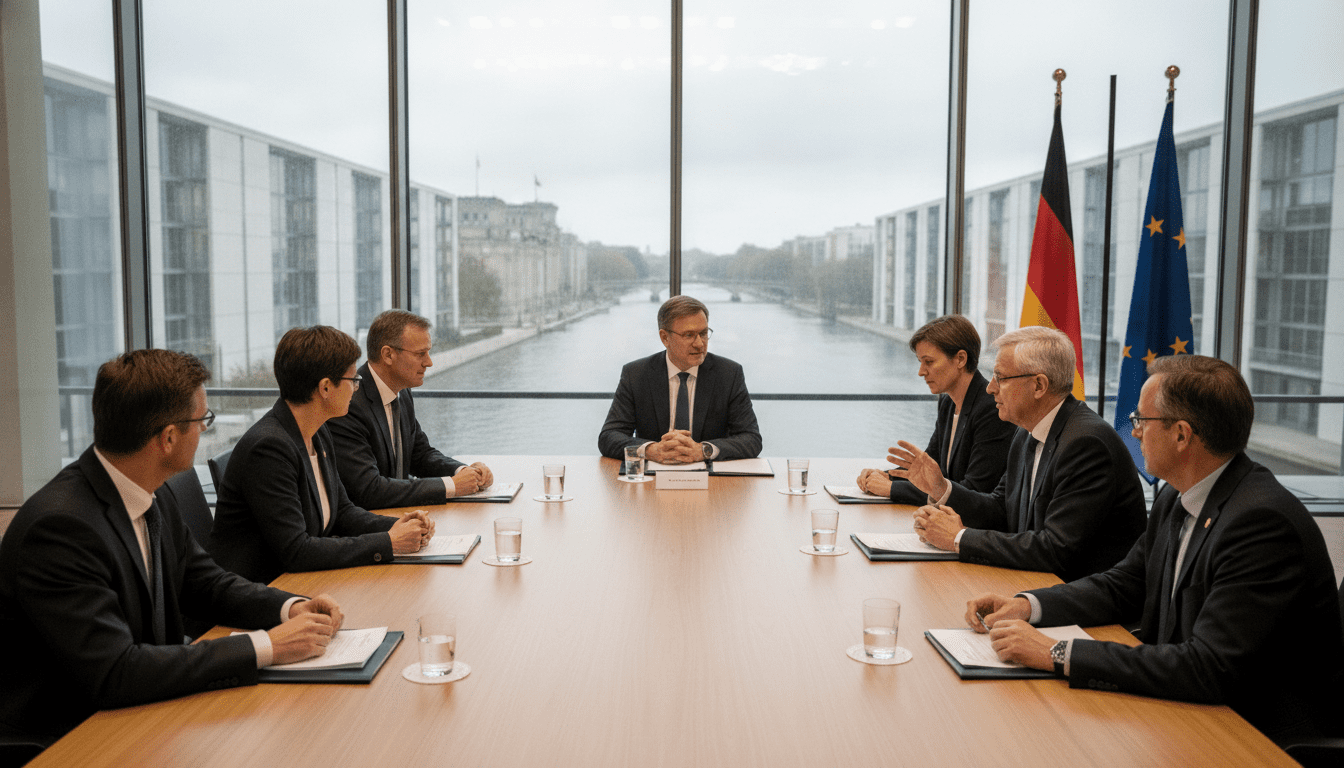
Germany social partners summit held at Chancellery to seek common ground on reforms
Government convenes meeting with employers and unions to exchange positions and identify overlaps ahead of pending reform debates.
The Germany social partners summit, chaired by Chancellor Merz at the Federal Chancellery, brought top employer and union leaders together for a structured exchange of political positions and ideas on upcoming reforms. The federal government made clear that the session was designed as a fact-finding and alignment meeting rather than a decision-making forum. Officials said the objective was to map areas of overlap that could ease legislative debate on the reform agenda in the weeks ahead.
Chancellor Merz chairs meeting at the Federal Chancellery
Chancellor Merz opened the talks with a call for constructive dialogue among stakeholders, framing the meeting as an opportunity to clarify priorities and trade-offs. Government sources stressed the meeting’s role as a convening device to surface consensus points, not to finalize policy. Participants were asked to focus on concrete proposals and areas where employers and unions might converge on reform design.
Government aims to identify overlaps before parliamentary debate
A government spokesperson described the summit as intended to provide clarity on “schnittmengen”—overlapping positions—so ministers and legislators could better prepare for formal reform proposals. The vice government spokesman, Steffen Meyer, said officials would welcome any common understanding of challenges and next steps that emerged from the discussions. The administration emphasized that outcomes from the summit would inform, but not pre-empt, upcoming interministerial and parliamentary deliberations.
Representative delegations from employers and unions attended
On the employers’ side, the meeting included the heads of the Confederation of German Employers’ Associations (BDA), the Federation of German Industries (BDI), the Association of German Chambers of Commerce and Industry (DIHK), and the German Confederation of Skilled Crafts (ZDH). Labour interests were represented by senior leaders from the German Trade Union Confederation (DGB), the service workers’ union Verdi, IG Metall, and the IG Bergbau, Chemie, Energie (IG BCE). Each delegation was instructed to present both red lines and areas where compromise might be possible.
No decisions taken but government seeks practical signals
Officials reiterated that the session was diagnostic rather than determinative, with no formal votes or commitments scheduled. Nevertheless, the government signaled it would consider any practical signals of agreement as helpful for shaping timelines and drafting legislative text. Ministers who followed the meeting said they would take the contours of the discussion back to their departments for more detailed assessment.
Stakeholder priorities highlighted in high-level exchanges
Participants used the forum to reiterate longstanding priorities: employers underscored competitiveness and regulatory clarity, while unions stressed social protection and fair transition measures for workers. Across the room, speakers acknowledged the need to reconcile economic efficiency with social safeguards, though the precise balance remains subject to negotiation. Several attendees noted that identifying narrow technical fixes where agreement is possible could speed up progress on larger, more contentious items.
Next steps include follow-up consultations and legislative preparation
Government officials indicated that the summit would be followed by targeted consultations between relevant ministries and stakeholder representatives to translate identified overlaps into draft measures. Parliamentary committees and party groups are expected to receive briefings in the coming days as ministers refine reform proposals. The administration described the summit as one stage in a broader, iterative process that will involve additional stakeholder input and formal legislative steps.
The summit at the Federal Chancellery underscored the government’s preference for early, structured dialogue with social partners as it prepares a reform package, while firmly reserving political decisions for later stages of the process.
