
Rising energy prices slow German economy’s rebound, Merzometer shows pre-conflict momentum
Rising energy costs and geopolitical shocks have weakened the German economy. Merzometer showed growth before 28 February, yet GDP forecasts were cut to 0.5%.
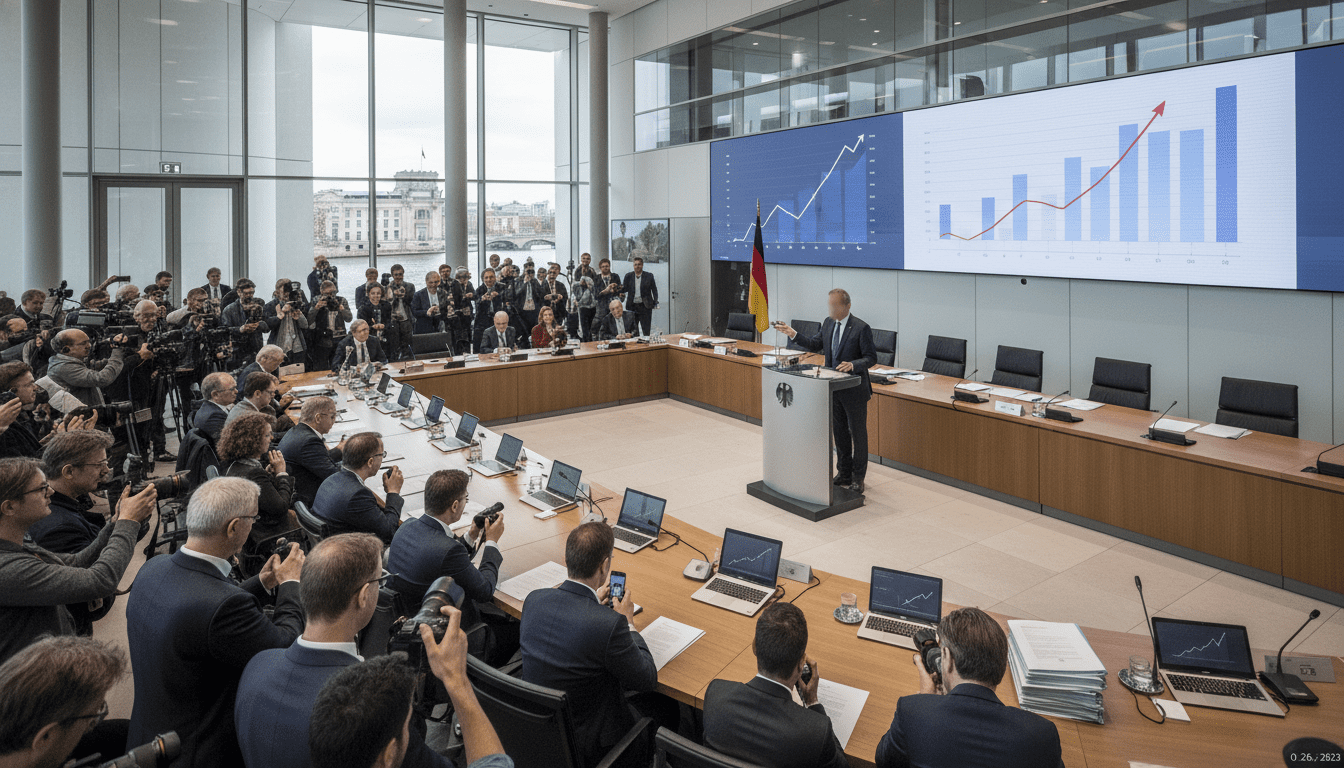
The German economy has lost momentum as surging energy prices and international tensions push policymakers and analysts to lower growth expectations. New data from the Merzometer indicate the economy was on an upward trajectory before the outbreak of fighting in the Middle East on 28 February, but that trajectory has been undermined by higher costs and global uncertainty. The federal government now expects gross domestic product to expand by just 0.5 percent this year, reflecting a sharp reassessment of near-term prospects.
Merzometer points to pre-conflict growth
The Merzometer, an index used by ZEIT to evaluate the government’s economic performance, registered positive movement in the quarter before the conflict began. The index suggests private demand and industrial output were showing signs of recovery after earlier shocks to supply and demand. Analysts view the pre-conflict uptick as evidence that domestic fundamentals had been stabilising prior to the renewed external shock.
Energy prices have become the dominant drag
Rising wholesale and retail energy prices are now the main headwind for households and businesses, eroding purchasing power and squeezing profit margins. Firms in energy-intensive sectors have already reported higher input costs, prompting production adjustments and, in some cases, investment deferrals. The cumulative effect has been sufficient for several research institutes to revise their growth forecasts downward in recent weeks.
Federal government trims GDP forecast to 0.5 percent
Officials in Berlin have adjusted official expectations to reflect the new environment, forecasting a modest 0.5 percent expansion for the year. The downgrade encapsulates weaker private consumption, increased business caution, and the knock-on effects of tighter global financing conditions. While a smaller deficit and some stabilisation in public finances are cited as positives, the slim growth projection places pressure on policymakers to balance support measures with fiscal discipline.
Labour market shows resilience but rising unemployment
Despite the slowdown, labour market indicators remain mixed rather than uniformly negative. Employment levels have held up in several sectors, and wage growth has continued in many segments, offering some protection for consumer spending. However, unemployment has edged higher as hiring plans are postponed and firms adjust staffing in response to lower demand, signaling a gradual weakening that could weigh on domestic consumption if it persists.
Public investment and private sentiment are misaligned
Public investment has been portrayed as a stabilising force, but its pace has not been sufficient to fully offset declines in private-sector activity. Business and consumer sentiment indices have turned more cautious amid the energy shock and geopolitical uncertainty, leading to lower capital expenditure and reduced big-ticket household purchases. Economists warn that unless sentiment stabilises, the recovery visible before the conflict may stall or reverse.
Construction and property markets show tentative improvement
Amid the broader slowdown, the construction sector and parts of the real-estate market have shown modest signs of improvement. Lower mortgage rates compared with earlier peaks, combined with persistent housing demand, have eased some pressures and supported activity in building and renovation. Still, higher material and energy costs complicate profitability for construction firms, tempering the positive signals from sales and permit data.
Geopolitical risk clouds medium-term outlook
The conflict in the Middle East has introduced a persistent layer of uncertainty that could amplify energy market volatility and disrupt trade and supply chains. Market participants are monitoring the situation closely for any escalation that might drive further price spikes or shipping disruptions. Economists caution that elevated geopolitical risk will likely keep investment decisions conservative and could slow the pace of any sustained recovery.
Policy trade-offs are now central to the debate in Berlin, where ministers must weigh targeted relief for vulnerable households and businesses against the need to maintain fiscal headroom. The Merzometer’s indication of pre-conflict growth complicates that calculus by showing the recovery potential that now risks being lost. Absent a rapid easing of energy price pressures or a stabilisation in global tensions, next quarters are likely to reflect subdued activity, making policy choices over investment, support, and inflation management particularly consequential.
