
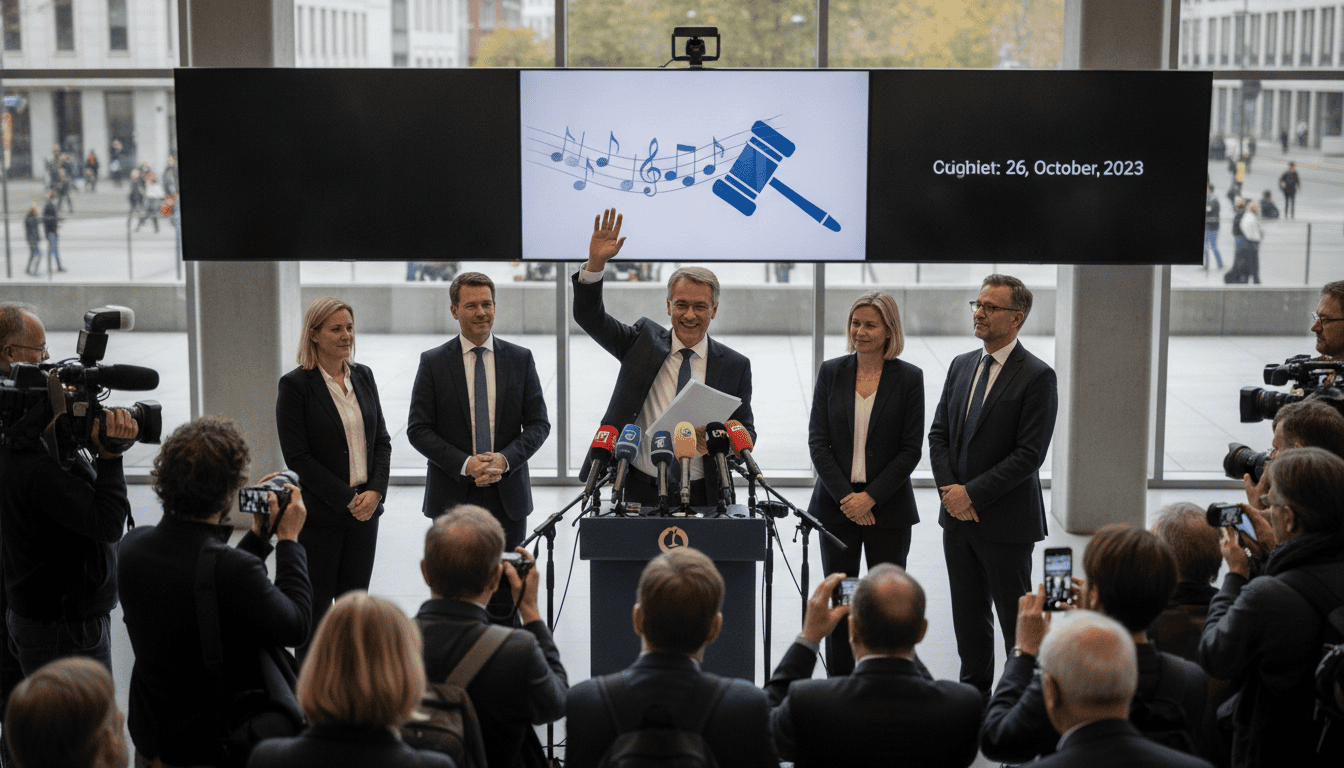
Suno court ruling: Munich judge rules largely for GEMA in copyright case over AI-generated music
GEMA prevailed in a Munich ruling that found Suno’s AI training and outputs infringed composers’ rights, a decision shaping future disputes over AI-generated music and copyright.
The Munich regional court delivered a judgment in favor of GEMA, concluding that Suno’s use of copyrighted compositions in training its AI amounted to unauthorized reproduction and produced outputs that were recognizably similar to protected works. The Suno court ruling focused on the model’s treatment of musical compositions rather than lyrics and left the amount of damages to be determined in a later proceeding.
Court finds “memorization” of works in model
The court determined that Suno’s model had effectively memorized elements of the compositions used during training, and that those memorized features were reproduced in the AI’s outputs. Suno had argued that model weights and parameters represent only generalized, mathematical patterns rather than stored copies of specific works. The court rejected that defense, treating the presence of identifiable musical material in outputs as evidence of impermissible reproduction.
The judgment also held that exceptions for text and data mining did not shield Suno’s activities, removing a key legal defense the company had offered. The ruling therefore framed the core legal issue as whether the technical process of machine learning can be reconciled with reproduction rights when specific creative material reappears in generated results.
Dispute centered on six songs used in the complaint
GEMA’s complaint focused on six specific compositions, including Helene Fischer’s “Atemlos,” Boney M’s “Rasputin” and Alphaville’s “Forever Young.” According to court filings, GEMA representatives refined prompts that included lyrics, musical style cues and song names to generate outputs; some prompted attempts required extensive iteration — reportedly 176 prompts in the case of an “Atemlos”-like result and a dozen for “Forever Young.”
Those prompt sequences were central to the court’s assessment of whether the model’s outputs were merely inspired by genre conventions or unlawfully reproduced distinctive elements of the original works. The court concluded the latter for the pieces contested in the suit, without extending the decision’s immediate factual findings beyond the six compositions in the complaint.
GEMA frames verdict as landmark for creators
GEMA’s leadership described the ruling as a significant victory for rights holders and for Europe’s cultural sector, arguing the judgment confirms that training on copyrighted works without authorization can amount to intellectual property theft. The association emphasized that the court applied rights-protection principles even though some of the training occurred in the United States, rejecting Suno’s jurisdictional objection.
GEMA’s public statements highlight the decision’s potential scope, noting the court characterized the case as addressing systemic practices rather than a narrow dispute. The association and its members are likely to treat the ruling as a precedent when negotiating licenses or pursuing further litigation over AI training practices.
Suno denies wrongdoing and signals appeal
A Suno spokesperson said the company disagrees with the judgment, asserting the decision rests on a misunderstanding of the technology’s operation and of applicable law. Suno maintained its platform is intended to enable music creation — both for professional musicians and hobbyists — and that safeguards are in place to avoid reproducing existing songs.
The company indicated it is considering all available options, including appeal, and stressed that a final determination on liability and damages remained pending. The court’s decision is not yet legally binding, and Suno’s pending appeals in national and international venues could alter the ultimate legal landscape for AI music generation.
Company size, licensing posture and market footprint
Suno has grown rapidly since its founding and markets itself as a leading AI music platform capable of generating complete songs from prompts and assisting in songwriting workflows. Company figures cited in legal and promotional materials point to millions of subscribers, substantial annual revenue and a multibillion-dollar valuation following large financing rounds.
Despite that commercial scale, the company’s training practices reportedly relied largely on unlicensed use of copyrighted works, with only a limited number of licensing agreements publicly acknowledged — one notable deal with Warner Music among them. That combination of scale and limited licensing has been a focal point for rights holders demanding clearer commercial arrangements and compensation for use of protected catalogs.
Parallel U.S. litigation and questions around fair use
Suno faces related litigation in the United States brought by major record companies, including claims asserted by Universal Music and Sony Music. Those cases turn heavily on the interpretation of the U.S. fair use doctrine, which some AI firms contend permits unlicensed reuse of copyrighted material when the result is sufficiently transformative.
The Munich court’s ruling rejects an analogous defense in the German proceeding, finding that the training and outputs at issue undermined the market for licensed works and were not covered by permissible exceptions. With U.S. proceedings still unresolved in lower courts, outcomes across jurisdictions may diverge and will be watched closely by creators, platforms and policymakers.
Suno court ruling signals a turning point in how courts treat AI training on copyrighted music and will influence licensing strategies, product design and industry negotiations as the company and rights holders navigate appeals and damage determinations.
