
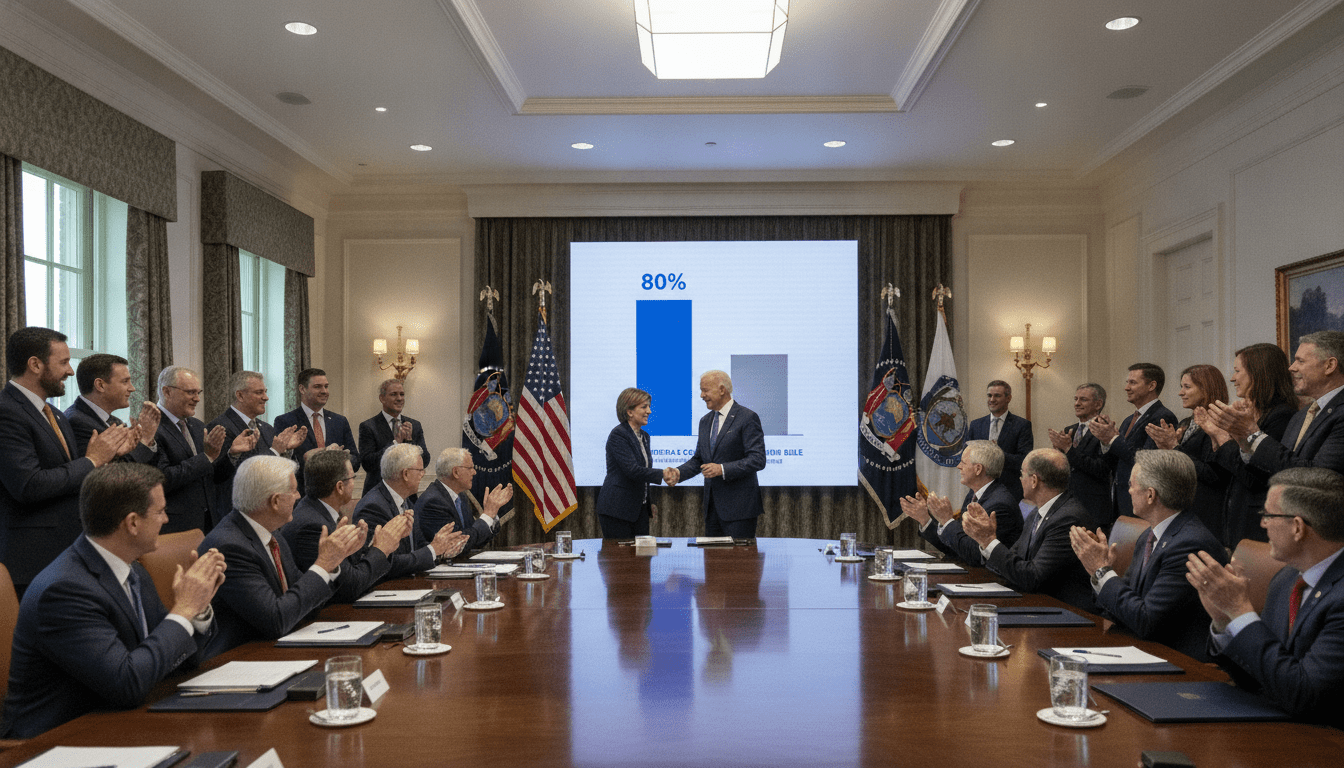
Germany’s federal and state leaders agree 80% “Wer bestellt, bezahlt” rule to share costs and ease municipal deficits
Germany’s federal and state leaders agreed an 80% ‘Wer bestellt, bezahlt’ rule and a funding package to relieve municipal deficits and enable fiscal reforms.
The chancellor and the heads of Germany’s 16 states concluded extended talks at the Chancellery with a joint agreement on a new cost‑sharing mechanism commonly referred to as the “Wer bestellt, bezahlt” principle. The pact sets an 80 percent federal compensation rate for significant new burdens arising from federal laws, and it aims to provide immediate relief to cash‑strapped municipalities. State leaders publicly emphasized a spirit of cooperation after the meeting, while differences over specific reform packages — notably in healthcare financing and tax policy — remain to be resolved.
Chancellery meeting produces cross‑party endorsement
The meeting in Berlin ran longer than planned, and state premiers used the post‑session press appearances to stress unity. Olaf Lies of Lower Saxony, speaking first, framed the outcome as a fair compromise and highlighted a cooperative tone between the federal government and Länder. Friedrich Merz of the CDU echoed that sentiment in calling the result a new model of federal collaboration, and Gordon Schnieder, the incoming chair for the conference, described the talks as proof that the system is functioning.
The public affirmations mask a political reality in which the coalition government needs Länder approval for several key reforms. Nevertheless, the visible accord aims to build momentum ahead of parliamentary procedures and to reassure local authorities that Berlin and the Länder will coordinate on the fiscal effects of future federal measures.
Key terms: 80 percent compensation and the 200 million euro threshold
Under the agreed formula, the federal government will compensate Länder and municipalities for 80 percent of additional annual costs triggered by federal legislation, provided the financial impact for a given measure exceeds 200 million euros per year. The agreement also stipulates that the federal government and the states will jointly develop the cost estimates going forward, with municipal umbrella organizations participating in the process.
Officials said the mechanism will be applied symmetrically: if federal acts reduce local costs, the fiscal gains are expected to be reflected accordingly. Exemptions were clarified as well — tax laws remain governed by constitutional rules and are therefore not covered by the new compensation framework, and judicial decisions or mandatory EU implementations are treated separately unless the federal government extends obligations beyond those requirements.
Municipal finances and immediate relief measures
State leaders framed the deal as a response to mounting municipal pressures, which they estimate at roughly 30 billion euros in cumulative shortfalls. Gordon Schnieder indicated that municipalities could expect around 3 billion euros in relief next year as part of the immediate package under discussion. The federal plan also includes targeted transfers meant to address structural imbalances.
Parliamentary measures under preparation include annual payments of 400 million euros to donor states through 2029, targeted 250 million euro annual allocations for financially weak Länder with heavily indebted municipalities, and a 350 million euro annual provision for eastern states to offset burdens tied to legacy supplementary pension systems. Lawmakers signaled that the bill would face its first reading in the Bundestag as legislative work continues.
Healthcare financing and tax reform remain contentious
Despite the cost‑sharing breakthrough, disagreements surfaced over planned savings in the health sector and a proposed tax reform. State premiers warned that changes to hospital financing could shift burdens onto municipalities, threatening services in rural areas. Gordon Schnieder put a potential extra burden for Rhineland‑Palatinate at roughly 500 million euros and cautioned that some non‑state hospital operators might withdraw, prompting a wave of re‑municipalization.
Länder representatives insisted any relief package must not create offsetting pressures at the local level. They urged close consultation with the federal government on hospital financing changes and asked that the Bundesrat be kept fully engaged during the design and approval of tax reform measures that require state consent.
Parliamentary timetable and unresolved technical work
Officials indicated the Bundestag would begin formal consideration of a legislative proposal titled “Entlastung der Länder und ihrer Kommunen” with a first reading scheduled late in the evening following the summit. In parallel, technical working groups will refine the modalities for assessing impacts and for calculating the mutual compensation that the new “Wer bestellt, bezahlt” rule requires.
State and federal sources say the exact mechanisms for easing three major benefit laws — integration assistance, child and youth welfare, and the maintenance advance scheme — will be clarified by year‑end. Until then, municipal associations and finance ministries at both levels will continue discussions on allocation formulas and eligibility thresholds.
The final decisions will also need to navigate constitutional responsibilities: the federal government underlined that Länder have a duty to finance local authorities so that municipalities can meet statutory tasks. Berlin’s statement reiterated that when federal legislation imposes additional burdens, a corresponding relief mechanism should follow — an argument intended to anchor the compensation principle in both political practice and legal expectations.
Longer term, the new agreement seeks to prevent repeated fiscal disputes by formalizing early consultation on cost estimates and by sharing responsibility for sizable fiscal consequences of national policy choices.
The talks produced a short‑term package and a framework that, if implemented as stated, will shift the dynamics of federal‑state fiscal relations by making cost compensation more predictable and participatory.
