
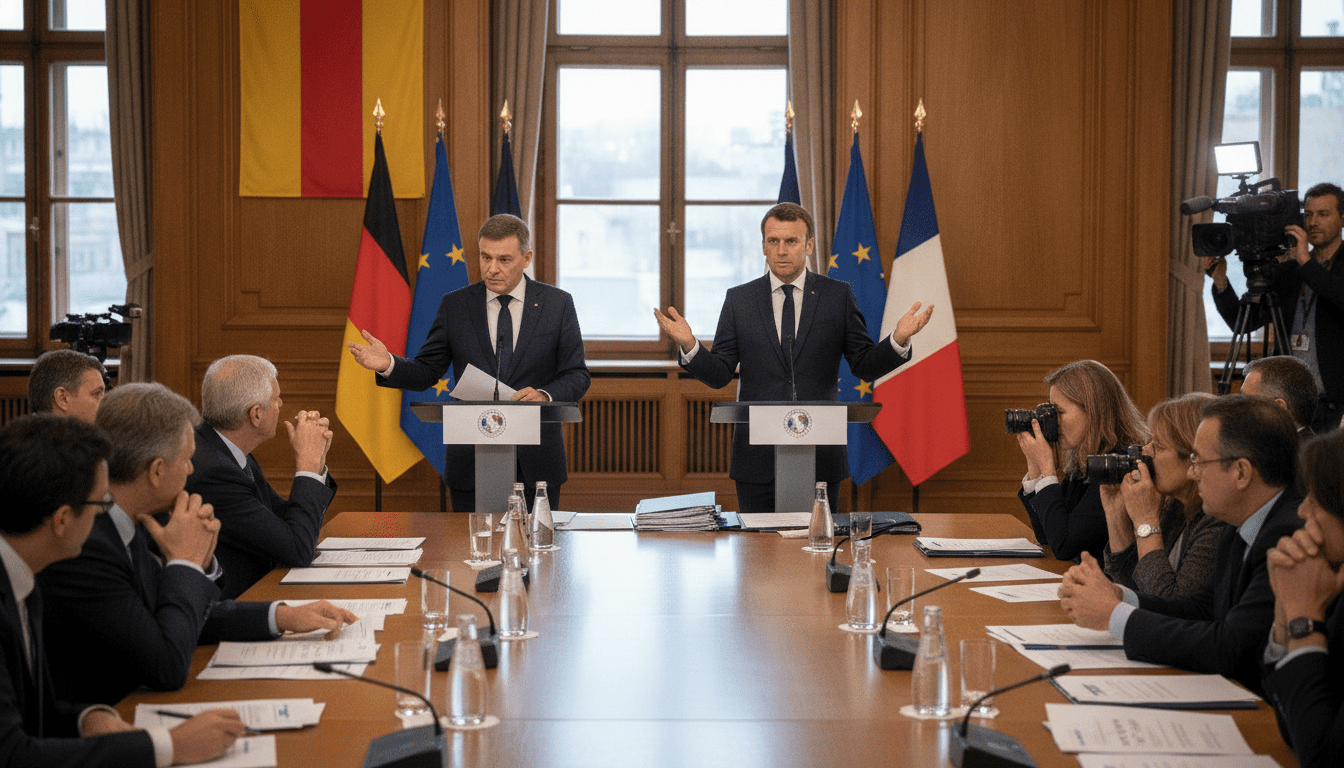
Germany and France Abandon FCAS Fighter Project, Exposing Industrial Rift and Strategic Strain
FCAS collapse leaves Europe facing lost contracts and a security gap as partners pivot to national programmes and alliance adjustments.
The German and French governments have agreed to halt the joint development of the Future Combat Air System (FCAS), effectively abandoning the planned sixth‑generation fighter that had been central to a decade‑long bid to build a European air‑combat capability. The decision ends a high‑profile Franco‑German effort after years of disputes over leadership, workshare and design, and removes a programme once estimated in the tens of billions of euros from the EU defence agenda. (tagesschau.de)
Germany and France End Joint Fighter Development
Officials in Berlin and Paris concluded that the industrial partners at the heart of FCAS — Airbus and Dassault — could not bridge deep disagreements over who would lead the manned fighter element of the programme. Political leaders judged the corporate impasse unsolvable at the level needed to push the aircraft into production, prompting the governments to step back from the core fighter component while keeping some collaborative pieces under review. (tagesschau.de)
The termination does not eliminate all FCAS activity: governments say they will preserve work on shared sensors, drone networks and the combat cloud where possible, but the symbolic centrepiece — the joint manned fighter — has been shelved. That outcome marks a sharp reversal for a programme that had been promoted as the backbone of future Franco‑German air defence. (lemonde.fr)
Industrial Split Between Airbus and Dassault
Sources and industry analysts point to a protracted clash between Airbus and Dassault over governance, technical leadership and the distribution of lucrative manufacturing work as the proximate cause of failure. The two companies, each with competing fighter legacies and national political backing, were unable to agree a governance model acceptable to both governments, which ultimately undermined the programme’s industrial foundation. (cincodias.elpais.com)
The row over who would control key software, engine and airframe development grew into a broader dispute about national industrial sovereignty, with Spain and other partners increasingly frustrated by the stalled negotiations. Observers say the impasse reflects wider frictions in European defence cooperation when strategic and commercial interests collide. (defence24.com)
Economic Stakes and Lost Contracts
The cancellation threatens billions in future contracts for European suppliers and casts uncertainty over long‑term industrial planning for defence firms across Germany, France and Spain. FCAS had been pitched as a sprawling programme covering fighters, drones, sensors and a combat cloud, with procurement and development spending projected to run into the tens of billions of euros over decades. (defence24.com)
Industry lobby groups and unions have already floated alternative models, including national or two‑aircraft solutions, as firms scramble to protect workstreams and maintain technology roadmaps for a next‑generation platform. Analysts warn that reassigning programmes and rewriting contracts will be costly and time‑consuming, with knock‑on effects for suppliers and research partnerships. (handelsblatt.com)
Strategic Consequences for European Defence
Security experts say the FCAS breakdown removes a major element of Europe’s long‑term plan to reduce dependency on non‑European suppliers and to field sovereign high‑end combat capabilities. The decision arrives amid a broader wave of European rearmament driven by instability on the continent, and it underscores the political and industrial barriers to building truly integrated defence projects. (eutoday.net)
Some analysts caution that the collapse will be read with concern by rivals and adversaries, since it signals fault lines in European strategic autonomy at a moment when deterrence calculations are intensifying. Others argue the setback may accelerate national initiatives, with Berlin and Paris now likely to pursue parallel or remodelled programmes to safeguard critical skills and technological investments. (carnegieendowment.org)
Political Reactions in Germany and France
German Green co‑chair Franziska Brantner described the outcome as a “serious setback for European security and defence policy,” blaming a failure to secure a viable Franco‑German industrial model and calling for clearer government leadership on collaborative defence projects. The remark reflects a broader domestic debate in Germany about how the state should steer strategic industrial cooperation and how to protect jobs and technology. (deutschlandfunk.de)
Paris and Berlin have exchanged guarded statements emphasizing continued cooperation on select FCAS elements and on other joint programmes, but political leaders face pressure at home to show rapid alternatives for sustaining domestic defence industries. Opposition figures and industry representatives are already pressing for new procurement plans and compensation measures for affected suppliers. (tagesschau.de)
Allies, U.S. Posture and NATO Implications
The FCAS collapse coincides with a wider re‑examination of force posture in Europe as Washington signals adjustments to its deployments and alliance roles, a development that has prompted debate on burden‑sharing and the pace of European capability development. U.S. policy shifts and announced troop reductions in parts of Europe have heightened urgency in capitals that counted on transatlantic reassurance while building continental capabilities. (stripes.com)
Strategists warn that fragmented procurement and weaker industrial coordination increase the burden on NATO’s political cohesion and could complicate collective planning, especially for high‑end air combat capabilities that are costly and technically demanding. The combination of waning cooperative programmes and shifting allied force posture is likely to spur renewed diplomatic activity on defence industrial policy. (eutoday.net)
The FCAS episode exposes the practical limits of European defence cooperation when industrial rivalry and national priorities collide with strategic ambitions. As Berlin and Paris pursue replacement pathways — whether national programmes, new bilateral frameworks, or modular collaboration on sensors and networks — the immediate task for both governments will be to manage supplier fallout, reassure partners and define a credible roadmap for Europe’s air‑combat future. (lemonde.fr)
