
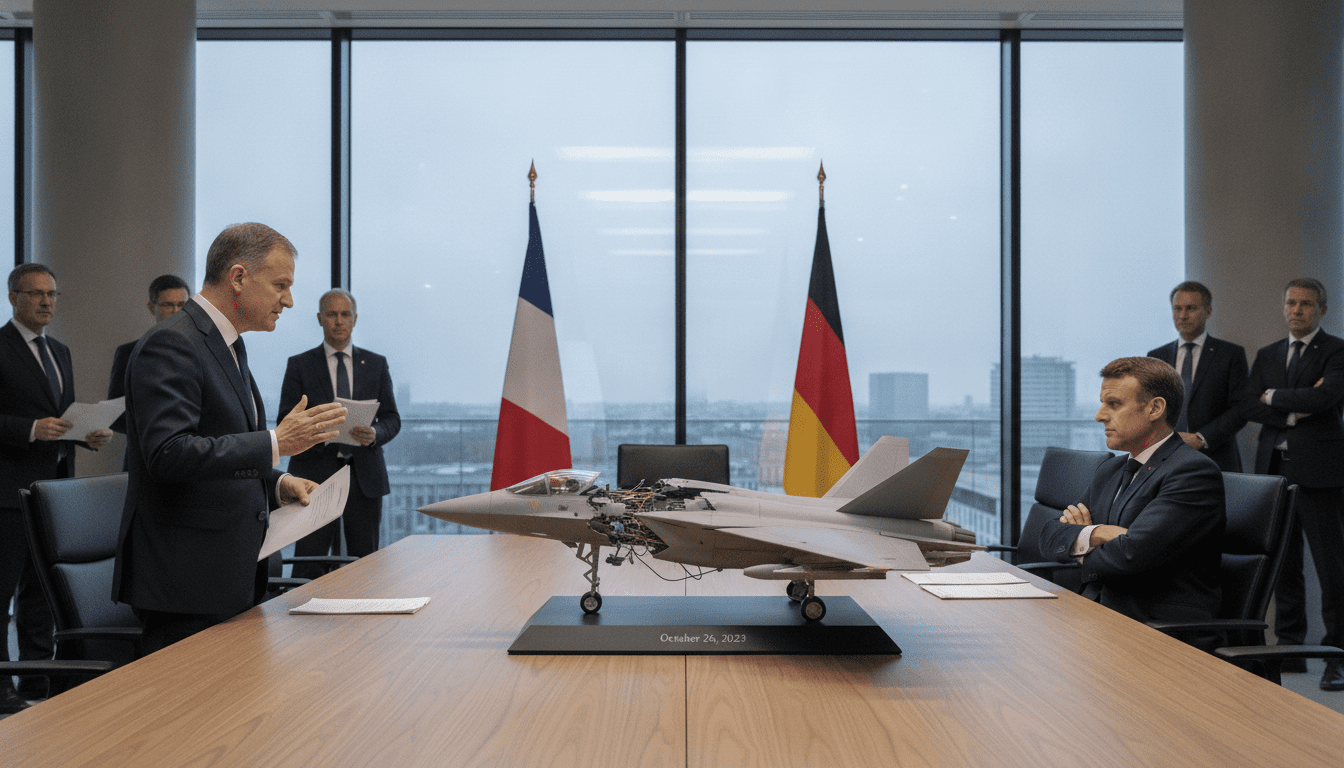
Germany and France Signal End to FCAS Joint Fighter Project
European leaders reportedly agree FCAS joint development is unworkable; differences over nuclear and carrier requirements and industrial roles stall the program.
Germany and France signaled a likely end to the joint Future Combat Air System (FCAS) fighter project after Chancellor Friedrich Merz advised President Emmanuel Macron to stop pursuing a single, jointly developed combat aircraft, government sources said. The recommendation followed talks on June 5, 2026, at the EU-Western Balkans summit in Tivat, Montenegro, and reflects growing recognition in both capitals that industrial, technical and strategic differences have become insurmountable for a shared fighter program.
Berlin advised halting the joint fighter effort
German officials said Chancellor Merz told President Macron that the companies involved could not find a workable path to co-develop a single fighter platform, and that this reality should be acknowledged politically. Berlin’s position, according to those officials, is grounded in persistent disagreements over technical specifications and leadership roles that have impeded progress across multiple working groups.
Paris reacted with surprise to Berlin’s public stance
French officials expressed surprise at the uncoordinated communication coming from Berlin and emphasized that political direction is needed to align industrial partners. Paris stressed that FCAS remains a key project for strengthening European defence capabilities and warned that France will not allow the programme to fail because of messaging or bilateral tensions.
Requirements gap at the heart of the dispute
At the core of the rupture are divergent operational needs: France continues to require a next-generation aircraft that is both nuclear-capable and carrier-capable, while Germany has not identified those capabilities as priorities for the Bundeswehr. Chancellor Merz has repeatedly argued that the two countries’ specifications are fundamentally different, and that without reconciling those requirements a joint platform is unfeasible.
Industrial leadership and Dassault’s role intensified tensions
Industry sources and German critics have long pointed to French manufacturer Dassault’s insistence on a leading development role as a sticking point in negotiations. Attempts this year to reconcile corporate positions on workshare, governance and technical leadership reportedly failed at the working level, exacerbating political doubts in Berlin about the viability of a single-platform solution.
Historic context and timeline of FCAS
FCAS was launched in 2017 by then-Chancellor Angela Merkel and President Emmanuel Macron as a response to shifting transatlantic security assumptions and perceived gaps in Europe’s strategic autonomy. The programme envisaged production beginning around 2040 and included ambitious goals such as integrating manned fighters, unmanned systems and a shared “Combat Cloud” network for sensors and weapons.
Shift toward a modular European system and national solutions
In light of the breakdown in collaboration on a single fighter, German officials say the project’s core — described as a European system of systems and a Combat Cloud linking aircraft and drones — should be preserved and progressed as a multinational capability. At the same time, Berlin has signalled a renewed focus on national solutions for specific capabilities, citing projects such as Germany’s military cloud as examples of where national approaches may be more practical.
Upcoming Franco‑German ministerial talks to narrow cooperation
Officials in both capitals said defence ministries will meet at the Franco-German ministerial council scheduled for June 2026 to produce a joint industrial cooperation plan that focuses on “a few realistic, relevant” initiatives. The planned workplan is intended to salvage common projects that can be implemented without resolving the broader dispute over a single, shared combat aircraft.
The reported divergence over FCAS highlights longstanding challenges in reconciling military requirements, industrial interests and political priorities between European partners. Whether the Combat Cloud and modular cooperation can become the new centrepiece of Franco‑German defence collaboration now depends on rapid political decisions and concrete industrial compromises in the weeks ahead.
