
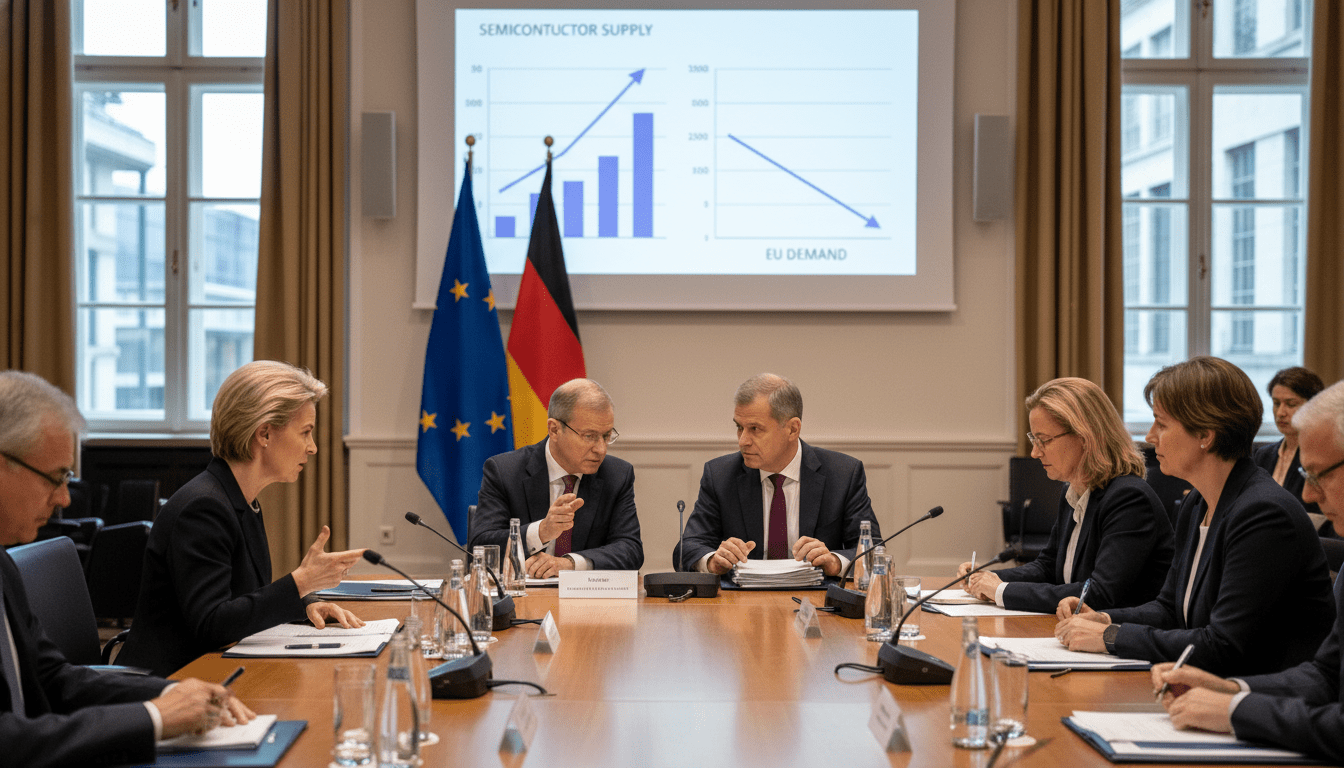
European chip production must expand rapidly as Germany becomes central to EU semiconductor ambitions
European chip production must scale as demand soars; Germany’s Dresden cluster and firms Infineon and NXP anchor efforts amid EU Chips Act discussions.
European chip production is under fresh scrutiny after industry leaders and analysts urged a rapid expansion of manufacturing capacity to meet surging demand. At a Berlin industry summit, NXP’s chief technologist showcased a battery-powered chip that can transmit data up to 50 kilometres, underscoring the kind of low-power, long-range components Europe can supply. Policymakers, trade groups and manufacturers now face a narrowing window to convert those capabilities into large-scale, resilient production.
NXP showcases low-power long-range chip as a European success
Lars Reger of NXP displayed a small device on stage in Berlin, saying it could run for a decade on a button cell and transmit signals up to 50 kilometres. The demonstration highlighted Europe’s strengths in sensors, microcontrollers and power-efficient designs that are central to industrial applications. Company officials argued such innovations show the continent can produce differentiated semiconductors even as global giants focus capital elsewhere.
Study finds Europe short of modern fabs needed for future demand
A new study by the German electrical industry association ZVEI, “Europe’s Semiconductor Business Case,” warns that Europe is missing more than a dozen modern chip fabs and will need far more capacity in the years ahead. The report projects that demand from the manufacturing sector will more than double over the next 15 years, yet current European capacity can cover only about half of today’s needs. Analysts from PwC and other consultancies say closing that gap will require a sustained build-out of large, modern fabrication plants.
Germany and the Dresden cluster positioned as the continent’s chip heartland
Germany’s chip ecosystem, led by a dense cluster around Dresden and a nationwide network of suppliers, is the continent’s largest manufacturing base and its principal buyer of semiconductors. The region is seeing a construction boom, with dozens of cranes and new facilities slated to begin production in the coming months. Domestic firms such as Infineon and multinationals like NXP are expanding local output, reinforcing Germany’s central role in any European strategy to cut reliance on overseas producers.
Industry executives call for a clear European target and long-term strategy
Senior figures from Infineon and NXP told attendees Europe lacks a clear target for semiconductor sovereignty and needs a roadmap to get there. Andreas Urschitz of Infineon said Europe must decide which segments to prioritise and double down on existing strengths rather than attempt to compete everywhere at once. Executives pressed for predictable, long-horizon industrial policies and funding mechanisms that can attract private capital and reduce investor uncertainty.
Assessment of Chips Act 1.0 shows partial progress and enduring shortfalls
The 2023 Chips Act loosened state aid rules and marshalled billions of euros to boost European fabrication, yet auditors and industry critics say results have been mixed. While many projects gained momentum, several high-profile promises from non-European firms were delayed or withdrawn, underscoring that financial incentives alone have not guaranteed rapid capacity growth. The European Court of Auditors and industry groups have pointed to higher costs, regulatory hurdles and investor hesitation as key obstacles to meeting the Act’s targets.
Global competition and cost differentials put pressure on European plans
Europe faces stiff competition from vast investments in Asia and the United States, where labor, energy and regulatory frameworks often favour rapid deployment of gigafabs. The ZVEI and PwC analyses note that manufacturing costs in Europe can be up to 30 percent higher than in Asia, while only a small share of the world’s most advanced facilities currently operate on the continent. That imbalance, combined with surging demand from data centres and electrified transport, means Europe must move quickly to secure strategic capacity.
Europe’s semiconductor pathway will rely heavily on aligning industrial policy with private investment, and Germany is likely to remain the linchpin of that effort. The industry is awaiting the second edition of the EU Chips Act, due for presentation in early June, which Brussels hopes will sharpen incentives and simplify approval processes. Unless member states and Brussels accelerate funding, planning and permitting, the analysts warn the region may struggle to meet demand and protect supply chains for critical industry sectors.
The coming weeks are likely to test whether Europe can convert prototypes and policy intentions into factories and workforce training at the scale required for technological sovereignty.
