
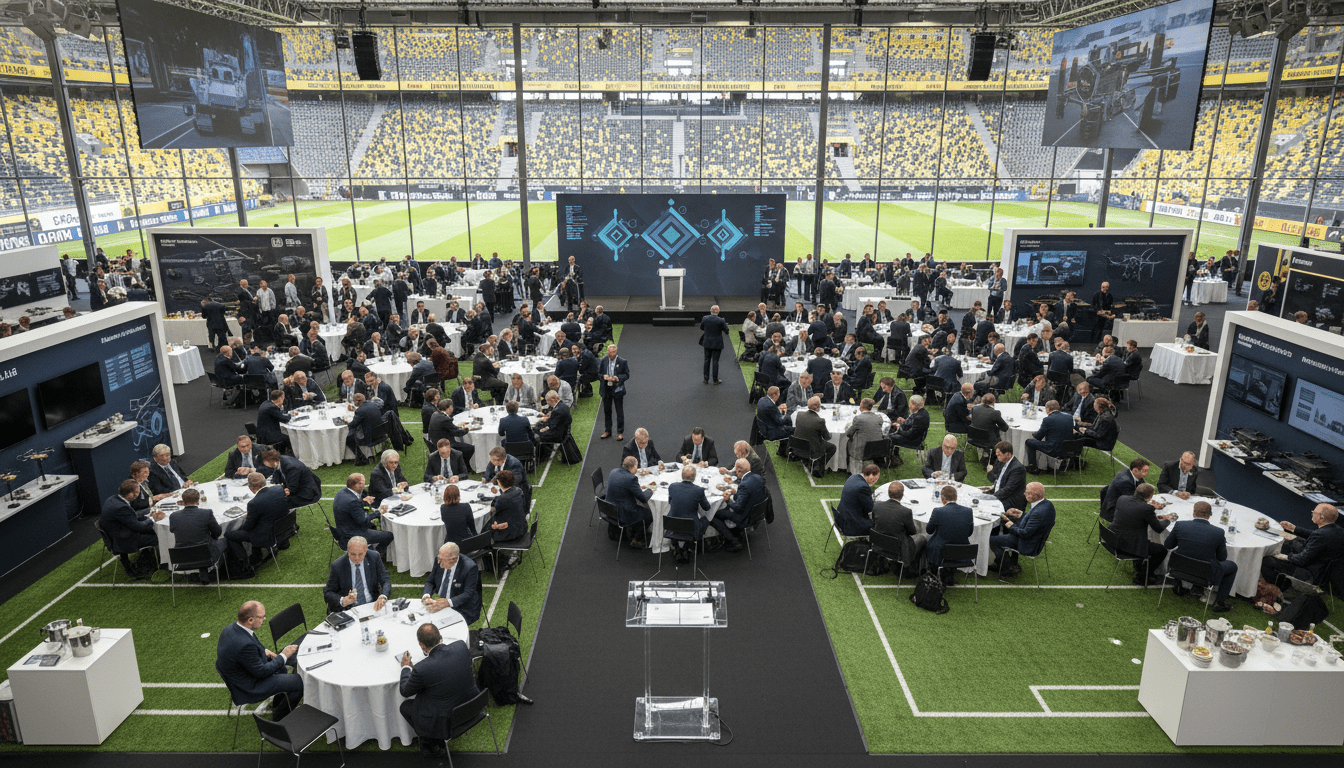
Defense industry goes public as Rheinmetall and peers brief 500 business leaders at Borussia Dortmund stadium
Rheinmetall, MBDA and drone maker Quantum Systems addressed 500 business leaders at Borussia Dortmund, marking a notable shift as the defense industry seeks broader partnerships.
The event brought representatives from major defense firms, drone developers, military advisers and former NATO generals together in Borussia Dortmund’s stadium to brief a largely civilian audience about equipment, readiness and innovation bottlenecks. Organizers and speakers emphasized the need for cross-sector collaboration to speed procurement, advance dual‑use technologies and strengthen national resilience. The appearance of the defense industry in a high‑profile public venue reflected a rapid normalization of military suppliers in business and civic spaces since the war in Ukraine.
Attendance and participants at the stadium briefing
Representatives from Rheinmetall, MBDA and Quantum Systems joined retired senior NATO officers and private military consultants on stage to outline capability gaps and procurement challenges. About 500 attendees were mostly Mittelstand executives and members of a Borussia Dortmund business network who had limited prior contact with the defense sector. The choice of venue was explained by the corporate ties between some manufacturers and sports sponsorships, a symbol of how previously insular defense firms are seeking wider public engagement.
Topics covered: equipment, readiness and bureaucracy
Speakers focused on the practical needs of armed forces, from drones and sensors to logistics and cyber defenses, while also addressing how bureaucratic delays hinder timely deployment. Presenters warned that procurement processes and certification hurdles slow the flow of innovations from startups into military use. Several panelists argued that clearer pathways for dual‑use technologies and streamlined approval mechanisms are essential to translate research into operational systems quickly.
Economic motivations for wider industry involvement
The defense sector has emerged as a comparatively robust market in an otherwise slow economy, offering long‑term contracts that appeal to suppliers and manufacturers. Attendees noted the opportunity for automotive and mechanical suppliers to diversify away from cyclical sectors by qualifying as defense subcontractors. Conversely, weapon makers could benefit from the Mittelstand’s precision manufacturing and supply‑chain expertise to scale production beyond artisanal runs.
NRW.Bank incubator and the rise of defense tech startups
Regional initiatives such as a Defense‑Tech incubator launched by a North Rhine‑Westphalia development bank were highlighted as evidence of institutional support for military‑relevant innovation. The incubator aims to help startups and university spin‑offs bring sensor, robotics, AI and cybersecurity solutions to market with dual‑use potential. Organizers said workshops and mentor networks have been fully booked, signaling strong interest from entrepreneurs and researchers in defense‑relevant applications.
Public reaction and ethical concerns among fans and activists
The stadium appearance drew criticism from some fan groups and activists who oppose military industry sponsorship of sport and public life. Speakers acknowledged these concerns and stressed the difference between discussion and endorsement, insisting the aim was transparency and engagement rather than glamorizing weaponry. Civil society voices at the event called for clear safeguards, ethical contracting standards and parliamentary oversight to ensure political accountability for defense procurement.
Practical resilience measures discussed for businesses
Panelists broadened the conversation beyond armaments to civilian resilience, urging companies to plan for staff absences tied to emergency duties and volunteer obligations. Examples included cross‑training employees, certifying additional drivers and stockpiling essential spare parts to prevent supply chain stoppages during crises. Organizers argued that adopting simple preparedness measures and crisis playbooks would reduce paralysis in emergencies and strengthen societal stability.
The convergence of defense firms and a mainstream business audience in a high‑profile public setting marks a pragmatic reorientation in Germany’s security landscape. As defense companies seek partners, capital and public legitimacy, the debate this event provoked underscores a growing expectation that industry, government and civil society must negotiate new boundaries for transparency, ethics and cooperation.
