
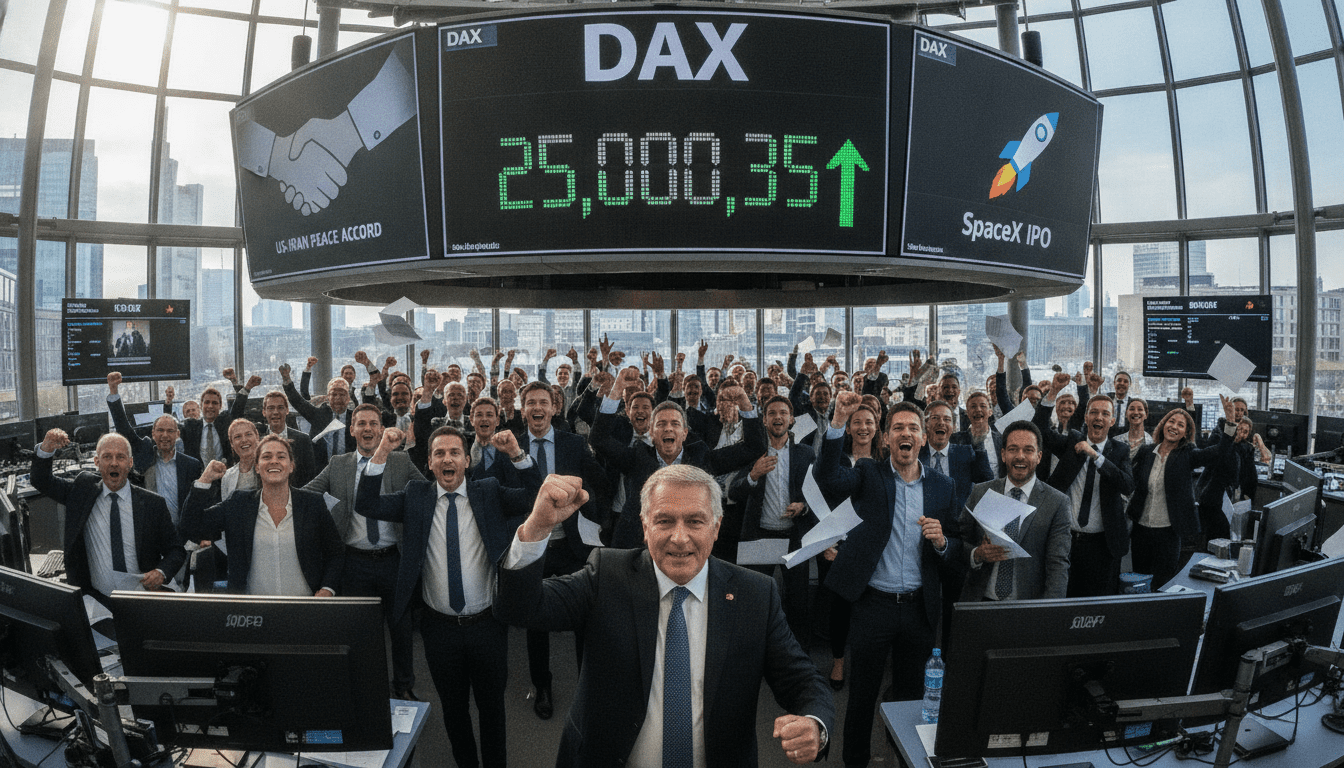
Dax set to open higher as markets rally after U.S.-Iran peace agreement and SpaceX debut
Dax set to open higher as markets rally after U.S.-Iran peace deal; oil prices fall and Asian stocks surge. Investors await G7 summit and economic data.
The Dax is set to open higher on Monday as global markets reacted to easing geopolitical tensions and a string of market-moving events. Pre-market indicators pointed to gains after last week’s advance, with sentiment buoyed by a U.S.-Iran peace announcement and a high-profile space-sector listing. Traders also digested a sharp drop in oil prices and a busy calendar of political and economic developments.
Dax poised to reclaim 25,000 threshold
Three hours before the Xetra open the Dax was quoted about 1.6 percent higher, edging back toward the 25,000 mark after closing Friday at 24,635 points. A sustained move above 25,000 would place the index within sight of the January record high near 25,507 points. Market participants said attention will quickly shift to whether the advance can be sustained amid upcoming data and policy drivers.
U.S. and Iran announce peace agreement with signing set for June 19, 2026
U.S. and Iranian officials, along with Pakistan as mediator, said late Sunday that they had reached a peace accord and planned a formal signing on Friday, June 19, 2026. The announcements came from multiple official channels, including statements attributed to the U.S. president and Iran’s foreign ministry. Market strategists cautioned that significant follow-up talks remain on complex issues such as Iran’s nuclear program and regional security, and that those outstanding negotiations represent a material risk to sentiment.
Brent and WTI tumble as Strait of Hormuz reopening priced in
Commodity markets reacted quickly to the prospect of reduced supply risk in the Gulf, pushing Brent crude down by nearly 4.7 percent to about $83.25 a barrel and U.S. WTI roughly 5.6 percent lower to near $80.20. Traders said the main driver was the expectation of a reopening or safer passage through the Strait of Hormuz, a chokepoint that handles a sizable portion of global seaborne oil flows. The rapid unwinding of the geopolitical risk premium contributed to outsized moves in energy markets early on Monday.
Asian and U.S. equity moves reflect easing geopolitical risk
Asian equities rallied strongly, with Japan’s Nikkei jumping more than 3 percent to roughly 68,261 points while the broader Topix climbed about 2.4 percent. Analysts flagged the gains as a market reaction to the agreement rather than proof of durable peace, noting that implementation will be the critical test. In the United States, major indexes closed the prior week higher as hopes for geopolitical stability fed risk-on flows, with the Dow, S&P 500 and Nasdaq all posting modest gains.
G-7 leaders to meet in Evian as summit opens on June 15, 2026
G-7 heads of state and government convene in Evian from June 15 for a three-day meeting that will address the Iran and Ukraine conflicts, global economic frictions and the implications of artificial intelligence. Delegations are expected to discuss coordination on sanctions, trade and economic resilience, alongside security considerations tied to the new developments in the Middle East. Observers said leaders will also monitor market reactions to the peace announcement and any near-term effects on energy and inflation dynamics.
Currencies and bonds move as yields decline and risk appetite rises
Currency markets reflected falling bond yields and a pickup in risk tolerance, with the dollar trading near 160.13 yen and little changed against the yuan at about 6.7575. The dollar weakened against the Swiss franc, and the euro rose to approximately $1.1598, underscoring a broader shift away from safe-haven assets. Market participants noted that lower yields and cheaper oil could influence central bank calculations, but they also emphasized that policy responses will hinge on whether the geopolitical détente is durable.
Investors say the immediate market reaction has been emphatic, but they are reserving judgment until the details of the agreement are implemented and verified. Near-term focus will be on Friday’s scheduled signing on June 19, 2026, upcoming Eurozone trade and industrial data for April, and U.S. industrial output for May. The path of oil prices and any fresh signals from the G-7 summit in Evian will be watched closely as markets weigh whether the short-term relief can translate into a sustained risk-on environment.
